

18 Ecology and Applied Environmental Science
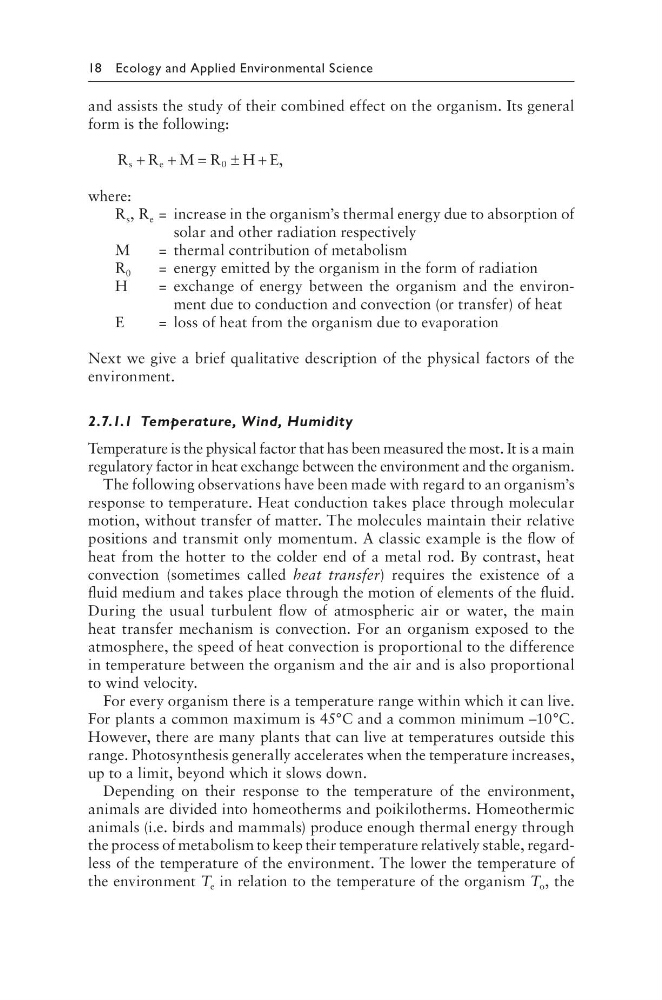
and assists the study of their combined effect on the organism. Its general
form is the following:
R R M R H E,
s
e
+
+ =
± +
0
where:
R s , R e = increase in the organism’s thermal energy due to absorption of
solar and other radiation respectively
M
= thermal contribution of metabolism
R 0
= energy emitted by the organism in the form of radiation
H
= exchange of energy between the organism and the environment due to conduction and convection (or transfer) of heat
E
= loss of heat from the organism due to evaporation
Next we give a brief qualitative description of the physical factors of the
environment.
2.7.1.1 Temperature, Wind, Humidity
Temperature is the physical factor that has been measured the most. It is a main
regulatory factor in heat exchange between the environment and the organism.
The following observations have been made with regard to an organism’s
response to temperature. Heat conduction takes place through molecular
motion, without transfer of matter. The molecules maintain their relative
positions and transmit only momentum. A classic example is the flow of
heat from the hotter to the colder end of a metal rod. By contrast, heat
convection (sometimes called heat transfer) requires the existence of a
fluid medium and takes place through the motion of elements of the fluid.
During the usual turbulent flow of atmospheric air or water, the main
heat transfer mechanism is convection. For an organism exposed to the
atmosphere, the speed of heat convection is proportional to the difference
in temperature between the organism and the air and is also proportional
to wind velocity.
For every organism there is a temperature range within which it can live.
For plants a common maximum is 45°C and a common minimum –10°C.
However, there are many plants that can live at temperatures outside this
range. Photosynthesis generally accelerates when the temperature increases,
up to a limit, beyond which it slows down.
Depending on their response to the temperature of the environment,
animals are divided into homeotherms and poikilotherms. Homeothermic
animals (i.e. birds and mammals) produce enough thermal energy through
the process of metabolism to keep their temperature relatively stable, regardless of the temperature of the environment. The lower the temperature of
the environment T e in relation to the temperature of the organism T o , the
and assists the study of their combined effect on the organism. Its general
form is the following:
R R M R H E,
s
e
+
+ =
± +
0
where:
R s , R e = increase in the organism’s thermal energy due to absorption of
solar and other radiation respectively
M
= thermal contribution of metabolism
R 0
= energy emitted by the organism in the form of radiation
H
= exchange of energy between the organism and the environment due to conduction and convection (or transfer) of heat
E
= loss of heat from the organism due to evaporation
Next we give a brief qualitative description of the physical factors of the
environment.
2.7.1.1 Temperature, Wind, Humidity
Temperature is the physical factor that has been measured the most. It is a main
regulatory factor in heat exchange between the environment and the organism.
The following observations have been made with regard to an organism’s
response to temperature. Heat conduction takes place through molecular
motion, without transfer of matter. The molecules maintain their relative
positions and transmit only momentum. A classic example is the flow of
heat from the hotter to the colder end of a metal rod. By contrast, heat
convection (sometimes called heat transfer) requires the existence of a
fluid medium and takes place through the motion of elements of the fluid.
During the usual turbulent flow of atmospheric air or water, the main
heat transfer mechanism is convection. For an organism exposed to the
atmosphere, the speed of heat convection is proportional to the difference
in temperature between the organism and the air and is also proportional
to wind velocity.
For every organism there is a temperature range within which it can live.
For plants a common maximum is 45°C and a common minimum –10°C.
However, there are many plants that can live at temperatures outside this
range. Photosynthesis generally accelerates when the temperature increases,
up to a limit, beyond which it slows down.
Depending on their response to the temperature of the environment,
animals are divided into homeotherms and poikilotherms. Homeothermic
animals (i.e. birds and mammals) produce enough thermal energy through
the process of metabolism to keep their temperature relatively stable, regardless of the temperature of the environment. The lower the temperature of
the environment T e in relation to the temperature of the organism T o , the