

14 Ecology and Applied Environmental Science
2.3 MEtaboliSM—EnzyMES
The chemical reactions that make up metabolism are carried out with the
selves undergoing permanent chemical change. The following is a simplified form of an enzymatic reaction:
F E FE P E
+ →
→ +
where F is food, P the final product, and E the enzyme. In reality, however,
a complete enzymatic reaction consists of a series of secondary reactions,
with a special enzyme intervening in each of them.
Enzymes are complex proteins. The maximum potency of an enzyme
usually develops in a narrow zone, around a pH (usually pH = 7) and
temperature value. Outside these zones, potency is very rapidly reduced,
whereas above a certain temperature threshold the enzyme is destroyed.
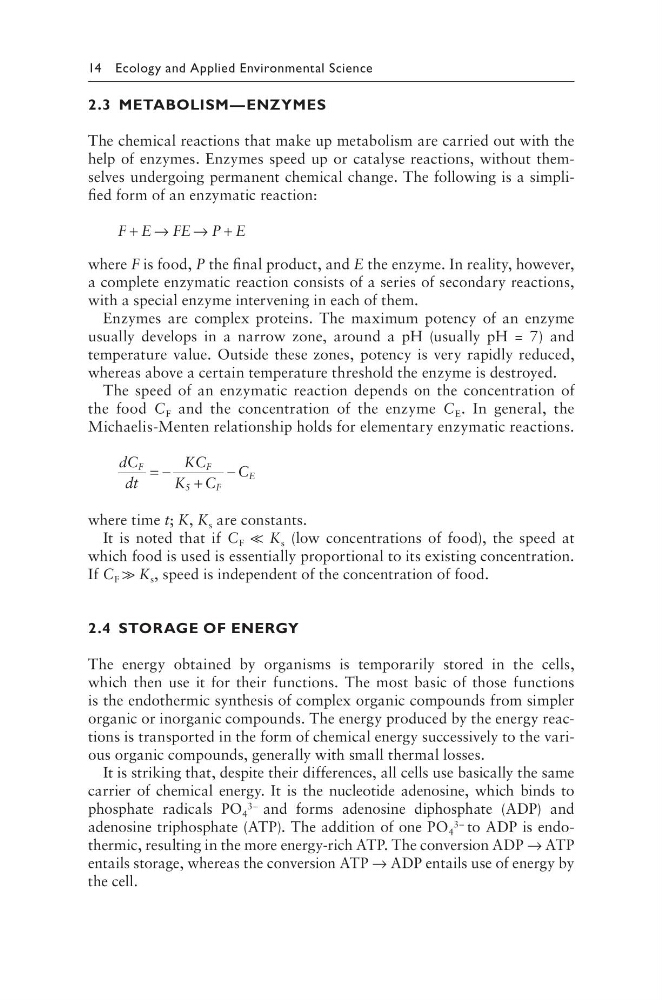
The speed of an enzymatic reaction depends on the concentration of
the food C F and the concentration of the enzyme C E . In general, the
Michaelis-Menten relationship holds for elementary enzymatic reactions.
dC
dt
KC
K C
C
F
F
F
E
= −
+
−
5
where time t; K, K s are constants.
It is noted that if C F K s (low concentrations of food), the speed at
which food is used is essentially proportional to its existing concentration.
If C F K s , speed is independent of the concentration of food.
2.4 StoragE oF EnErgy
The energy obtained by organisms is temporarily stored in the cells,
which then use it for their functions. The most basic of those functions
is the endothermic synthesis of complex organic compounds from simpler
tions is transported in the form of chemical energy successively to the various organic compounds, generally with small thermal losses.
It is striking that, despite their differences, all cells use basically the same
carrier of chemical energy. It is the nucleotide adenosine, which binds to
phosphate radicals PO 4
3– and forms adenosine diphosphate (ADP) and
adeno sine triphosphate (ATP). The addition of one PO 4
3– to ADP is endothermic, resulting in the more energy-rich ATP. The conversion ADP → ATP
entails storage, whereas the conversion ATP → ADP entails use of energy by
the cell.
2.3 MEtaboliSM—EnzyMES
The chemical reactions that make up metabolism are carried out with the
selves undergoing permanent chemical change. The following is a simplified form of an enzymatic reaction:
F E FE P E
+ →
→ +
where F is food, P the final product, and E the enzyme. In reality, however,
a complete enzymatic reaction consists of a series of secondary reactions,
with a special enzyme intervening in each of them.
Enzymes are complex proteins. The maximum potency of an enzyme
usually develops in a narrow zone, around a pH (usually pH = 7) and
temperature value. Outside these zones, potency is very rapidly reduced,
whereas above a certain temperature threshold the enzyme is destroyed.
The speed of an enzymatic reaction depends on the concentration of
the food C F and the concentration of the enzyme C E . In general, the
Michaelis-Menten relationship holds for elementary enzymatic reactions.
dC
dt
KC
K C
C
F
F
F
E
= −
+
−
5
where time t; K, K s are constants.
It is noted that if C F K s (low concentrations of food), the speed at
which food is used is essentially proportional to its existing concentration.
If C F K s , speed is independent of the concentration of food.
2.4 StoragE oF EnErgy
The energy obtained by organisms is temporarily stored in the cells,
which then use it for their functions. The most basic of those functions
is the endothermic synthesis of complex organic compounds from simpler
tions is transported in the form of chemical energy successively to the various organic compounds, generally with small thermal losses.
It is striking that, despite their differences, all cells use basically the same
carrier of chemical energy. It is the nucleotide adenosine, which binds to
phosphate radicals PO 4
3– and forms adenosine diphosphate (ADP) and
adeno sine triphosphate (ATP). The addition of one PO 4
3– to ADP is endothermic, resulting in the more energy-rich ATP. The conversion ADP → ATP
entails storage, whereas the conversion ATP → ADP entails use of energy by
the cell.