

12 Ecology and Applied Environmental Science
All the single-celled organisms, along with organisms composed of more
than one cell but without differentiated functions, are characterised by
a small degree of complexity. Composed of small, relatively incomplete
cells, bacteria are the most elementary independent organisms. Fungi are
many-celled organisms, whereas algae and protozoa may be single-celled
or many-celled, but they are larger and more organised than bacteria. From
the aspect of function, algae may be characterised as primitive plants and
protozoa as primitive animals.
Plants and animals are characterised by differentiation of their cells and
a significant degree of organisation and complexity. They are divided into
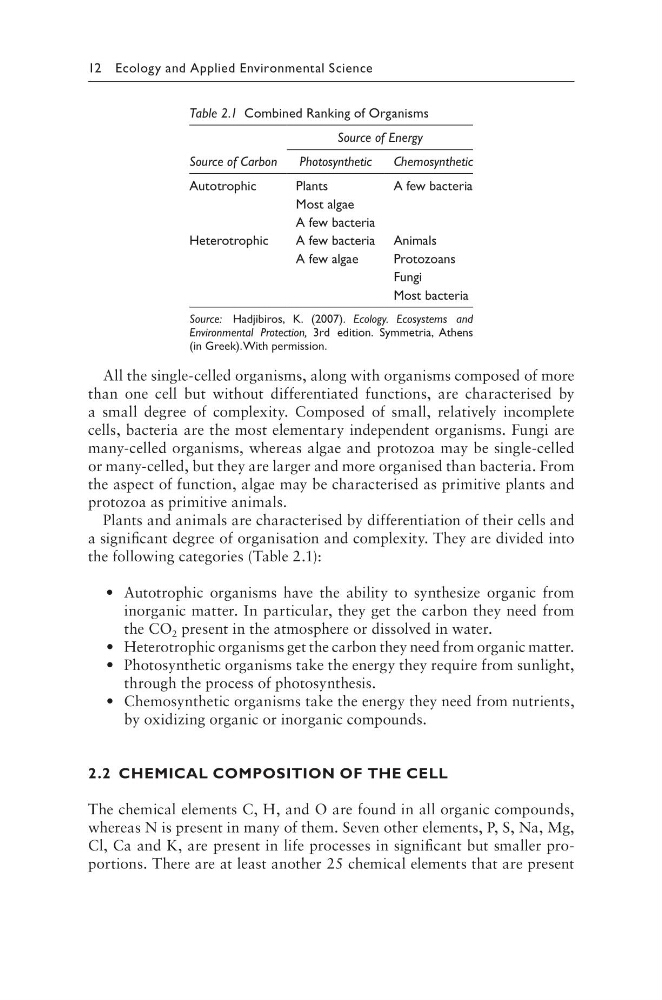
the following categories (Table 2.1):
• Autotrophic organisms have the ability to synthesize organic from
inorganic matter. In particular, they get the carbon they need from
the CO 2 present in the atmosphere or dissolved in water.
• Heterotrophic organisms get the carbon they need from organic matter.
• Photosynthetic organisms take the energy they require from sunlight,
through the process of photosynthesis.
• Chemosynthetic organisms take the energy they need from nutrients,
by oxidizing organic or inorganic compounds.
2.2 chEMical coMPoSition oF thE cEll
The chemical elements C, H, and O are found in all organic compounds,
whereas N is present in many of them. Seven other elements, P, S, Na, Mg,
Cl, Ca and K, are present in life processes in significant but smaller proportions. There are at least another 25 chemical elements that are present
Table 2.1 Combined Ranking of Organisms
Source of Carbon
Source of Energy
Photosynthetic
Chemosynthetic
Autotrophic
Plants
A few bacteria
Most algae
A few bacteria
Heterotrophic
A few bacteria Animals
A few algae
Protozoans
Fungi
Most bacteria
Source: Hadjibiros, K. (2007). Ecology. Ecosystems and
Environmental Protection, 3rd edition. Symmetria, Athens
(in Greek). With permission.
All the single-celled organisms, along with organisms composed of more
than one cell but without differentiated functions, are characterised by
a small degree of complexity. Composed of small, relatively incomplete
cells, bacteria are the most elementary independent organisms. Fungi are
many-celled organisms, whereas algae and protozoa may be single-celled
or many-celled, but they are larger and more organised than bacteria. From
the aspect of function, algae may be characterised as primitive plants and
protozoa as primitive animals.
Plants and animals are characterised by differentiation of their cells and
a significant degree of organisation and complexity. They are divided into
the following categories (Table 2.1):
• Autotrophic organisms have the ability to synthesize organic from
inorganic matter. In particular, they get the carbon they need from
the CO 2 present in the atmosphere or dissolved in water.
• Heterotrophic organisms get the carbon they need from organic matter.
• Photosynthetic organisms take the energy they require from sunlight,
through the process of photosynthesis.
• Chemosynthetic organisms take the energy they need from nutrients,
by oxidizing organic or inorganic compounds.
2.2 chEMical coMPoSition oF thE cEll
The chemical elements C, H, and O are found in all organic compounds,
whereas N is present in many of them. Seven other elements, P, S, Na, Mg,
Cl, Ca and K, are present in life processes in significant but smaller proportions. There are at least another 25 chemical elements that are present
Table 2.1 Combined Ranking of Organisms
Source of Carbon
Source of Energy
Photosynthetic
Chemosynthetic
Autotrophic
Plants
A few bacteria
Most algae
A few bacteria
Heterotrophic
A few bacteria Animals
A few algae
Protozoans
Fungi
Most bacteria
Source: Hadjibiros, K. (2007). Ecology. Ecosystems and
Environmental Protection, 3rd edition. Symmetria, Athens
(in Greek). With permission.