

Systems and Ecosystems 9
• Forecasting environmental phenomena or the behaviour of environmental systems
• Studying environmental impacts of works or activities or studying the
management of parts of the environment, and studying the environment in general
• Determining the need, the type, and the manner of an environmental
intervention
In all the above cases, one of the basic direct or indirect objectives of the
approaches is to determine the temporal evolution, the behaviour, the equilibrium points, and the stability or the instability of the systems under study.
1.5 MathEMatical ModElS oF EcoSyStEMS
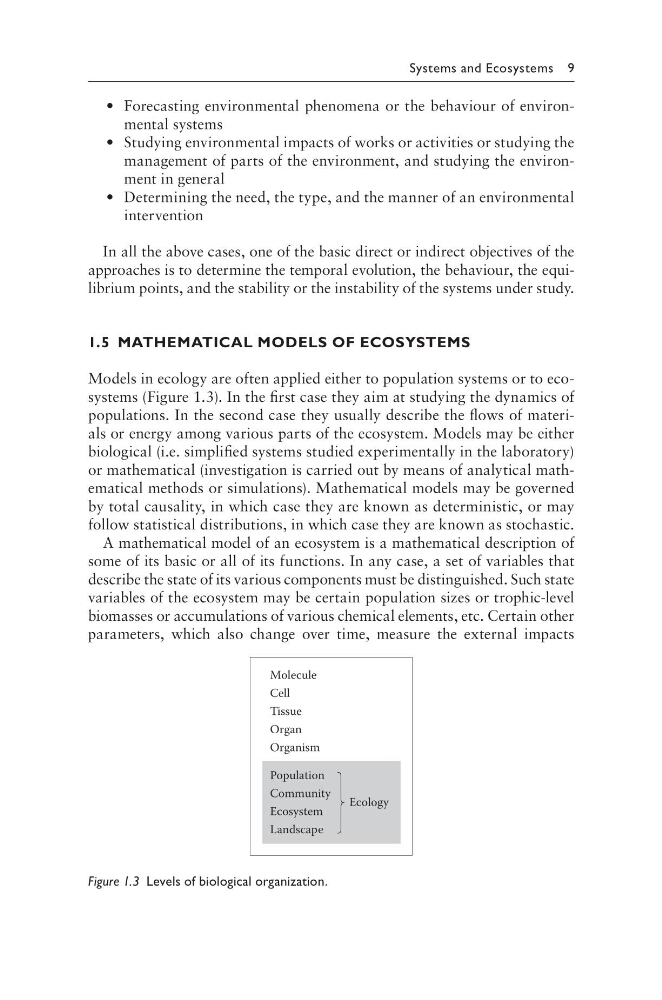
Models in ecology are often applied either to population systems or to ecosystems (Figure 1.3). In the first case they aim at studying the dynamics of
populations. In the second case they usually describe the flows of materials or energy among various parts of the ecosystem. Models may be either
biological (i.e. simplified systems studied experimentally in the laboratory)
or mathematical (investigation is carried out by means of analytical mathematical methods or simulations). Mathematical models may be governed
by total causality, in which case they are known as deterministic, or may
follow statistical distributions, in which case they are known as stochastic.
A mathematical model of an ecosystem is a mathematical description of
some of its basic or all of its functions. In any case, a set of variables that
describe the state of its various components must be distinguished. Such state
variables of the ecosystem may be certain population sizes or trophic-level
biomasses or accumulations of various chemical elements, etc. Certain other
parameters, which also change over time, measure the external impacts
Molecule
Cell
Tissue
Organ
Organism
Population
Community
Ecosystem
Landscape
Ecology
Figure 1.3 Levels of biological organization.
• Forecasting environmental phenomena or the behaviour of environmental systems
• Studying environmental impacts of works or activities or studying the
management of parts of the environment, and studying the environment in general
• Determining the need, the type, and the manner of an environmental
intervention
In all the above cases, one of the basic direct or indirect objectives of the
approaches is to determine the temporal evolution, the behaviour, the equilibrium points, and the stability or the instability of the systems under study.
1.5 MathEMatical ModElS oF EcoSyStEMS
Models in ecology are often applied either to population systems or to ecosystems (Figure 1.3). In the first case they aim at studying the dynamics of
populations. In the second case they usually describe the flows of materials or energy among various parts of the ecosystem. Models may be either
biological (i.e. simplified systems studied experimentally in the laboratory)
or mathematical (investigation is carried out by means of analytical mathematical methods or simulations). Mathematical models may be governed
by total causality, in which case they are known as deterministic, or may
follow statistical distributions, in which case they are known as stochastic.
A mathematical model of an ecosystem is a mathematical description of
some of its basic or all of its functions. In any case, a set of variables that
describe the state of its various components must be distinguished. Such state
variables of the ecosystem may be certain population sizes or trophic-level
biomasses or accumulations of various chemical elements, etc. Certain other
parameters, which also change over time, measure the external impacts
Molecule
Cell
Tissue
Organ
Organism
Population
Community
Ecosystem
Landscape
Ecology
Figure 1.3 Levels of biological organization.