

Systems and Ecosystems 7
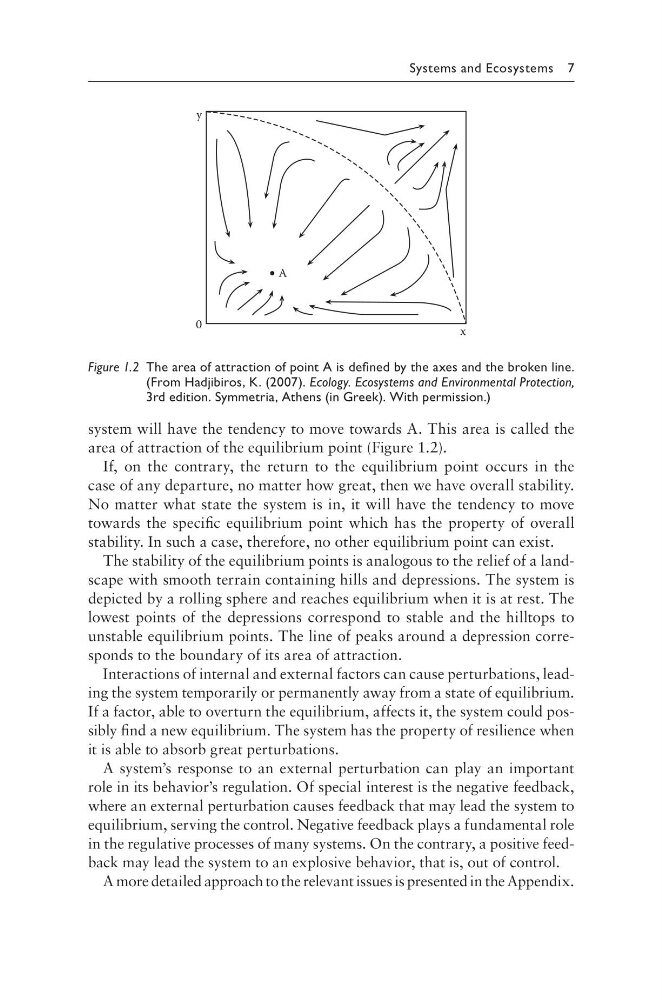
system will have the tendency to move towards A. This area is called the
area of attraction of the equilibrium point (Figure 1.2).
If, on the contrary, the return to the equilibrium point occurs in the
case of any departure, no matter how great, then we have overall stability.
No matter what state the system is in, it will have the tendency to move
towards the specific equilibrium point which has the property of overall
stability. In such a case, therefore, no other equilibrium point can exist.
The stability of the equilibrium points is analogous to the relief of a landscape with smooth terrain containing hills and depressions. The system is
depicted by a rolling sphere and reaches equilibrium when it is at rest. The
lowest points of the depressions correspond to stable and the hilltops to
unstable equilibrium points. The line of peaks around a depression corresponds to the boundary of its area of attraction.
Interactions of internal and external factors can cause perturbations, leading the system temporarily or permanently away from a state of equilibrium.
If a factor, able to overturn the equilibrium, affects it, the system could possibly find a new equilibrium. The system has the property of resilience when
it is able to absorb great perturbations.
A system’s response to an external perturbation can play an important
role in its behavior’s regulation. Of special interest is the negative feedback,
where an external perturbation causes feedback that may lead the system to
equilibrium, serving the control. Negative feedback plays a fundamental role
in the regulative processes of many systems. On the contrary, a positive feedback may lead the system to an explosive behavior, that is, out of control.
A more detailed approach to the relevant issues is presented in the Appendix.
A
0
y
x
Figure 1.2 The area of attraction of point A is defined by the axes and the broken line.
(From Hadjibiros, K. (2007). Ecology. Ecosystems and Environmental Protection,
3rd edition. Symmetria, Athens (in Greek). With permission.)
system will have the tendency to move towards A. This area is called the
area of attraction of the equilibrium point (Figure 1.2).
If, on the contrary, the return to the equilibrium point occurs in the
case of any departure, no matter how great, then we have overall stability.
No matter what state the system is in, it will have the tendency to move
towards the specific equilibrium point which has the property of overall
stability. In such a case, therefore, no other equilibrium point can exist.
The stability of the equilibrium points is analogous to the relief of a landscape with smooth terrain containing hills and depressions. The system is
depicted by a rolling sphere and reaches equilibrium when it is at rest. The
lowest points of the depressions correspond to stable and the hilltops to
unstable equilibrium points. The line of peaks around a depression corresponds to the boundary of its area of attraction.
Interactions of internal and external factors can cause perturbations, leading the system temporarily or permanently away from a state of equilibrium.
If a factor, able to overturn the equilibrium, affects it, the system could possibly find a new equilibrium. The system has the property of resilience when
it is able to absorb great perturbations.
A system’s response to an external perturbation can play an important
role in its behavior’s regulation. Of special interest is the negative feedback,
where an external perturbation causes feedback that may lead the system to
equilibrium, serving the control. Negative feedback plays a fundamental role
in the regulative processes of many systems. On the contrary, a positive feedback may lead the system to an explosive behavior, that is, out of control.
A more detailed approach to the relevant issues is presented in the Appendix.
A
0
y
x
Figure 1.2 The area of attraction of point A is defined by the axes and the broken line.
(From Hadjibiros, K. (2007). Ecology. Ecosystems and Environmental Protection,
3rd edition. Symmetria, Athens (in Greek). With permission.)