

226 Ecology and Applied Environmental Science
which, however, constitutes a successful slogan that has theoretically been
adopted both by governments and non-governmental organizations. The
emergence of interest by the international capital (green capitalism) for
investments in sectors such as waste recycling, health products, renewable
energy sources etc. reinforces the acceptance of relevant ideas by the international community.
Rational management often requires a cyclic movement of natural resource
products either in the frame of cycles that exist in nature ( renewable natural
resources) or by the creation of artificial cycles (recyclable natural resources).
The relative shortening of the cycle period is an important parameter for pollution avoidance (e.g. prompt recycling of used metals), while the very long
period of certain natural cycles (e.g. phosphorus cycle) deprives the respective natural resource of the recyclable property. The rational management of
renewable natural resources (freshwater, forest, fauna etc.) includes saving,
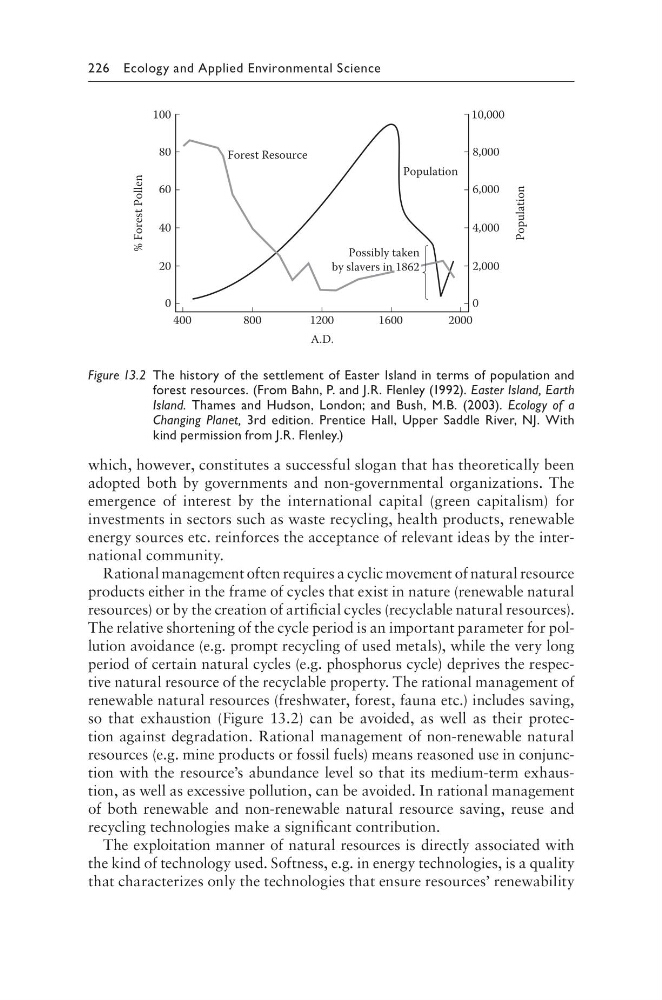
so that exhaustion (Figure 13.2) can be avoided, as well as their protection against degradation. Rational management of non-renewable natural
tion with the resource’s abundance level so that its medium-term exhaustion, as well as excessive pollution, can be avoided. In rational management
of both renewable and non-renewable natural resource saving, reuse and
recycling technologies make a significant contribution.
The exploitation manner of natural resources is directly associated with
the kind of technology used. Softness, e.g. in energy technologies, is a quality
that characterizes only the technologies that ensure resources’ renewability
400
800
1200
1600
2000
20
40
60
% Forest Pollen
Population
80
Forest Resource
Population
100
A.D.
0
2,000
4,000
6,000
8,000
10,000
0
Possibly taken
by slavers in 1862
Figure 13.2 The history of the settlement of Easter Island in terms of population and
forest resources. (From Bahn, P. and J.R. Flenley (1992). Easter Island, Earth
Island. Thames and Hudson, London; and Bush, M.B. (2003). Ecology of a
Changing Planet, 3rd edition. Prentice Hall, Upper Saddle River, NJ. With
kind permission from J.R. Flenley.)
which, however, constitutes a successful slogan that has theoretically been
adopted both by governments and non-governmental organizations. The
emergence of interest by the international capital (green capitalism) for
investments in sectors such as waste recycling, health products, renewable
energy sources etc. reinforces the acceptance of relevant ideas by the international community.
Rational management often requires a cyclic movement of natural resource
products either in the frame of cycles that exist in nature ( renewable natural
resources) or by the creation of artificial cycles (recyclable natural resources).
The relative shortening of the cycle period is an important parameter for pollution avoidance (e.g. prompt recycling of used metals), while the very long
period of certain natural cycles (e.g. phosphorus cycle) deprives the respective natural resource of the recyclable property. The rational management of
renewable natural resources (freshwater, forest, fauna etc.) includes saving,
so that exhaustion (Figure 13.2) can be avoided, as well as their protection against degradation. Rational management of non-renewable natural
tion with the resource’s abundance level so that its medium-term exhaustion, as well as excessive pollution, can be avoided. In rational management
of both renewable and non-renewable natural resource saving, reuse and
recycling technologies make a significant contribution.
The exploitation manner of natural resources is directly associated with
the kind of technology used. Softness, e.g. in energy technologies, is a quality
that characterizes only the technologies that ensure resources’ renewability
400
800
1200
1600
2000
20
40
60
% Forest Pollen
Population
80
Forest Resource
Population
100
A.D.
0
2,000
4,000
6,000
8,000
10,000
0
Possibly taken
by slavers in 1862
Figure 13.2 The history of the settlement of Easter Island in terms of population and
forest resources. (From Bahn, P. and J.R. Flenley (1992). Easter Island, Earth
Island. Thames and Hudson, London; and Bush, M.B. (2003). Ecology of a
Changing Planet, 3rd edition. Prentice Hall, Upper Saddle River, NJ. With
kind permission from J.R. Flenley.)