

Pollution Control Technology 195
about possible hazards or accidents etc. They are also associated with the
unavoidable conflict of local interests with the greater social interest.
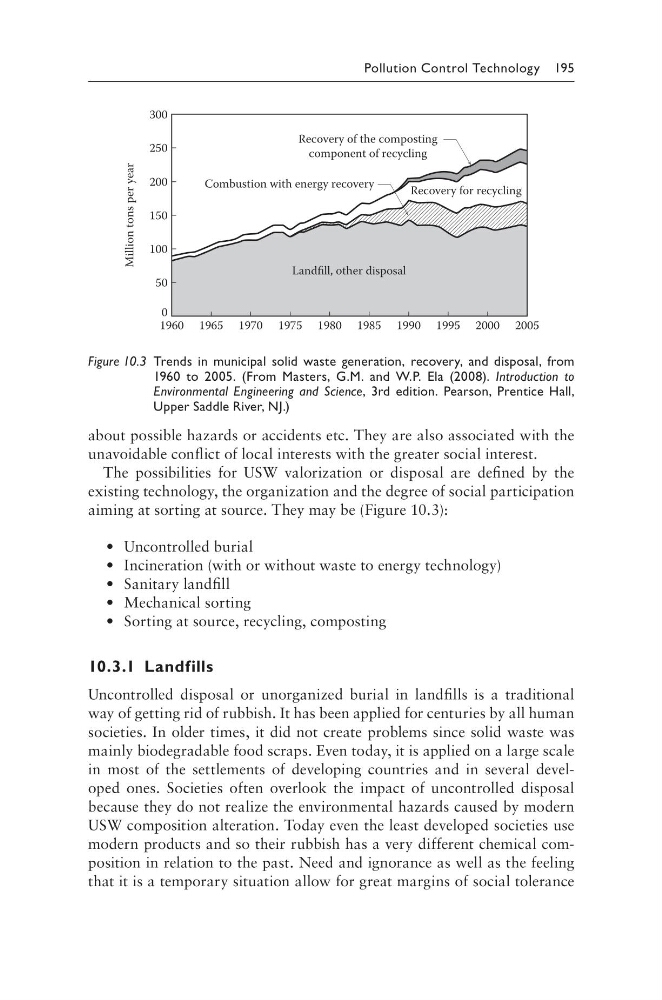
The possibilities for USW valorization or disposal are defined by the
existing technology, the organization and the degree of social participation
aiming at sorting at source. They may be (Figure 10.3):
• Uncontrolled burial
• Incineration (with or without waste to energy technology)
• Sanitary landfill
• Mechanical sorting
• Sorting at source, recycling, composting
10.3.1 landfills
Uncontrolled disposal or unorganized burial in landfills is a traditional
way of getting rid of rubbish. It has been applied for centuries by all human
societies. In older times, it did not create problems since solid waste was
mainly biodegradable food scraps. Even today, it is applied on a large scale
in most of the settlements of developing countries and in several developed ones. Societies often overlook the impact of uncontrolled disposal
because they do not realize the environmental hazards caused by modern
USW composition alteration. Today even the least developed societies use
modern products and so their rubbish has a very different chemical composition in relation to the past. Need and ignorance as well as the feeling
that it is a temporary situation allow for great margins of social tolerance
1965
1960
1970 1975 1980 1985 1990 1995 2000 2005
50
100
150
200
Million tons per year
250
300
Recovery of the composting
component of recycling
Recovery for recycling
Combustion with energy recovery
Landfill, other disposal
0
Figure 10.3 Trends in municipal solid waste generation, recovery, and disposal, from
1960 to 2005. (From Masters, G.M. and W.P. Ela (2008). Introduction to
Environmental Engineering and Science, 3rd edition. Pearson, Prentice Hall,
Upper Saddle River, NJ.)
about possible hazards or accidents etc. They are also associated with the
unavoidable conflict of local interests with the greater social interest.
The possibilities for USW valorization or disposal are defined by the
existing technology, the organization and the degree of social participation
aiming at sorting at source. They may be (Figure 10.3):
• Uncontrolled burial
• Incineration (with or without waste to energy technology)
• Sanitary landfill
• Mechanical sorting
• Sorting at source, recycling, composting
10.3.1 landfills
Uncontrolled disposal or unorganized burial in landfills is a traditional
way of getting rid of rubbish. It has been applied for centuries by all human
societies. In older times, it did not create problems since solid waste was
mainly biodegradable food scraps. Even today, it is applied on a large scale
in most of the settlements of developing countries and in several developed ones. Societies often overlook the impact of uncontrolled disposal
because they do not realize the environmental hazards caused by modern
USW composition alteration. Today even the least developed societies use
modern products and so their rubbish has a very different chemical composition in relation to the past. Need and ignorance as well as the feeling
that it is a temporary situation allow for great margins of social tolerance
1965
1960
1970 1975 1980 1985 1990 1995 2000 2005
50
100
150
200
Million tons per year
250
300
Recovery of the composting
component of recycling
Recovery for recycling
Combustion with energy recovery
Landfill, other disposal
0
Figure 10.3 Trends in municipal solid waste generation, recovery, and disposal, from
1960 to 2005. (From Masters, G.M. and W.P. Ela (2008). Introduction to
Environmental Engineering and Science, 3rd edition. Pearson, Prentice Hall,
Upper Saddle River, NJ.)