

Air Pollution and Global Change 175
The ozone layer absorbs a great percentage of the sun’s ultraviolet radiation and forms a critical shield for the protection of Earth organisms.
Absorption at wavelengths 180–240 nm leads to ozone formation from
oxygen and at wavelengths 200–320 nm leads to oxygen formation from
ozone. Ultraviolet radiation that reaches the atmosphere can be of UV-C,
UV-B, or UV-A type. The first contains more energy and is absorbed by
ozone to a percentage of more than 99%. Fifty percent of the second is
absorbed and only a small percentage of the third, which contains less
energy and is relatively harmless, is absorbed.
Strong ultraviolet radiation causes skin cancer, cataracts and genetic
cially at wavelengths 280–320 nm, and suffers serious damage. The presence of the ozone layer allowed life 400 million years ago to develop out of
the oceans and colonize the land. It has been estimated that an increase of
incident ultraviolet radiation by 1% would cause an increase of mortality
due to melanoma by 0.8–1.5% in the United States. The increase of UV-B
in aquatic ecosystems has serious repercussions because of the decrease of
phytoplankton. It can also affect terrestrial and aquatic organisms, damage
agricultural production and accelerate the decomposition of some plastics.
The increase of UV-B that reaches the lower troposphere also causes an
increase of the concentrations of tropospheric ozone (Sections 9.1 and 9.4).
Since the late 1970s, scientific observations both from satellites and from
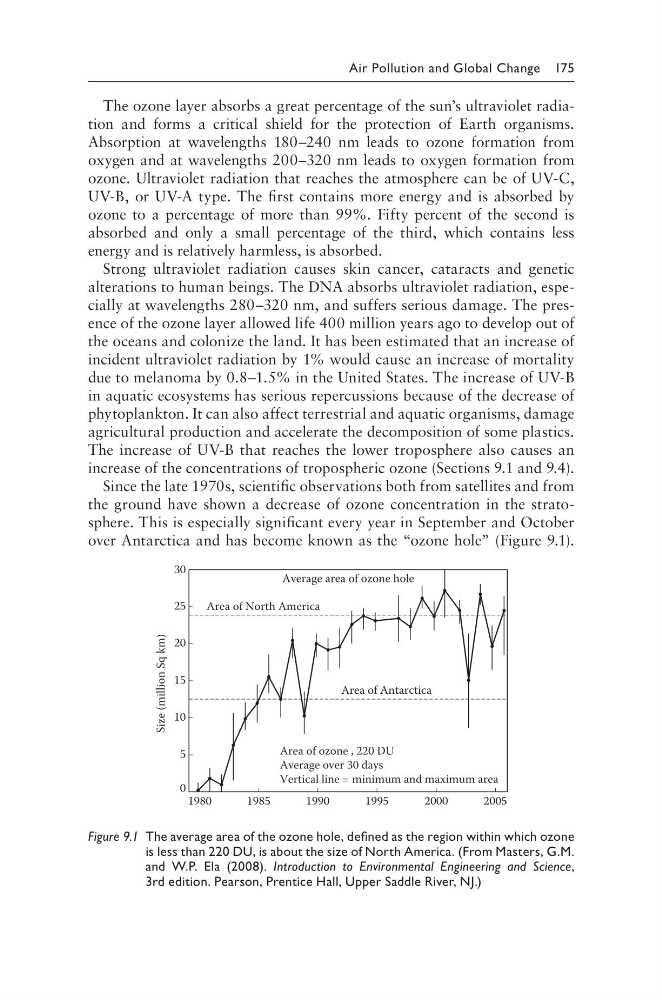
the ground have shown a decrease of ozone concentration in the stratosphere. This is especially significant every year in September and October
over Antarctica and has become known as the “ozone hole” (Figure 9.1).
1980
1985
1990
1995
2000
2005
5
10
15
25
20
30
Size (million Sq km)
Area of North America
Average area of ozone hole
0
Area of Antarctica
Area of ozone , 220 DU
Average over 30 days
Vertical line = minimum and maximum area
Figure 9.1 The average area of the ozone hole, defined as the region within which ozone
is less than 220 DU, is about the size of North America. (From Masters, G.M.
and W.P. Ela (2008). Introduction to Environmental Engineering and Science,
3rd edition. Pearson, Prentice Hall, Upper Saddle River, NJ.)
The ozone layer absorbs a great percentage of the sun’s ultraviolet radiation and forms a critical shield for the protection of Earth organisms.
Absorption at wavelengths 180–240 nm leads to ozone formation from
oxygen and at wavelengths 200–320 nm leads to oxygen formation from
ozone. Ultraviolet radiation that reaches the atmosphere can be of UV-C,
UV-B, or UV-A type. The first contains more energy and is absorbed by
ozone to a percentage of more than 99%. Fifty percent of the second is
absorbed and only a small percentage of the third, which contains less
energy and is relatively harmless, is absorbed.
Strong ultraviolet radiation causes skin cancer, cataracts and genetic
cially at wavelengths 280–320 nm, and suffers serious damage. The presence of the ozone layer allowed life 400 million years ago to develop out of
the oceans and colonize the land. It has been estimated that an increase of
incident ultraviolet radiation by 1% would cause an increase of mortality
due to melanoma by 0.8–1.5% in the United States. The increase of UV-B
in aquatic ecosystems has serious repercussions because of the decrease of
phytoplankton. It can also affect terrestrial and aquatic organisms, damage
agricultural production and accelerate the decomposition of some plastics.
The increase of UV-B that reaches the lower troposphere also causes an
increase of the concentrations of tropospheric ozone (Sections 9.1 and 9.4).
Since the late 1970s, scientific observations both from satellites and from
the ground have shown a decrease of ozone concentration in the stratosphere. This is especially significant every year in September and October
over Antarctica and has become known as the “ozone hole” (Figure 9.1).
1980
1985
1990
1995
2000
2005
5
10
15
25
20
30
Size (million Sq km)
Area of North America
Average area of ozone hole
0
Area of Antarctica
Area of ozone , 220 DU
Average over 30 days
Vertical line = minimum and maximum area
Figure 9.1 The average area of the ozone hole, defined as the region within which ozone
is less than 220 DU, is about the size of North America. (From Masters, G.M.
and W.P. Ela (2008). Introduction to Environmental Engineering and Science,
3rd edition. Pearson, Prentice Hall, Upper Saddle River, NJ.)