

152 Ecology and Applied Environmental Science
safety of fluoridation is not complete. Instead of mass fluoridation, there is the
possibility of individuals who so desire to apply fluoride simply and cheaply.
7.5 radioactivity
7.5.1 Essential knowledge of the Physics of radioactivity
Elements whose nuclei undergo automatic transformation, i.e. without the
action of an outside force, are known as radioactive. During the transformation, the nucleus emits energy in the form of rapidly moving particles or
in the form of electromagnetic radiation. Such emissions cause ionisation
of the matter and belong to one of the three types of radioactivity: alpha
(α), beta (β) and gamma (γ); even when they consist of particles, they are
commonly known as radioactive radiation.
Alpha (α) particles are helium nuclei, that is, they are made up of two protons and two neutrons. They are emitted at speeds equal to approximately
10% of the speed of light, and their penetrating power is low. This is because
due to their substantial mass, they lose their energy quickly, causing strong
ionisation of matter through successive collisions. In the atmosphere they
travel for distances of not more than 10 cm or so at ordinary temperatures.
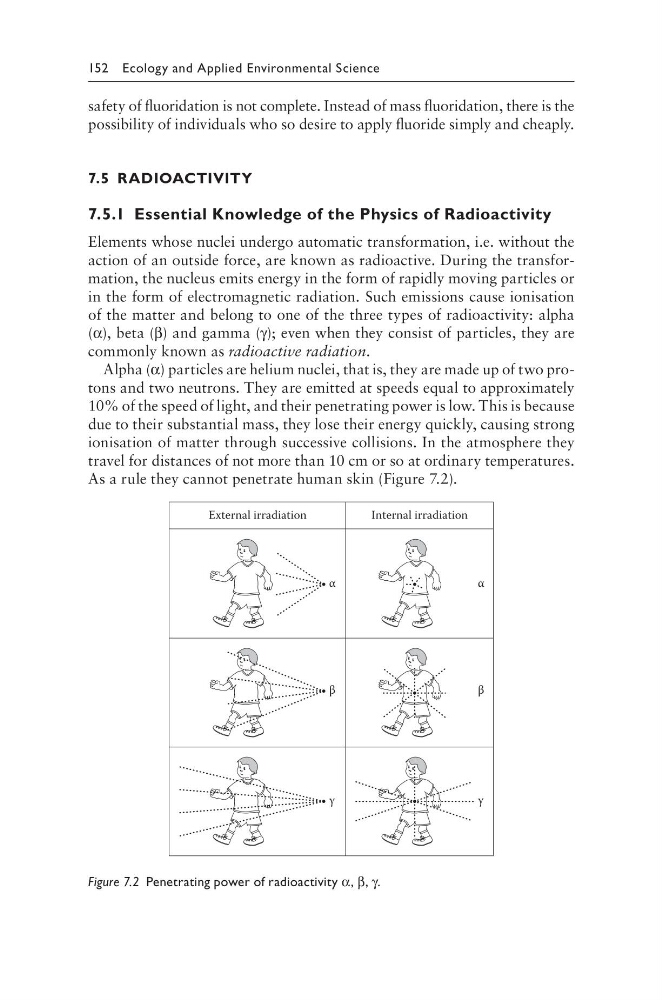
As a rule they cannot penetrate human skin (Figure 7.2).
α
β
γ
α
β
γ
External irradiation
Internal irradiation
. .
..
. .
..
. .
..
. .
..
. .
..
. .
..
Figure 7.2 Penetrating power of radioactivity α, β, γ.
safety of fluoridation is not complete. Instead of mass fluoridation, there is the
possibility of individuals who so desire to apply fluoride simply and cheaply.
7.5 radioactivity
7.5.1 Essential knowledge of the Physics of radioactivity
Elements whose nuclei undergo automatic transformation, i.e. without the
action of an outside force, are known as radioactive. During the transformation, the nucleus emits energy in the form of rapidly moving particles or
in the form of electromagnetic radiation. Such emissions cause ionisation
of the matter and belong to one of the three types of radioactivity: alpha
(α), beta (β) and gamma (γ); even when they consist of particles, they are
commonly known as radioactive radiation.
Alpha (α) particles are helium nuclei, that is, they are made up of two protons and two neutrons. They are emitted at speeds equal to approximately
10% of the speed of light, and their penetrating power is low. This is because
due to their substantial mass, they lose their energy quickly, causing strong
ionisation of matter through successive collisions. In the atmosphere they
travel for distances of not more than 10 cm or so at ordinary temperatures.
As a rule they cannot penetrate human skin (Figure 7.2).
α
β
γ
α
β
γ
External irradiation
Internal irradiation
. .
..
. .
..
. .
..
. .
..
. .
..
. .
..
Figure 7.2 Penetrating power of radioactivity α, β, γ.