

Toxic Pollution 143
Large doses in mice have been associated with increased incidence of cancer
of the liver. Concentrations of chlorinated hydrocarbons were significantly
higher in the bodies of people who died of brain haemorrhage, cirrhosis of the
liver and various cancers than in the bodies of people who died of infectious
diseases. The patients’ histories showed a correlation between concentrations
of DDT and the extent to which the patients used it in their homes. In the
early 1970s the breast milk of many mothers in the United States contained
DDT in concentrations that would have been considered impermissible for
commercially sold milk, in accordance with the provisions then in effect.
Bans on the use of chlorinated hydrocarbons in many countries bring
about a gradual decrease in concentrations in their human populations,
but many years have to go by before there will be enough data on the
consequences and before the concentrations become low enough for this
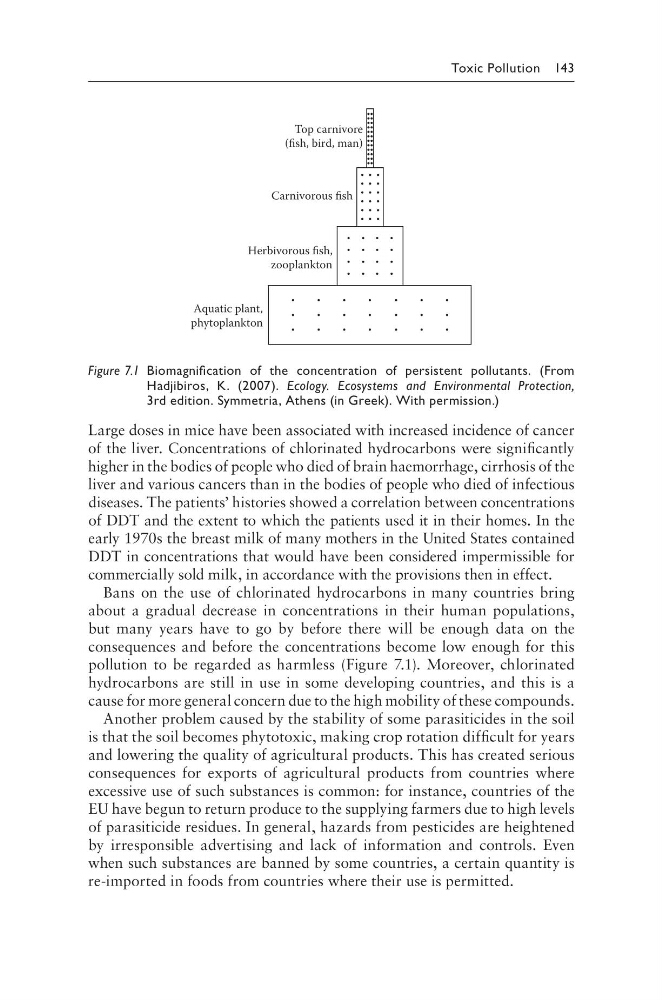
pollution to be regarded as harmless (Figure 7.1). Moreover, chlorinated
hydro carbons are still in use in some developing countries, and this is a
cause for more general concern due to the high mobility of these compounds.
Another problem caused by the stability of some parasiticides in the soil
is that the soil becomes phytotoxic, making crop rotation difficult for years
and lowering the quality of agricultural products. This has created serious
consequences for exports of agricultural products from countries where
excessive use of such substances is common: for instance, countries of the
EU have begun to return produce to the supplying farmers due to high levels
of parasiticide residues. In general, hazards from pesticides are heightened
by irresponsible advertising and lack of information and controls. Even
when such substances are banned by some countries, a certain quantity is
re-imported in foods from countries where their use is permitted.
Aquatic plant,
phytoplankton
Herbivorous fish,
zooplankton
Carnivorous fish
Top carnivore
(fish, bird, man)
Figure 7.1 Biomagnification of the concentration of persistent pollutants. (From
Hadjibiros, K. (2007). Ecology. Ecosystems and Environmental Protection,
3rd edition . Symmetria, Athens (in Greek). With permission.)
Large doses in mice have been associated with increased incidence of cancer
of the liver. Concentrations of chlorinated hydrocarbons were significantly
higher in the bodies of people who died of brain haemorrhage, cirrhosis of the
liver and various cancers than in the bodies of people who died of infectious
diseases. The patients’ histories showed a correlation between concentrations
of DDT and the extent to which the patients used it in their homes. In the
early 1970s the breast milk of many mothers in the United States contained
DDT in concentrations that would have been considered impermissible for
commercially sold milk, in accordance with the provisions then in effect.
Bans on the use of chlorinated hydrocarbons in many countries bring
about a gradual decrease in concentrations in their human populations,
but many years have to go by before there will be enough data on the
consequences and before the concentrations become low enough for this
pollution to be regarded as harmless (Figure 7.1). Moreover, chlorinated
hydro carbons are still in use in some developing countries, and this is a
cause for more general concern due to the high mobility of these compounds.
Another problem caused by the stability of some parasiticides in the soil
is that the soil becomes phytotoxic, making crop rotation difficult for years
and lowering the quality of agricultural products. This has created serious
consequences for exports of agricultural products from countries where
excessive use of such substances is common: for instance, countries of the
EU have begun to return produce to the supplying farmers due to high levels
of parasiticide residues. In general, hazards from pesticides are heightened
by irresponsible advertising and lack of information and controls. Even
when such substances are banned by some countries, a certain quantity is
re-imported in foods from countries where their use is permitted.
Aquatic plant,
phytoplankton
Herbivorous fish,
zooplankton
Carnivorous fish
Top carnivore
(fish, bird, man)
Figure 7.1 Biomagnification of the concentration of persistent pollutants. (From
Hadjibiros, K. (2007). Ecology. Ecosystems and Environmental Protection,
3rd edition . Symmetria, Athens (in Greek). With permission.)