

Organisation at the Ecosystem Level 81
known deterministic or stochastic function of time. We assume that the
incoming phosphorus scatters instantly and uniformly in the lake ( complete
mixture) and remains diluted in the water in its totality without any
observed phenomena of sinking in the bottom of the lake.
Organisms are divided into only two categories: producers and consumers. State variables of the ecosystem are the concentrations of organisms
X p and X c and the concentration of inorganic phosphorus C. For each one
of the two categories we assume that the biomass creation speed is analogous to the consumption speed of the limiting food, with corresponding
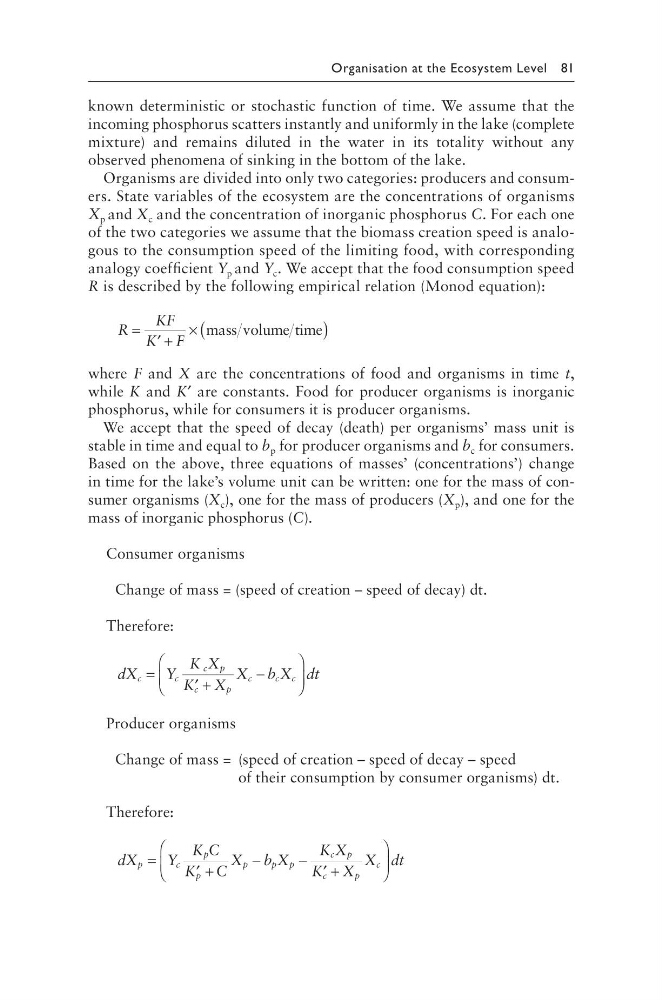
analogy coefficient Y p and Y c . We accept that the food consumption speed
R is described by the following empirical relation (Monod equation):
R
KF
K F
= ′ +
× (
)
mass volume time
where F and X are the concentrations of food and organisms in time t,
while K and K′ are constants. Food for producer organisms is inorganic
phosphorus, while for consumers it is producer organisms.
We accept that the speed of decay (death) per organisms’ mass unit is
stable in time and equal to b p for producer organisms and b c for consumers.
Based on the above, three equations of masses’ (concentrations’) change
in time for the lake’s volume unit can be written: one for the mass of consumer organisms (X c ), one for the mass of producers (X p ), and one for the
mass of inorganic phosphorus (C).
Consumer organisms
Change of mass = (speed of creation – speed of decay) dt.
Therefore:
dX
Y
K X
K X
X b X dt
c
c
c p
c
p
c
c c
=
′ +
−
Producer organisms
Change of mass = (speed of creation – speed of decay – speed
of their consumption by consumer organisms) dt.
Therefore:
dX
Y
K C
K C
X b X
K X
K X
X dt
p
c
p
p
p
p p
c p
c
p
c
=
′ +
−
− ′ +
known deterministic or stochastic function of time. We assume that the
incoming phosphorus scatters instantly and uniformly in the lake ( complete
mixture) and remains diluted in the water in its totality without any
observed phenomena of sinking in the bottom of the lake.
Organisms are divided into only two categories: producers and consumers. State variables of the ecosystem are the concentrations of organisms
X p and X c and the concentration of inorganic phosphorus C. For each one
of the two categories we assume that the biomass creation speed is analogous to the consumption speed of the limiting food, with corresponding
analogy coefficient Y p and Y c . We accept that the food consumption speed
R is described by the following empirical relation (Monod equation):
R
KF
K F
= ′ +
× (
)
mass volume time
where F and X are the concentrations of food and organisms in time t,
while K and K′ are constants. Food for producer organisms is inorganic
phosphorus, while for consumers it is producer organisms.
We accept that the speed of decay (death) per organisms’ mass unit is
stable in time and equal to b p for producer organisms and b c for consumers.
Based on the above, three equations of masses’ (concentrations’) change
in time for the lake’s volume unit can be written: one for the mass of consumer organisms (X c ), one for the mass of producers (X p ), and one for the
mass of inorganic phosphorus (C).
Consumer organisms
Change of mass = (speed of creation – speed of decay) dt.
Therefore:
dX
Y
K X
K X
X b X dt
c
c
c p
c
p
c
c c
=
′ +
−
Producer organisms
Change of mass = (speed of creation – speed of decay – speed
of their consumption by consumer organisms) dt.
Therefore:
dX
Y
K C
K C
X b X
K X
K X
X dt
p
c
p
p
p
p p
c p
c
p
c
=
′ +
−
− ′ +