

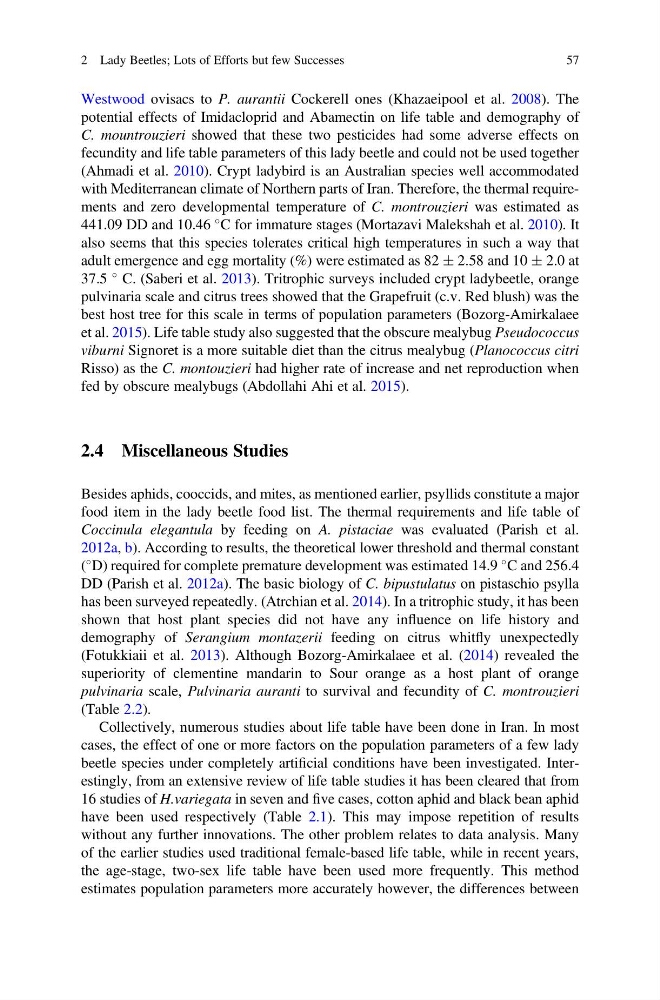
Westwood ovisacs to P. aurantii Cockerell ones (Khazaeipool et al. 2008). The
potential effects of Imidacloprid and Abamectin on life table and demography of
C. mountrouzieri showed that these two pesticides had some adverse effects on
fecundity and life table parameters of this lady beetle and could not be used together
(Ahmadi et al. 2010). Crypt ladybird is an Australian species well accommodated
with Mediterranean climate of Northern parts of Iran. Therefore, the thermal requirements and zero developmental temperature of C. montrouzieri was estimated as
441.09 DD and 10.46
C for immature stages (Mortazavi Malekshah et al. 2010). It
also seems that this species tolerates critical high temperatures in such a way that
adult emergence and egg mortality (%) were estimated as 82 Æ 2.58 and 10 Æ 2.0 at
37.5
C. (Saberi et al. 2013). Tritrophic surveys included crypt ladybeetle, orange
pulvinaria scale and citrus trees showed that the Grapefruit (c.v. Red blush) was the
best host tree for this scale in terms of population parameters (Bozorg-Amirkalaee
et al. 2015). Life table study also suggested that the obscure mealybug Pseudococcus
viburni Signoret is a more suitable diet than the citrus mealybug (Planococcus citri
Risso) as the C. montouzieri had higher rate of increase and net reproduction when
fed by obscure mealybugs (Abdollahi Ahi et al. 2015).
2.4 Miscellaneous Studies
Besides aphids, cooccids, and mites, as mentioned earlier, psyllids constitute a major
food item in the lady beetle food list. The thermal requirements and life table of
Coccinula elegantula by feeding on A. pistaciae was evaluated (Parish et al.
2012a, b). According to results, the theoretical lower threshold and thermal constant
(
D) required for complete premature development was estimated 14.9
C and 256.4
DD (Parish et al. 2012a). The basic biology of C. bipustulatus on pistaschio psylla
has been surveyed repeatedly. (Atrchian et al. 2014). In a tritrophic study, it has been
shown that host plant species did not have any influence on life history and
demography of Serangium montazerii feeding on citrus whitfly unexpectedly
(Fotukkiaii et al. 2013). Although Bozorg-Amirkalaee et al. (2014) revealed the
superiority of clementine mandarin to Sour orange as a host plant of orange
pulvinaria scale, Pulvinaria auranti to survival and fecundity of C. montrouzieri
(Table 2.2).
Collectively, numerous studies about life table have been done in Iran. In most
cases, the effect of one or more factors on the population parameters of a few lady
beetle species under completely artificial conditions have been investigated. Interestingly, from an extensive review of life table studies it has been cleared that from
16 studies of H.variegata in seven and five cases, cotton aphid and black bean aphid
have been used respectively (Table 2.1). This may impose repetition of results
without any further innovations. The other problem relates to data analysis. Many
of the earlier studies used traditional female-based life table, while in recent years,
the age-stage, two-sex life table have been used more frequently. This method
estimates population parameters more accurately however, the differences between
2 Lady Beetles; Lots of Efforts but few Successes
57
potential effects of Imidacloprid and Abamectin on life table and demography of
C. mountrouzieri showed that these two pesticides had some adverse effects on
fecundity and life table parameters of this lady beetle and could not be used together
(Ahmadi et al. 2010). Crypt ladybird is an Australian species well accommodated
with Mediterranean climate of Northern parts of Iran. Therefore, the thermal requirements and zero developmental temperature of C. montrouzieri was estimated as
441.09 DD and 10.46
C for immature stages (Mortazavi Malekshah et al. 2010). It
also seems that this species tolerates critical high temperatures in such a way that
adult emergence and egg mortality (%) were estimated as 82 Æ 2.58 and 10 Æ 2.0 at
37.5
C. (Saberi et al. 2013). Tritrophic surveys included crypt ladybeetle, orange
pulvinaria scale and citrus trees showed that the Grapefruit (c.v. Red blush) was the
best host tree for this scale in terms of population parameters (Bozorg-Amirkalaee
et al. 2015). Life table study also suggested that the obscure mealybug Pseudococcus
viburni Signoret is a more suitable diet than the citrus mealybug (Planococcus citri
Risso) as the C. montouzieri had higher rate of increase and net reproduction when
fed by obscure mealybugs (Abdollahi Ahi et al. 2015).
2.4 Miscellaneous Studies
Besides aphids, cooccids, and mites, as mentioned earlier, psyllids constitute a major
food item in the lady beetle food list. The thermal requirements and life table of
Coccinula elegantula by feeding on A. pistaciae was evaluated (Parish et al.
2012a, b). According to results, the theoretical lower threshold and thermal constant
(
D) required for complete premature development was estimated 14.9
C and 256.4
DD (Parish et al. 2012a). The basic biology of C. bipustulatus on pistaschio psylla
has been surveyed repeatedly. (Atrchian et al. 2014). In a tritrophic study, it has been
shown that host plant species did not have any influence on life history and
demography of Serangium montazerii feeding on citrus whitfly unexpectedly
(Fotukkiaii et al. 2013). Although Bozorg-Amirkalaee et al. (2014) revealed the
superiority of clementine mandarin to Sour orange as a host plant of orange
pulvinaria scale, Pulvinaria auranti to survival and fecundity of C. montrouzieri
(Table 2.2).
Collectively, numerous studies about life table have been done in Iran. In most
cases, the effect of one or more factors on the population parameters of a few lady
beetle species under completely artificial conditions have been investigated. Interestingly, from an extensive review of life table studies it has been cleared that from
16 studies of H.variegata in seven and five cases, cotton aphid and black bean aphid
have been used respectively (Table 2.1). This may impose repetition of results
without any further innovations. The other problem relates to data analysis. Many
of the earlier studies used traditional female-based life table, while in recent years,
the age-stage, two-sex life table have been used more frequently. This method
estimates population parameters more accurately however, the differences between
2 Lady Beetles; Lots of Efforts but few Successes
57