

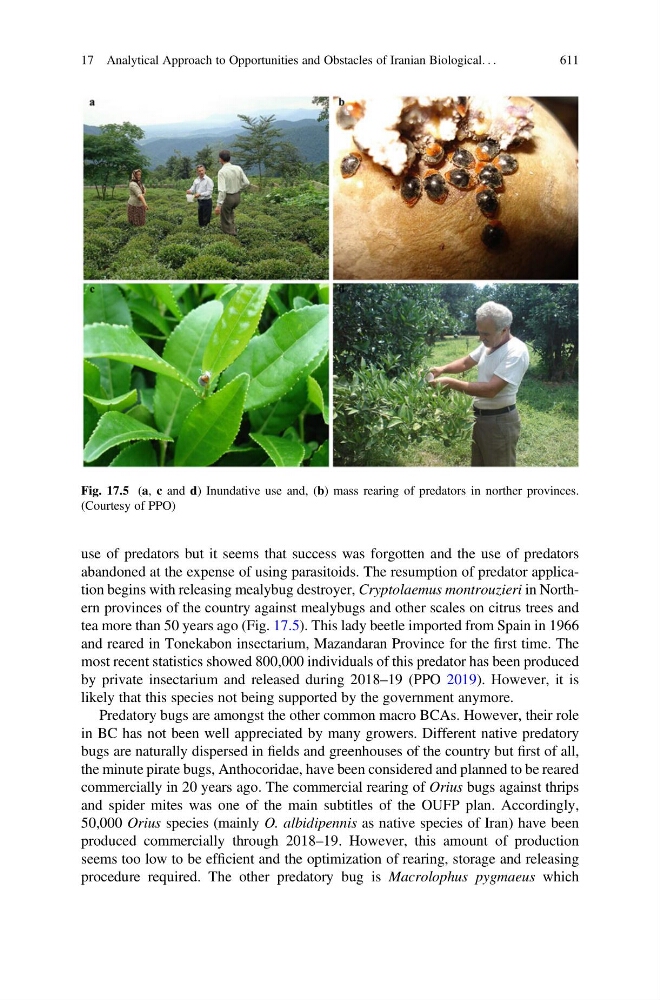
use of predators but it seems that success was forgotten and the use of predators
abandoned at the expense of using parasitoids. The resumption of predator application begins with releasing mealybug destroyer, Cryptolaemus montrouzieri in Northern provinces of the country against mealybugs and other scales on citrus trees and
tea more than 50 years ago (Fig. 17.5). This lady beetle imported from Spain in 1966
and reared in Tonekabon insectarium, Mazandaran Province for the first time. The
most recent statistics showed 800,000 individuals of this predator has been produced
by private insectarium and released during 2018–19 (PPO 2019). However, it is
likely that this species not being supported by the government anymore.
Predatory bugs are amongst the other common macro BCAs. However, their role
in BC has not been well appreciated by many growers. Different native predatory
bugs are naturally dispersed in fields and greenhouses of the country but first of all,
the minute pirate bugs, Anthocoridae, have been considered and planned to be reared
commercially in 20 years ago. The commercial rearing of Orius bugs against thrips
and spider mites was one of the main subtitles of the OUFP plan. Accordingly,
50,000 Orius species (mainly O. albidipennis as native species of Iran) have been
produced commercially through 2018–19. However, this amount of production
seems too low to be efficient and the optimization of rearing, storage and releasing
procedure required. The other predatory bug is Macrolophus pygmaeus which
Fig. 17.5 (a, c and d) Inundative use and, (b) mass rearing of predators in norther provinces.
(Courtesy of PPO)
17 Analytical Approach to Opportunities and Obstacles of Iranian Biological. . .
611