

et al. 2019). Prevalence of infection in different populations of Cx. pipiens in the
North, Center, and South of Iran showed that all populations of the mentioned
species were infected with Wolbachia (Karami et al. 2016; Bozorg-Omid et al.
2019).
Screening and identification of midgut bacterial microbiota from wild-caught An.
stephensi larvae and adults in southern Iran for generation of paratransgenic mosquitoes refractory to transmission of malaria resulted in isolation of Pseudomonas
(Pseudomonadaceae),
Aeromonas
(Aeromonadaceae)
and
Myroides
(Flavobacteriaceae) genera from both larvae and adult stages indicating possible
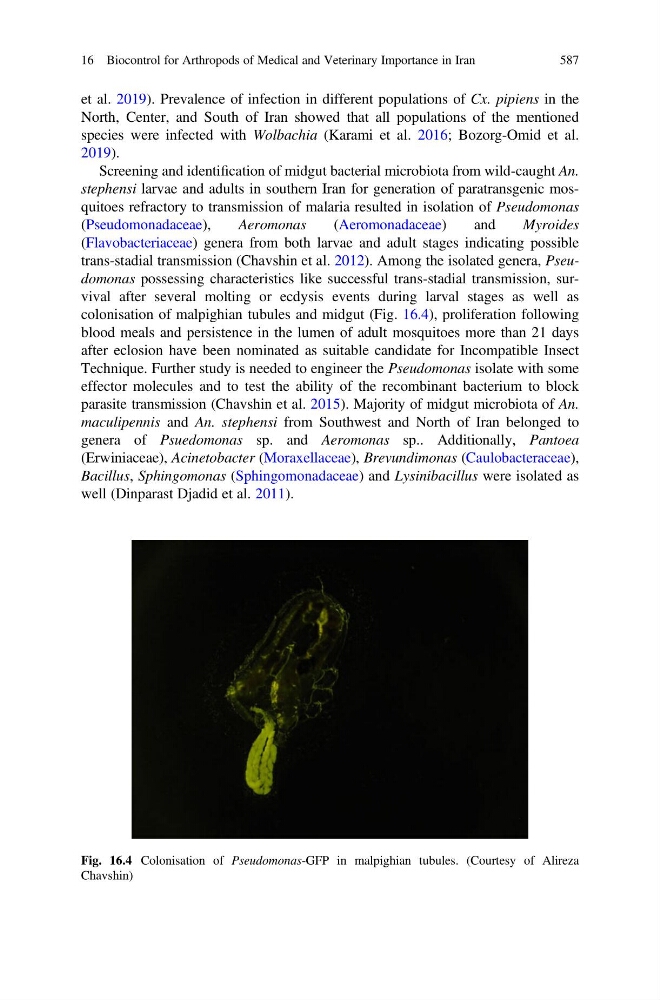
trans-stadial transmission (Chavshin et al. 2012). Among the isolated genera, Pseudomonas possessing characteristics like successful trans-stadial transmission, survival after several molting or ecdysis events during larval stages as well as
colonisation of malpighian tubules and midgut (Fig. 16.4), proliferation following
blood meals and persistence in the lumen of adult mosquitoes more than 21 days
after eclosion have been nominated as suitable candidate for Incompatible Insect
Technique. Further study is needed to engineer the Pseudomonas isolate with some
effector molecules and to test the ability of the recombinant bacterium to block
parasite transmission (Chavshin et al. 2015). Majority of midgut microbiota of An.
maculipennis and An. stephensi from Southwest and North of Iran belonged to
genera of Psuedomonas sp. and Aeromonas sp.. Additionally, Pantoea
(Erwiniaceae), Acinetobacter (Moraxellaceae), Brevundimonas (Caulobacteraceae),
Bacillus, Sphingomonas (Sphingomonadaceae) and Lysinibacillus were isolated as
well (Dinparast Djadid et al. 2011).
Fig. 16.4 Colonisation of Pseudomonas-GFP in malpighian tubules. (Courtesy of Alireza
Chavshin)
16 Biocontrol for Arthropods of Medical and Veterinary Importance in Iran
587
North, Center, and South of Iran showed that all populations of the mentioned
species were infected with Wolbachia (Karami et al. 2016; Bozorg-Omid et al.
2019).
Screening and identification of midgut bacterial microbiota from wild-caught An.
stephensi larvae and adults in southern Iran for generation of paratransgenic mosquitoes refractory to transmission of malaria resulted in isolation of Pseudomonas
(Pseudomonadaceae),
Aeromonas
(Aeromonadaceae)
and
Myroides
(Flavobacteriaceae) genera from both larvae and adult stages indicating possible
trans-stadial transmission (Chavshin et al. 2012). Among the isolated genera, Pseudomonas possessing characteristics like successful trans-stadial transmission, survival after several molting or ecdysis events during larval stages as well as
colonisation of malpighian tubules and midgut (Fig. 16.4), proliferation following
blood meals and persistence in the lumen of adult mosquitoes more than 21 days
after eclosion have been nominated as suitable candidate for Incompatible Insect
Technique. Further study is needed to engineer the Pseudomonas isolate with some
effector molecules and to test the ability of the recombinant bacterium to block
parasite transmission (Chavshin et al. 2015). Majority of midgut microbiota of An.
maculipennis and An. stephensi from Southwest and North of Iran belonged to
genera of Psuedomonas sp. and Aeromonas sp.. Additionally, Pantoea
(Erwiniaceae), Acinetobacter (Moraxellaceae), Brevundimonas (Caulobacteraceae),
Bacillus, Sphingomonas (Sphingomonadaceae) and Lysinibacillus were isolated as
well (Dinparast Djadid et al. 2011).
Fig. 16.4 Colonisation of Pseudomonas-GFP in malpighian tubules. (Courtesy of Alireza
Chavshin)
16 Biocontrol for Arthropods of Medical and Veterinary Importance in Iran
587