

0.63–2.53 days. Among these fungal isolates, M. anisopliae Iran 1018C isolate,
possessing some favourable characteristics in microbial control of mosquitoes, was
selected for further investigation (Fakoorziba et al. 2014). Among the aforementioned isolates, there were several isolates which also caused 100% mortality in
larvae and adults of house fly, Musca domestica (Muscidae) (Sharififard et al. 2011).
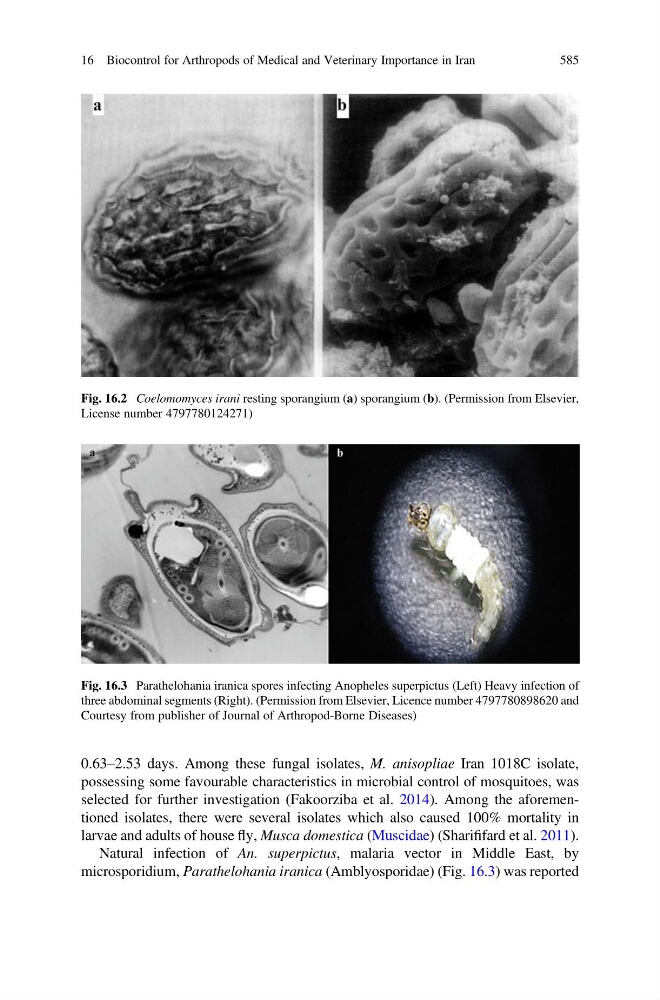
Natural infection of An. superpictus, malaria vector in Middle East, by
microsporidium, Parathelohania iranica (Amblyosporidae) (Fig. 16.3) was reported
Fig. 16.2 Coelomomyces irani resting sporangium (a) sporangium (b). (Permission from Elsevier,
License number 4797780124271)
Fig. 16.3 Parathelohania iranica spores infecting Anopheles superpictus (Left) Heavy infection of
three abdominal segments (Right). (Permission from Elsevier, Licence number 4797780898620 and
Courtesy from publisher of Journal of Arthropod-Borne Diseases)
16 Biocontrol for Arthropods of Medical and Veterinary Importance in Iran
585
possessing some favourable characteristics in microbial control of mosquitoes, was
selected for further investigation (Fakoorziba et al. 2014). Among the aforementioned isolates, there were several isolates which also caused 100% mortality in
larvae and adults of house fly, Musca domestica (Muscidae) (Sharififard et al. 2011).
Natural infection of An. superpictus, malaria vector in Middle East, by
microsporidium, Parathelohania iranica (Amblyosporidae) (Fig. 16.3) was reported
Fig. 16.2 Coelomomyces irani resting sporangium (a) sporangium (b). (Permission from Elsevier,
License number 4797780124271)
Fig. 16.3 Parathelohania iranica spores infecting Anopheles superpictus (Left) Heavy infection of
three abdominal segments (Right). (Permission from Elsevier, Licence number 4797780898620 and
Courtesy from publisher of Journal of Arthropod-Borne Diseases)
16 Biocontrol for Arthropods of Medical and Veterinary Importance in Iran
585