

mortality in prepupa (54%) while its effect was significantly reduced on second
instar larva (25%) at 10,000 IJs/ml. Similarly, S. carpocapsae was most effective on
prepupal stage (49%) and significantly ineffective against the second instar larva
(20%). Also, dissection of cadavers showed that EPNs were unable to reproduce
inside immature stages of thrips.
12.3.2.4 The Cucurbit Fruit Fly, Dacus ciliatus Loew, 1862 (Diptera:
Tephritidae)
The cucurbit fruit fly, Dacus ciliatus Loew, 1862 (Diptera: Tephritidae) is the most
serious pest of cucumber, melon, watermelon and related fruits in Iran (Arghand
1979). This fruit fly is multivoltine without any diapause in the southern part of the
country, causing serious damage on fruits from July to September (Arghand 1979;
Hancock 1989). Currently, the use of organophosphate insecticides is the main
control method for D. ciliatus, as authors saw several cases when farmers dip
infested fruits into insecticide solutions.
Kamali et al. (2013) examined biocontrol potential of the entomopathogenic
nematodes, H. bacteriophora and S. carpocapsae on third instar larvae, pupae,
and adult cucurbit flies under laboratory and greenhouse conditions. In laboratory
experiments, filter paper and potting soil, against third instar larvae, S. carpocapsae
and H. bacteriophora exhibited high infectivity and successfully reproduced and
emerged from larvae of D. ciliatus. Both nematode species induced low mortality on
pupae. These EPN species were effective against adult flies, as S. carpocapsae
caused higher adult mortality in than H. bacteriophora. In greenhouse test, they
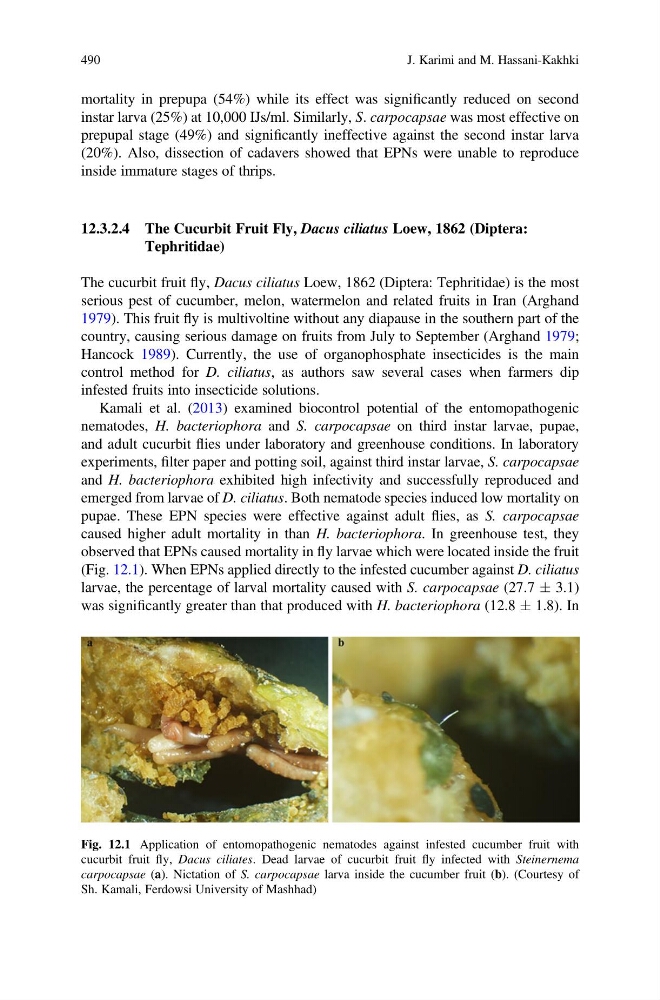
observed that EPNs caused mortality in fly larvae which were located inside the fruit
(Fig. 12.1). When EPNs applied directly to the infested cucumber against D. ciliatus
larvae, the percentage of larval mortality caused with S. carpocapsae (27.7 Æ 3.1)
was significantly greater than that produced with H. bacteriophora (12.8 Æ 1.8). In
Fig. 12.1 Application of entomopathogenic nematodes against infested cucumber fruit with
cucurbit fruit fly, Dacus ciliates. Dead larvae of cucurbit fruit fly infected with Steinernema
carpocapsae (a). Nictation of S. carpocapsae larva inside the cucumber fruit (b). (Courtesy of
Sh. Kamali, Ferdowsi University of Mashhad)
490
J. Karimi and M. Hassani-Kakhki
instar larva (25%) at 10,000 IJs/ml. Similarly, S. carpocapsae was most effective on
prepupal stage (49%) and significantly ineffective against the second instar larva
(20%). Also, dissection of cadavers showed that EPNs were unable to reproduce
inside immature stages of thrips.
12.3.2.4 The Cucurbit Fruit Fly, Dacus ciliatus Loew, 1862 (Diptera:
Tephritidae)
The cucurbit fruit fly, Dacus ciliatus Loew, 1862 (Diptera: Tephritidae) is the most
serious pest of cucumber, melon, watermelon and related fruits in Iran (Arghand
1979). This fruit fly is multivoltine without any diapause in the southern part of the
country, causing serious damage on fruits from July to September (Arghand 1979;
Hancock 1989). Currently, the use of organophosphate insecticides is the main
control method for D. ciliatus, as authors saw several cases when farmers dip
infested fruits into insecticide solutions.
Kamali et al. (2013) examined biocontrol potential of the entomopathogenic
nematodes, H. bacteriophora and S. carpocapsae on third instar larvae, pupae,
and adult cucurbit flies under laboratory and greenhouse conditions. In laboratory
experiments, filter paper and potting soil, against third instar larvae, S. carpocapsae
and H. bacteriophora exhibited high infectivity and successfully reproduced and
emerged from larvae of D. ciliatus. Both nematode species induced low mortality on
pupae. These EPN species were effective against adult flies, as S. carpocapsae
caused higher adult mortality in than H. bacteriophora. In greenhouse test, they
observed that EPNs caused mortality in fly larvae which were located inside the fruit
(Fig. 12.1). When EPNs applied directly to the infested cucumber against D. ciliatus
larvae, the percentage of larval mortality caused with S. carpocapsae (27.7 Æ 3.1)
was significantly greater than that produced with H. bacteriophora (12.8 Æ 1.8). In
Fig. 12.1 Application of entomopathogenic nematodes against infested cucumber fruit with
cucurbit fruit fly, Dacus ciliates. Dead larvae of cucurbit fruit fly infected with Steinernema
carpocapsae (a). Nictation of S. carpocapsae larva inside the cucumber fruit (b). (Courtesy of
Sh. Kamali, Ferdowsi University of Mashhad)
490
J. Karimi and M. Hassani-Kakhki