

more effective at lower concentrations compared to S. feltiae. A considerable part of
this work was the evaluation of sublethal doses of EPNs on the pest. Some adult
insects that survived after exposure to nematodes, 23.5% and 18.2% of insects
treated with H. bacteriophora and S. feltiae, respectively, showed signs like
deformed elytra or incomplete formation of wings. Also, in 45.8% of insects treated
with S. feltiae, delayed eclosion in adult was observed. Sublethal effect of EPN
infection on the host would have adverse consequences on the fitness criteria of the
target pest, e.g. mating success, fecundity, and host-finding ability. Before this study,
the fate of surviving adult insects after infection with EPNs in larval stage have not
been reported; these new finding revealed another positive trait of the EPNs ability in
controlling insect pest.
12.3.2.2 The Potato Tuber Moth, Phthorimaea operculella Zeller, 1873
(Lepidoptera: Gelechiidae)
Potato tuber moth (PTM), Phthorimaea operculella Zeller, 1873 (Lepidoptera:
Gelechiidae) is a primary pest of solanaceous plants which contributes to potato
loss in field and storage. For controlling PTM in the field, farmers rely on the
repeated application of wide spectrum insecticides. On the other hand, protected
tunneling behavior of PTM larvae in foliage and tubers makes it difficult to control,
as some studies have found pesticides application can’t effectively control PTM
when the tubers are infested under the ground. So, the selection of alternative
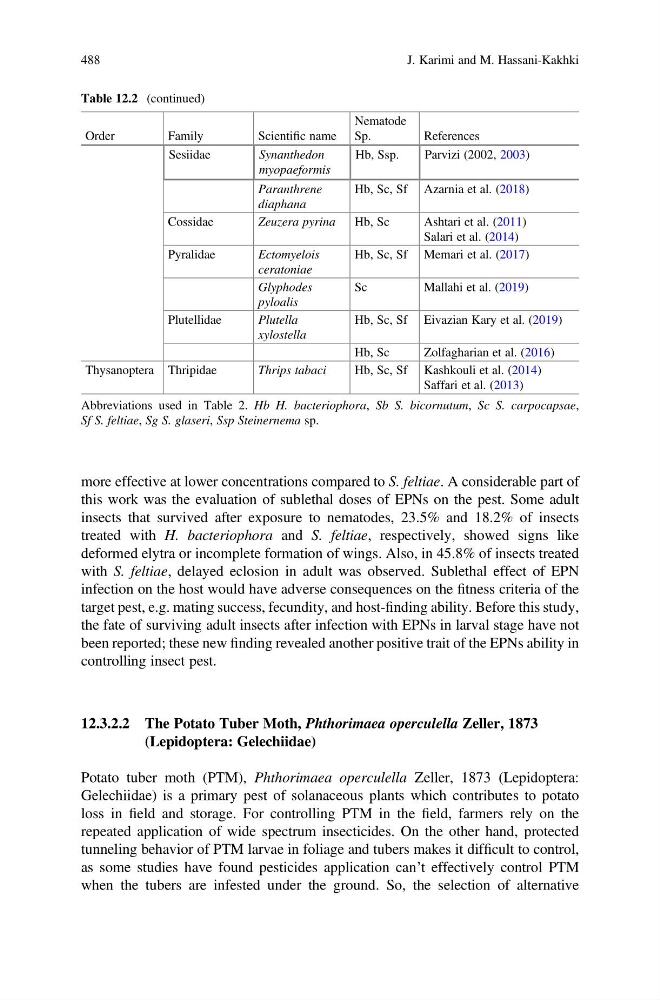
Table 12.2 (continued)
Order
Family
Scientific name
Nematode
Sp.
References
Sesiidae
Synanthedon
myopaeformis
Hb, Ssp.
Parvizi (2002, 2003)
Paranthrene
diaphana
Hb, Sc, Sf Azarnia et al. (2018)
Cossidae
Zeuzera pyrina
Hb, Sc
Ashtari et al. (2011)
Salari et al. (2014)
Pyralidae
Ectomyelois
ceratoniae
Hb, Sc, Sf Memari et al. (2017)
Glyphodes
pyloalis
Sc
Mallahi et al. (2019)
Plutellidae
Plutella
xylostella
Hb, Sc, Sf Eivazian Kary et al. (2019)
Hb, Sc
Zolfagharian et al. (2016)
Thysanoptera Thripidae
Thrips tabaci
Hb, Sc, Sf Kashkouli et al. (2014)
Saffari et al. (2013)
Abbreviations used in Table 2. Hb H. bacteriophora, Sb S. bicornutum, Sc S. carpocapsae,
Sf S. feltiae, Sg S. glaseri, Ssp Steinernema sp.
488
J. Karimi and M. Hassani-Kakhki
this work was the evaluation of sublethal doses of EPNs on the pest. Some adult
insects that survived after exposure to nematodes, 23.5% and 18.2% of insects
treated with H. bacteriophora and S. feltiae, respectively, showed signs like
deformed elytra or incomplete formation of wings. Also, in 45.8% of insects treated
with S. feltiae, delayed eclosion in adult was observed. Sublethal effect of EPN
infection on the host would have adverse consequences on the fitness criteria of the
target pest, e.g. mating success, fecundity, and host-finding ability. Before this study,
the fate of surviving adult insects after infection with EPNs in larval stage have not
been reported; these new finding revealed another positive trait of the EPNs ability in
controlling insect pest.
12.3.2.2 The Potato Tuber Moth, Phthorimaea operculella Zeller, 1873
(Lepidoptera: Gelechiidae)
Potato tuber moth (PTM), Phthorimaea operculella Zeller, 1873 (Lepidoptera:
Gelechiidae) is a primary pest of solanaceous plants which contributes to potato
loss in field and storage. For controlling PTM in the field, farmers rely on the
repeated application of wide spectrum insecticides. On the other hand, protected
tunneling behavior of PTM larvae in foliage and tubers makes it difficult to control,
as some studies have found pesticides application can’t effectively control PTM
when the tubers are infested under the ground. So, the selection of alternative
Table 12.2 (continued)
Order
Family
Scientific name
Nematode
Sp.
References
Sesiidae
Synanthedon
myopaeformis
Hb, Ssp.
Parvizi (2002, 2003)
Paranthrene
diaphana
Hb, Sc, Sf Azarnia et al. (2018)
Cossidae
Zeuzera pyrina
Hb, Sc
Ashtari et al. (2011)
Salari et al. (2014)
Pyralidae
Ectomyelois
ceratoniae
Hb, Sc, Sf Memari et al. (2017)
Glyphodes
pyloalis
Sc
Mallahi et al. (2019)
Plutellidae
Plutella
xylostella
Hb, Sc, Sf Eivazian Kary et al. (2019)
Hb, Sc
Zolfagharian et al. (2016)
Thysanoptera Thripidae
Thrips tabaci
Hb, Sc, Sf Kashkouli et al. (2014)
Saffari et al. (2013)
Abbreviations used in Table 2. Hb H. bacteriophora, Sb S. bicornutum, Sc S. carpocapsae,
Sf S. feltiae, Sg S. glaseri, Ssp Steinernema sp.
488
J. Karimi and M. Hassani-Kakhki