

12.3.2 Entomopathogenic Nematodes Experimental
Applications in Iran: Case Studies of Laboratory
and Greenhouse Experiments in Iran
Despite the knowledge on biological control programs in Iran, the use of EPNs has
been restricted to the research level, mainly due to the absence of EPN based
products on the Iran market. Only, a limited number of EPN products exist in
research centers currently. So, this chapter is a summary of some literature of carried
out studies which include laboratory or greenhouse trials about pathogenicity and
virulence of native or commercial species/populations of EPNs against certain pests
(summarized in Table 12.2).
12.3.2.1 The Colorado Potato Beetle, Leptinotarsa decemlineata Say,
1824 (Coleoptera: Chrysomelidae)
Among coleopterans, the Colorado potato beetle (CPB), Leptinotarsa decemlineata
Say, 1824 (Coleoptera: Chrysomelidae) is one of the most economically damaging
pests to potato, which developed resistance to the chemical insecticides. To assess
the potential of indigenous species of EPN on CPB, Eivazian et al. (2010b)
conducted a study using H. bacteriophora (four isolates), S. bicornutum,
S. carpocapsae and S. feltiae against CPB with three laboratory trials: filter paper
(on last larval instar), potato leaf (on last larval instar) and soil (on pre-pupa). In all
trials, H. bacteriophora caused the highest mortality and S. bicornutum had the
lowest mortality. In another study, Ebrahimi et al. (2011) assessed the lethal and
sublethal effects of two Iranian species of S. feltiae and H. bacteriophora on the
prepupal stage of the CPB, the life stage that EPNs can target in the soil. Results
revealed that both species were effective against CPB, but H. bacteriophora was
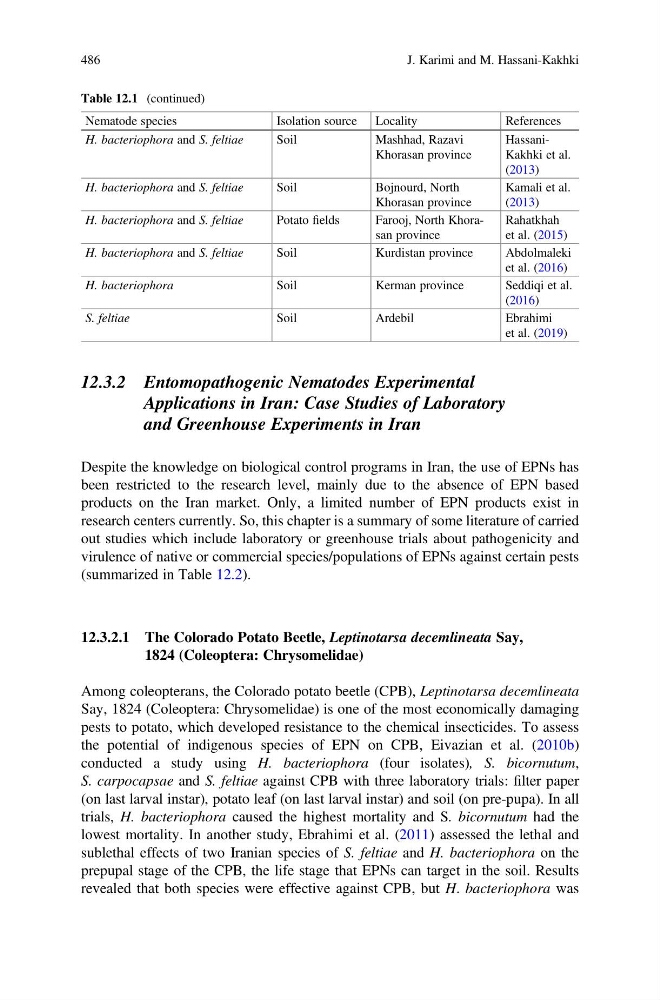
Table 12.1 (continued)
Nematode species
Isolation source Locality
References
H. bacteriophora and S. feltiae
Soil
Mashhad, Razavi
Khorasan province
HassaniKakhki et al.
(2013)
H. bacteriophora and S. feltiae
Soil
Bojnourd, North
Khorasan province
Kamali et al.
(2013)
H. bacteriophora and S. feltiae
Potato fields
Farooj, North Khorasan province
Rahatkhah
et al. (2015)
H. bacteriophora and S. feltiae
Soil
Kurdistan province
Abdolmaleki
et al. (2016)
H. bacteriophora
Soil
Kerman province
Seddiqi et al.
(2016)
S. feltiae
Soil
Ardebil
Ebrahimi
et al. (2019)
486
J. Karimi and M. Hassani-Kakhki
Applications in Iran: Case Studies of Laboratory
and Greenhouse Experiments in Iran
Despite the knowledge on biological control programs in Iran, the use of EPNs has
been restricted to the research level, mainly due to the absence of EPN based
products on the Iran market. Only, a limited number of EPN products exist in
research centers currently. So, this chapter is a summary of some literature of carried
out studies which include laboratory or greenhouse trials about pathogenicity and
virulence of native or commercial species/populations of EPNs against certain pests
(summarized in Table 12.2).
12.3.2.1 The Colorado Potato Beetle, Leptinotarsa decemlineata Say,
1824 (Coleoptera: Chrysomelidae)
Among coleopterans, the Colorado potato beetle (CPB), Leptinotarsa decemlineata
Say, 1824 (Coleoptera: Chrysomelidae) is one of the most economically damaging
pests to potato, which developed resistance to the chemical insecticides. To assess
the potential of indigenous species of EPN on CPB, Eivazian et al. (2010b)
conducted a study using H. bacteriophora (four isolates), S. bicornutum,
S. carpocapsae and S. feltiae against CPB with three laboratory trials: filter paper
(on last larval instar), potato leaf (on last larval instar) and soil (on pre-pupa). In all
trials, H. bacteriophora caused the highest mortality and S. bicornutum had the
lowest mortality. In another study, Ebrahimi et al. (2011) assessed the lethal and
sublethal effects of two Iranian species of S. feltiae and H. bacteriophora on the
prepupal stage of the CPB, the life stage that EPNs can target in the soil. Results
revealed that both species were effective against CPB, but H. bacteriophora was
Table 12.1 (continued)
Nematode species
Isolation source Locality
References
H. bacteriophora and S. feltiae
Soil
Mashhad, Razavi
Khorasan province
HassaniKakhki et al.
(2013)
H. bacteriophora and S. feltiae
Soil
Bojnourd, North
Khorasan province
Kamali et al.
(2013)
H. bacteriophora and S. feltiae
Potato fields
Farooj, North Khorasan province
Rahatkhah
et al. (2015)
H. bacteriophora and S. feltiae
Soil
Kurdistan province
Abdolmaleki
et al. (2016)
H. bacteriophora
Soil
Kerman province
Seddiqi et al.
(2016)
S. feltiae
Soil
Ardebil
Ebrahimi
et al. (2019)
486
J. Karimi and M. Hassani-Kakhki