

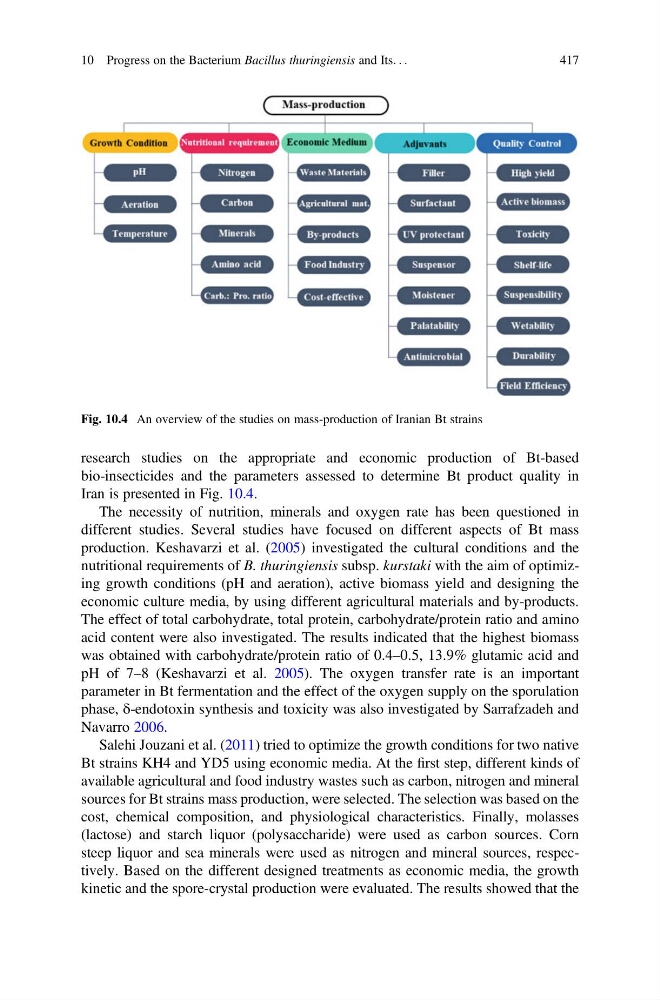
research studies on the appropriate and economic production of Bt-based
bio-insecticides and the parameters assessed to determine Bt product quality in
Iran is presented in Fig. 10.4.
The necessity of nutrition, minerals and oxygen rate has been questioned in
different studies. Several studies have focused on different aspects of Bt mass
production. Keshavarzi et al. (2005) investigated the cultural conditions and the
nutritional requirements of B. thuringiensis subsp. kurstaki with the aim of optimizing growth conditions (pH and aeration), active biomass yield and designing the
economic culture media, by using different agricultural materials and by-products.
The effect of total carbohydrate, total protein, carbohydrate/protein ratio and amino
acid content were also investigated. The results indicated that the highest biomass
was obtained with carbohydrate/protein ratio of 0.4–0.5, 13.9% glutamic acid and
pH of 7–8 (Keshavarzi et al. 2005). The oxygen transfer rate is an important
parameter in Bt fermentation and the effect of the oxygen supply on the sporulation
phase, δ-endotoxin synthesis and toxicity was also investigated by Sarrafzadeh and
Navarro 2006.
Salehi Jouzani et al. (2011) tried to optimize the growth conditions for two native
Bt strains KH4 and YD5 using economic media. At the first step, different kinds of
available agricultural and food industry wastes such as carbon, nitrogen and mineral
sources for Bt strains mass production, were selected. The selection was based on the
cost, chemical composition, and physiological characteristics. Finally, molasses
(lactose) and starch liquor (polysaccharide) were used as carbon sources. Corn
steep liquor and sea minerals were used as nitrogen and mineral sources, respectively. Based on the different designed treatments as economic media, the growth
kinetic and the spore-crystal production were evaluated. The results showed that the
Fig. 10.4 An overview of the studies on mass-production of Iranian Bt strains
10 Progress on the Bacterium Bacillus thuringiensis and Its. . .
417
bio-insecticides and the parameters assessed to determine Bt product quality in
Iran is presented in Fig. 10.4.
The necessity of nutrition, minerals and oxygen rate has been questioned in
different studies. Several studies have focused on different aspects of Bt mass
production. Keshavarzi et al. (2005) investigated the cultural conditions and the
nutritional requirements of B. thuringiensis subsp. kurstaki with the aim of optimizing growth conditions (pH and aeration), active biomass yield and designing the
economic culture media, by using different agricultural materials and by-products.
The effect of total carbohydrate, total protein, carbohydrate/protein ratio and amino
acid content were also investigated. The results indicated that the highest biomass
was obtained with carbohydrate/protein ratio of 0.4–0.5, 13.9% glutamic acid and
pH of 7–8 (Keshavarzi et al. 2005). The oxygen transfer rate is an important
parameter in Bt fermentation and the effect of the oxygen supply on the sporulation
phase, δ-endotoxin synthesis and toxicity was also investigated by Sarrafzadeh and
Navarro 2006.
Salehi Jouzani et al. (2011) tried to optimize the growth conditions for two native
Bt strains KH4 and YD5 using economic media. At the first step, different kinds of
available agricultural and food industry wastes such as carbon, nitrogen and mineral
sources for Bt strains mass production, were selected. The selection was based on the
cost, chemical composition, and physiological characteristics. Finally, molasses
(lactose) and starch liquor (polysaccharide) were used as carbon sources. Corn
steep liquor and sea minerals were used as nitrogen and mineral sources, respectively. Based on the different designed treatments as economic media, the growth
kinetic and the spore-crystal production were evaluated. The results showed that the
Fig. 10.4 An overview of the studies on mass-production of Iranian Bt strains
10 Progress on the Bacterium Bacillus thuringiensis and Its. . .
417