

9.5.2 Predators
Despite the relative trophic simplicity in the agroecosystems, the associated aphids
generally have a series of multiple natural enemies (Dixon 1998), interacting with
each other in various ways including predation (Snyder and Wise 1999; Symondson
et al. 2002). Direct and indirect interactions may occur through shared natural
enemies (predators and parasitoids) of the aphids, which may have various consequences both on community structure and biocontrol impact (van Veen et al. 2008).
The natural sequence of the parasitism on an aphid species starts usually prior to the
peak and increases in the population peak-decrease state. At this state, also the effect
and interactions with the other natural enemies becomes important. Immature stages
of the aphid parasitoids may be attacked by hyperparasitoids and the predators, as
well (Al-Rawy et al. 1969). This is a common trophic relation within the insect
communities (Rosenheim et al. 1995). The predatory insects normally kill the other
members of the same guild, therefore they reduce the potential competition and also
benefited by them as a food source. It is generally known as intra-guild predation
(Brodeur and Rosenheim 2000). The generalist predators like carabids interrupting
aphid population control by the specialist parasitoids. They are able to climb into
plants and prey upon the mummies, actively (Snyder and Ives 2001). The effects of
intra-guild predation cannot be defined in a simple way, since it is capable to produce
diverse impacts on biological control of herbivorous insects (Diehl 1993).
The aphids attacked by the parasitoids, usually remain active on the host plants
and continue feeding and even producing few number of progenies. The parasitized
aphids becoming less active with growth of the parasitoids, while staying among the
colonies or leaving for the nearby branches/leaves, being mummified. The dead
aphids containing the mature larva or pupa of parasitoid may be more vulnerable
comparing to the healthy aphids. Larvae and adults of various species of
coccinellids, larvae of the lacewings, adults and nymphs of the anthocorids and
nabids, as well as the larvae of syrphid flies and chamaemyiids are the major
predatory guild members associated with aphid colonies, many of them are generalist and are not strictly dependent to their host. The predatory insects like
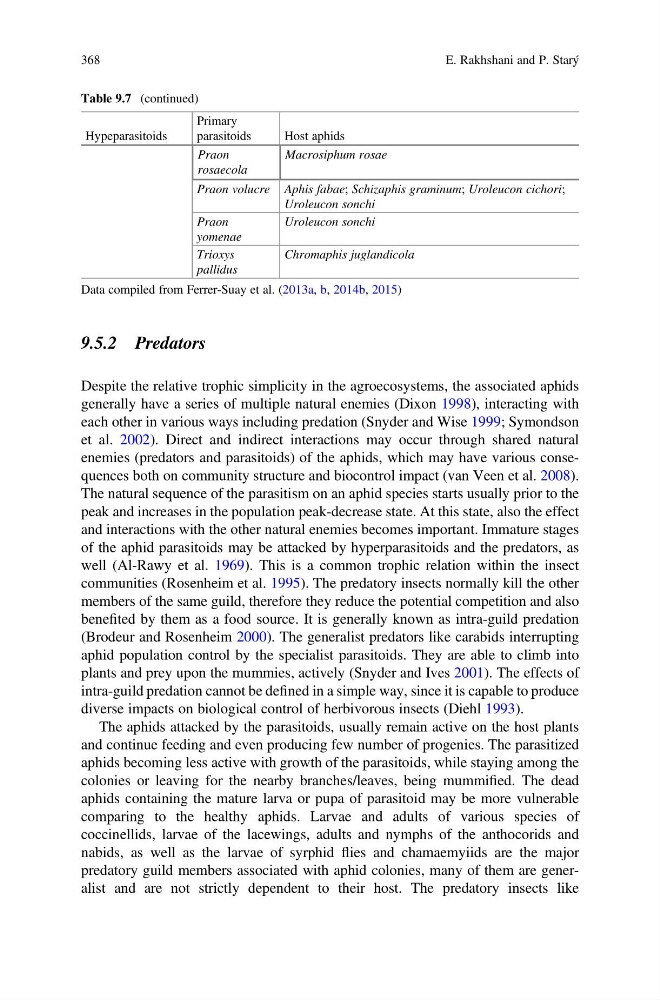
Table 9.7 (continued)
Hypeparasitoids
Primary
parasitoids
Host aphids
Praon
rosaecola
Macrosiphum rosae
Praon volucre Aphis fabae; Schizaphis graminum; Uroleucon cichori;
Uroleucon sonchi
Praon
yomenae
Uroleucon sonchi
Trioxys
pallidus
Chromaphis juglandicola
Data compiled from Ferrer-Suay et al. (2013a, b, 2014b, 2015)
368
E. Rakhshani and P. Starý
Despite the relative trophic simplicity in the agroecosystems, the associated aphids
generally have a series of multiple natural enemies (Dixon 1998), interacting with
each other in various ways including predation (Snyder and Wise 1999; Symondson
et al. 2002). Direct and indirect interactions may occur through shared natural
enemies (predators and parasitoids) of the aphids, which may have various consequences both on community structure and biocontrol impact (van Veen et al. 2008).
The natural sequence of the parasitism on an aphid species starts usually prior to the
peak and increases in the population peak-decrease state. At this state, also the effect
and interactions with the other natural enemies becomes important. Immature stages
of the aphid parasitoids may be attacked by hyperparasitoids and the predators, as
well (Al-Rawy et al. 1969). This is a common trophic relation within the insect
communities (Rosenheim et al. 1995). The predatory insects normally kill the other
members of the same guild, therefore they reduce the potential competition and also
benefited by them as a food source. It is generally known as intra-guild predation
(Brodeur and Rosenheim 2000). The generalist predators like carabids interrupting
aphid population control by the specialist parasitoids. They are able to climb into
plants and prey upon the mummies, actively (Snyder and Ives 2001). The effects of
intra-guild predation cannot be defined in a simple way, since it is capable to produce
diverse impacts on biological control of herbivorous insects (Diehl 1993).
The aphids attacked by the parasitoids, usually remain active on the host plants
and continue feeding and even producing few number of progenies. The parasitized
aphids becoming less active with growth of the parasitoids, while staying among the
colonies or leaving for the nearby branches/leaves, being mummified. The dead
aphids containing the mature larva or pupa of parasitoid may be more vulnerable
comparing to the healthy aphids. Larvae and adults of various species of
coccinellids, larvae of the lacewings, adults and nymphs of the anthocorids and
nabids, as well as the larvae of syrphid flies and chamaemyiids are the major
predatory guild members associated with aphid colonies, many of them are generalist and are not strictly dependent to their host. The predatory insects like
Table 9.7 (continued)
Hypeparasitoids
Primary
parasitoids
Host aphids
Praon
rosaecola
Macrosiphum rosae
Praon volucre Aphis fabae; Schizaphis graminum; Uroleucon cichori;
Uroleucon sonchi
Praon
yomenae
Uroleucon sonchi
Trioxys
pallidus
Chromaphis juglandicola
Data compiled from Ferrer-Suay et al. (2013a, b, 2014b, 2015)
368
E. Rakhshani and P. Starý