

enemies by different level of adaptations (Addicott 1979). In the case of some aphid
parasitoids, higher rate of oviposition was observed in ant attended colonies (Völkl
and Novak 1997) indicating they could overcome this protection by some adaptations. The root aphid parasitoid, Paralipsis enervis (not recorded from Iran) is a
highly evolved species co-existing in the ant attended aphid colonies. The ants may
mutilate large portions of its wings, but leave it alive, dispersing flightless (Starý
1970a, b). The parasitoid is believed to acquire some of the ants cuticular hydrocarbons by rubbing her legs and body on them, and become readily accepted to the ants
(Takada and Hashimoto 1985).
Lysiphlebus fabarum has taken more stages of adaptation. It might be unique in
soliciting honeydew secretion from the aphid host by the ant mimicry. Consequently, aphids serve both as hosts and as a source of necessary hydrocarbon for
the adult females. Experienced female parasitoid also performing an ant-like
antennation to reduce the defensive behavior of the host aphid (Aphis fabae),
which is mainly the frequent kicking by the hind legs. In such a peculiar case, the
mutualisms seem to evolve between L. fabarum and the ants instead of the aphids, so
that the progeny of L. fabarum also receive ant protection against the predators and
secondary parasitoids (Rasekh et al. 2010e). Other parasitoids of the same aphids
greatly suffered from the hyperparasitism caused by lack of the ants in the colonies
that the female parasitoids preferred for oviposition (Völkl 1992). The same behavior has also been recorded in some other Lysiphlebus species (Kaneko 2002), but ant
attendance had a negative effect on the efficiency of Lysiphlebus testaceipes
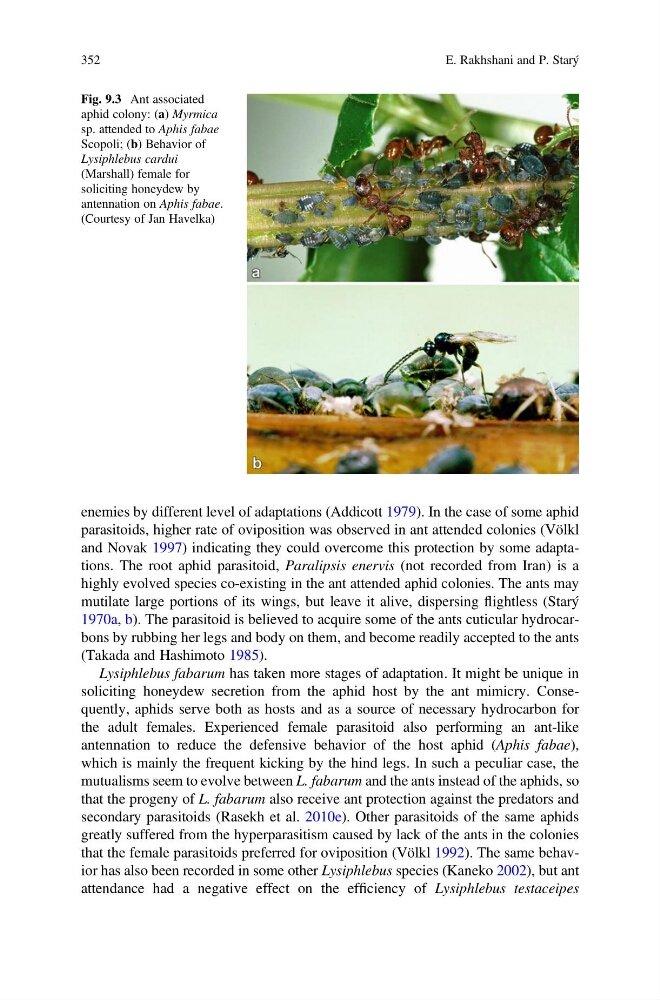
Fig. 9.3 Ant associated
aphid colony: (a) Myrmica
sp. attended to Aphis fabae
Scopoli; (b) Behavior of
Lysiphlebus cardui
(Marshall) female for
soliciting honeydew by
antennation on Aphis fabae.
(Courtesy of Jan Havelka)
352
E. Rakhshani and P. Starý
parasitoids, higher rate of oviposition was observed in ant attended colonies (Völkl
and Novak 1997) indicating they could overcome this protection by some adaptations. The root aphid parasitoid, Paralipsis enervis (not recorded from Iran) is a
highly evolved species co-existing in the ant attended aphid colonies. The ants may
mutilate large portions of its wings, but leave it alive, dispersing flightless (Starý
1970a, b). The parasitoid is believed to acquire some of the ants cuticular hydrocarbons by rubbing her legs and body on them, and become readily accepted to the ants
(Takada and Hashimoto 1985).
Lysiphlebus fabarum has taken more stages of adaptation. It might be unique in
soliciting honeydew secretion from the aphid host by the ant mimicry. Consequently, aphids serve both as hosts and as a source of necessary hydrocarbon for
the adult females. Experienced female parasitoid also performing an ant-like
antennation to reduce the defensive behavior of the host aphid (Aphis fabae),
which is mainly the frequent kicking by the hind legs. In such a peculiar case, the
mutualisms seem to evolve between L. fabarum and the ants instead of the aphids, so
that the progeny of L. fabarum also receive ant protection against the predators and
secondary parasitoids (Rasekh et al. 2010e). Other parasitoids of the same aphids
greatly suffered from the hyperparasitism caused by lack of the ants in the colonies
that the female parasitoids preferred for oviposition (Völkl 1992). The same behavior has also been recorded in some other Lysiphlebus species (Kaneko 2002), but ant
attendance had a negative effect on the efficiency of Lysiphlebus testaceipes
Fig. 9.3 Ant associated
aphid colony: (a) Myrmica
sp. attended to Aphis fabae
Scopoli; (b) Behavior of
Lysiphlebus cardui
(Marshall) female for
soliciting honeydew by
antennation on Aphis fabae.
(Courtesy of Jan Havelka)
352
E. Rakhshani and P. Starý