

the mixed-aged aphid colonies of its adapted host and do what the natural selection
already defined.
The female parasitoids generally try to decrease the risks for their progenies by
selecting the most appropriate host stage (Pyke 1984), while it may be affected by
the various factors (Jervis and Kidd 1996). The size of the host aphids, depending to
the nymphal instar influences directly biological characteristics of the adult emerging parasitoids, including size (Sequeira and Mackauer 1992b), developmental time
(Sequeira and Mackauer 1992a), fecundity (Hägvar and Hofsvang 1990) and sex
ratio (Cloutier et al. 2000) that can be defined by the behavior of foraging female at
the time of ovipostion. The aphid parasitoids showed a moderately different pattern
of host stage preference in laboratory conditions (Rakhshani et al. 2004a;
Takalloozadeh et al. 2004a; Talebi et al. 2006; Tahriri et al. 2007; Tazerouni et al.
2011; Farhad et al. 2011; Jokar et al. 2012; Pasandideh et al. 2015; Najafpour et al.
2016), which may be altered in natural condition (Sequeira and Mackauer 1993).
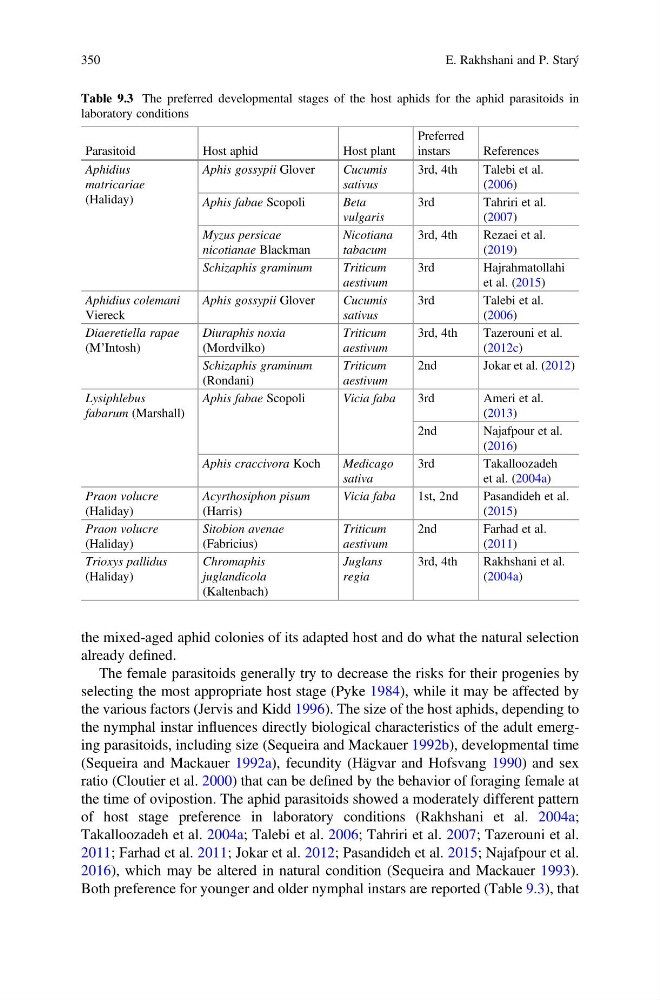
Both preference for younger and older nymphal instars are reported (Table 9.3), that
Table 9.3 The preferred developmental stages of the host aphids for the aphid parasitoids in
laboratory conditions
Parasitoid
Host aphid
Host plant
Preferred
instars
References
Aphidius
matricariae
(Haliday)
Aphis gossypii Glover
Cucumis
sativus
3rd, 4th
Talebi et al.
(2006)
Aphis fabae Scopoli
Beta
vulgaris
3rd
Tahriri et al.
(2007)
Myzus persicae
nicotianae Blackman
Nicotiana
tabacum
3rd, 4th
Rezaei et al.
(2019)
Schizaphis graminum
Triticum
aestivum
3rd
Hajrahmatollahi
et al. (2015)
Aphidius colemani
Viereck
Aphis gossypii Glover
Cucumis
sativus
3rd
Talebi et al.
(2006)
Diaeretiella rapae
(M’Intosh)
Diuraphis noxia
(Mordvilko)
Triticum
aestivum
3rd, 4th
Tazerouni et al.
(2012c)
Schizaphis graminum
(Rondani)
Triticum
aestivum
2nd
Jokar et al. (2012)
Lysiphlebus
fabarum (Marshall)
Aphis fabae Scopoli
Vicia faba
3rd
Ameri et al.
(2013)
2nd
Najafpour et al.
(2016)
Aphis craccivora Koch
Medicago
sativa
3rd
Takalloozadeh
et al. (2004a)
Praon volucre
(Haliday)
Acyrthosiphon pisum
(Harris)
Vicia faba
1st, 2nd
Pasandideh et al.
(2015)
Praon volucre
(Haliday)
Sitobion avenae
(Fabricius)
Triticum
aestivum
2nd
Farhad et al.
(2011)
Trioxys pallidus
(Haliday)
Chromaphis
juglandicola
(Kaltenbach)
Juglans
regia
3rd, 4th
Rakhshani et al.
(2004a)
350
E. Rakhshani and P. Starý
already defined.
The female parasitoids generally try to decrease the risks for their progenies by
selecting the most appropriate host stage (Pyke 1984), while it may be affected by
the various factors (Jervis and Kidd 1996). The size of the host aphids, depending to
the nymphal instar influences directly biological characteristics of the adult emerging parasitoids, including size (Sequeira and Mackauer 1992b), developmental time
(Sequeira and Mackauer 1992a), fecundity (Hägvar and Hofsvang 1990) and sex
ratio (Cloutier et al. 2000) that can be defined by the behavior of foraging female at
the time of ovipostion. The aphid parasitoids showed a moderately different pattern
of host stage preference in laboratory conditions (Rakhshani et al. 2004a;
Takalloozadeh et al. 2004a; Talebi et al. 2006; Tahriri et al. 2007; Tazerouni et al.
2011; Farhad et al. 2011; Jokar et al. 2012; Pasandideh et al. 2015; Najafpour et al.
2016), which may be altered in natural condition (Sequeira and Mackauer 1993).
Both preference for younger and older nymphal instars are reported (Table 9.3), that
Table 9.3 The preferred developmental stages of the host aphids for the aphid parasitoids in
laboratory conditions
Parasitoid
Host aphid
Host plant
Preferred
instars
References
Aphidius
matricariae
(Haliday)
Aphis gossypii Glover
Cucumis
sativus
3rd, 4th
Talebi et al.
(2006)
Aphis fabae Scopoli
Beta
vulgaris
3rd
Tahriri et al.
(2007)
Myzus persicae
nicotianae Blackman
Nicotiana
tabacum
3rd, 4th
Rezaei et al.
(2019)
Schizaphis graminum
Triticum
aestivum
3rd
Hajrahmatollahi
et al. (2015)
Aphidius colemani
Viereck
Aphis gossypii Glover
Cucumis
sativus
3rd
Talebi et al.
(2006)
Diaeretiella rapae
(M’Intosh)
Diuraphis noxia
(Mordvilko)
Triticum
aestivum
3rd, 4th
Tazerouni et al.
(2012c)
Schizaphis graminum
(Rondani)
Triticum
aestivum
2nd
Jokar et al. (2012)
Lysiphlebus
fabarum (Marshall)
Aphis fabae Scopoli
Vicia faba
3rd
Ameri et al.
(2013)
2nd
Najafpour et al.
(2016)
Aphis craccivora Koch
Medicago
sativa
3rd
Takalloozadeh
et al. (2004a)
Praon volucre
(Haliday)
Acyrthosiphon pisum
(Harris)
Vicia faba
1st, 2nd
Pasandideh et al.
(2015)
Praon volucre
(Haliday)
Sitobion avenae
(Fabricius)
Triticum
aestivum
2nd
Farhad et al.
(2011)
Trioxys pallidus
(Haliday)
Chromaphis
juglandicola
(Kaltenbach)
Juglans
regia
3rd, 4th
Rakhshani et al.
(2004a)
350
E. Rakhshani and P. Starý