

aphid haemolymph for subsequent regulation of the host development (Falabella
et al. 2000). The larva starts feeding the internal body of its host and the aphid will
then being killed upon final feeding steps by the mature mandibulate larva. At the
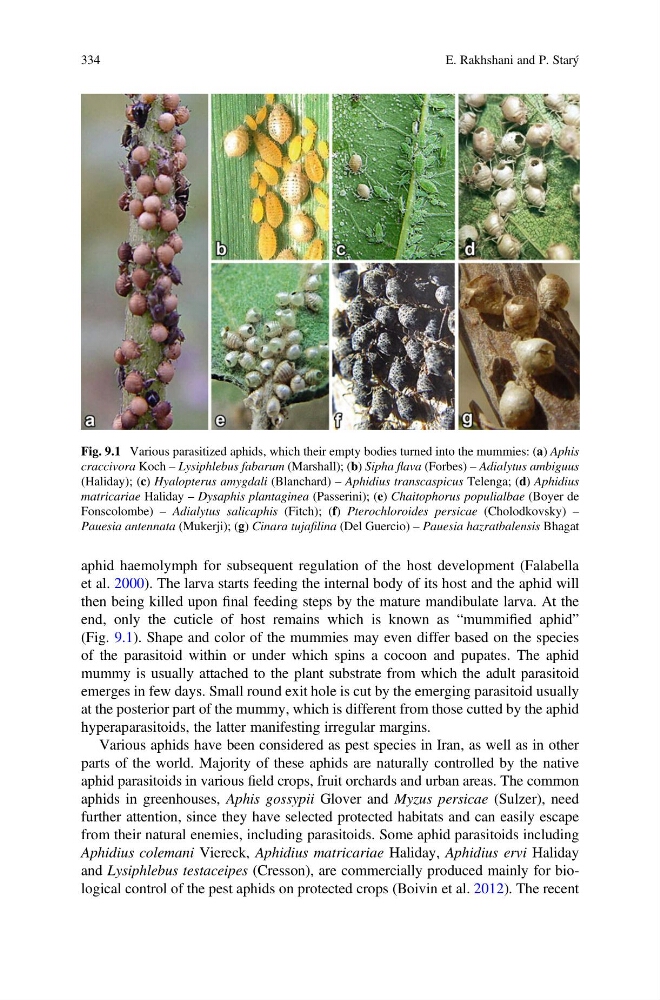
end, only the cuticle of host remains which is known as “mummified aphid”
(Fig. 9.1). Shape and color of the mummies may even differ based on the species
of the parasitoid within or under which spins a cocoon and pupates. The aphid
mummy is usually attached to the plant substrate from which the adult parasitoid
emerges in few days. Small round exit hole is cut by the emerging parasitoid usually
at the posterior part of the mummy, which is different from those cutted by the aphid
hyperaparasitoids, the latter manifesting irregular margins.
Various aphids have been considered as pest species in Iran, as well as in other
parts of the world. Majority of these aphids are naturally controlled by the native
aphid parasitoids in various field crops, fruit orchards and urban areas. The common
aphids in greenhouses, Aphis gossypii Glover and Myzus persicae (Sulzer), need
further attention, since they have selected protected habitats and can easily escape
from their natural enemies, including parasitoids. Some aphid parasitoids including
Aphidius colemani Viereck, Aphidius matricariae Haliday, Aphidius ervi Haliday
and Lysiphlebus testaceipes (Cresson), are commercially produced mainly for biological control of the pest aphids on protected crops (Boivin et al. 2012). The recent
Fig. 9.1 Various parasitized aphids, which their empty bodies turned into the mummies: (a) Aphis
craccivora Koch – Lysiphlebus fabarum (Marshall); (b) Sipha flava (Forbes) – Adialytus ambiguus
(Haliday); (c) Hyalopterus amygdali (Blanchard) – Aphidius transcaspicus Telenga; (d) Aphidius
matricariae Haliday – Dysaphis plantaginea (Passerini); (e) Chaitophorus populialbae (Boyer de
Fonscolombe) – Adialytus salicaphis (Fitch); (f) Pterochloroides persicae (Cholodkovsky) –
Pauesia antennata (Mukerji); (g) Cinara tujafilina (Del Guercio) – Pauesia hazratbalensis Bhagat
334
E. Rakhshani and P. Starý
et al. 2000). The larva starts feeding the internal body of its host and the aphid will
then being killed upon final feeding steps by the mature mandibulate larva. At the
end, only the cuticle of host remains which is known as “mummified aphid”
(Fig. 9.1). Shape and color of the mummies may even differ based on the species
of the parasitoid within or under which spins a cocoon and pupates. The aphid
mummy is usually attached to the plant substrate from which the adult parasitoid
emerges in few days. Small round exit hole is cut by the emerging parasitoid usually
at the posterior part of the mummy, which is different from those cutted by the aphid
hyperaparasitoids, the latter manifesting irregular margins.
Various aphids have been considered as pest species in Iran, as well as in other
parts of the world. Majority of these aphids are naturally controlled by the native
aphid parasitoids in various field crops, fruit orchards and urban areas. The common
aphids in greenhouses, Aphis gossypii Glover and Myzus persicae (Sulzer), need
further attention, since they have selected protected habitats and can easily escape
from their natural enemies, including parasitoids. Some aphid parasitoids including
Aphidius colemani Viereck, Aphidius matricariae Haliday, Aphidius ervi Haliday
and Lysiphlebus testaceipes (Cresson), are commercially produced mainly for biological control of the pest aphids on protected crops (Boivin et al. 2012). The recent
Fig. 9.1 Various parasitized aphids, which their empty bodies turned into the mummies: (a) Aphis
craccivora Koch – Lysiphlebus fabarum (Marshall); (b) Sipha flava (Forbes) – Adialytus ambiguus
(Haliday); (c) Hyalopterus amygdali (Blanchard) – Aphidius transcaspicus Telenga; (d) Aphidius
matricariae Haliday – Dysaphis plantaginea (Passerini); (e) Chaitophorus populialbae (Boyer de
Fonscolombe) – Adialytus salicaphis (Fitch); (f) Pterochloroides persicae (Cholodkovsky) –
Pauesia antennata (Mukerji); (g) Cinara tujafilina (Del Guercio) – Pauesia hazratbalensis Bhagat
334
E. Rakhshani and P. Starý