

7.3.5 Eurytomidae
The family is present and common in all zoogeographical regions. Eurytomids
exhibit a wide range of life histories, but the majority of the larvae are endophytic:
as seed feeders, gall formers, or parasitoids of phytophagous insects. Most
eurytomids are primary or secondary parasitoids, attacking eggs, larvae, or pupae
of various arthropods (Diptera, Coleoptera, Hymenoptera, Lepidoptera, Orthoptera,
and Araneae) (Lotfalizadeh et al. 2007a, 2007b).
Several studies on Iranian fauna, e.g. Hedicke (1921), Bouček (1952, 1970,
1977), Nikol’skaya (1952) and Burks (1971) contain some faunistic reports on
Iranian Eurytomidae. Modarres-Awal (1997) cited eight valid species of eurytomids
in his list of agricultural pests and their natural enemies in Iran. In recent years some
faunistic studies have been done on Iranian Eurytomidae and some new species have
been described (Narendran and Lotfalizadeh 1999; Zerova et al. 2004; Lotfalizadeh
et al. 2007a, 2007b; Zerova et al. 2008; Saghaei et al. 2018).
This family composited 89 species belonging to 8 genera Aximopsis,
Bruchophagus, Eurytoma, Exeurytoma, Macrorileya, Sycophila, Systole and
Tetramesa. Of the 8 genera, Eurytoma (41 species, 46.06%) and Bruchophagus
(19 species, 21.34%) are the most specious.
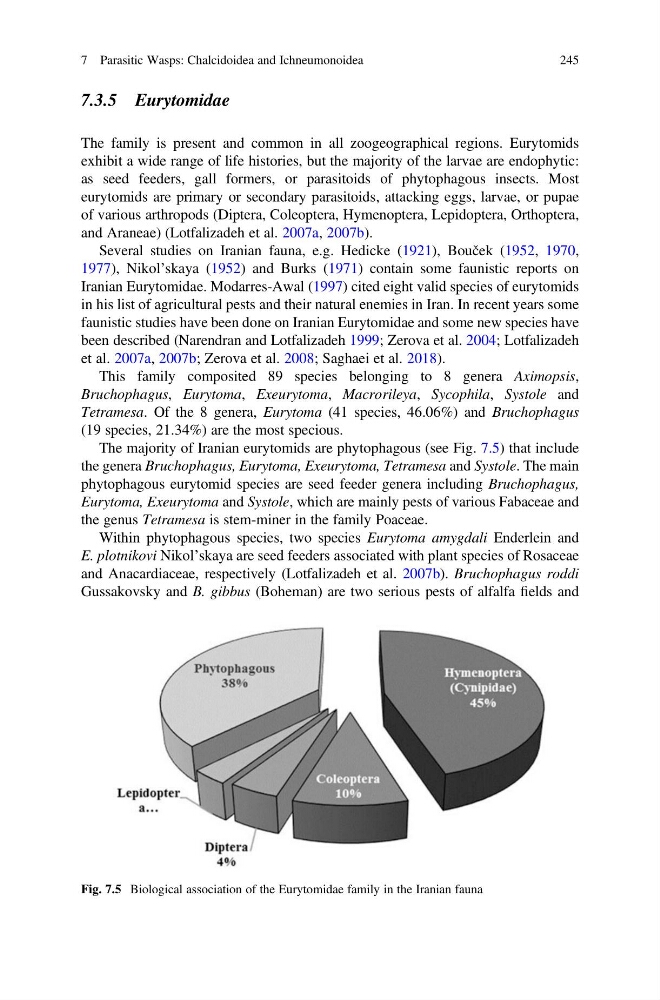
The majority of Iranian eurytomids are phytophagous (see Fig. 7.5) that include
the genera Bruchophagus, Eurytoma, Exeurytoma, Tetramesa and Systole. The main
phytophagous eurytomid species are seed feeder genera including Bruchophagus,
Eurytoma, Exeurytoma and Systole, which are mainly pests of various Fabaceae and
the genus Tetramesa is stem-miner in the family Poaceae.
Within phytophagous species, two species Eurytoma amygdali Enderlein and
E. plotnikovi Nikol’skaya are seed feeders associated with plant species of Rosaceae
and Anacardiaceae, respectively (Lotfalizadeh et al. 2007b). Bruchophagus roddi
Gussakovsky and B. gibbus (Boheman) are two serious pests of alfalfa fields and
Fig. 7.5 Biological association of the Eurytomidae family in the Iranian fauna
7 Parasitic Wasps: Chalcidoidea and Ichneumonoidea
245
The family is present and common in all zoogeographical regions. Eurytomids
exhibit a wide range of life histories, but the majority of the larvae are endophytic:
as seed feeders, gall formers, or parasitoids of phytophagous insects. Most
eurytomids are primary or secondary parasitoids, attacking eggs, larvae, or pupae
of various arthropods (Diptera, Coleoptera, Hymenoptera, Lepidoptera, Orthoptera,
and Araneae) (Lotfalizadeh et al. 2007a, 2007b).
Several studies on Iranian fauna, e.g. Hedicke (1921), Bouček (1952, 1970,
1977), Nikol’skaya (1952) and Burks (1971) contain some faunistic reports on
Iranian Eurytomidae. Modarres-Awal (1997) cited eight valid species of eurytomids
in his list of agricultural pests and their natural enemies in Iran. In recent years some
faunistic studies have been done on Iranian Eurytomidae and some new species have
been described (Narendran and Lotfalizadeh 1999; Zerova et al. 2004; Lotfalizadeh
et al. 2007a, 2007b; Zerova et al. 2008; Saghaei et al. 2018).
This family composited 89 species belonging to 8 genera Aximopsis,
Bruchophagus, Eurytoma, Exeurytoma, Macrorileya, Sycophila, Systole and
Tetramesa. Of the 8 genera, Eurytoma (41 species, 46.06%) and Bruchophagus
(19 species, 21.34%) are the most specious.
The majority of Iranian eurytomids are phytophagous (see Fig. 7.5) that include
the genera Bruchophagus, Eurytoma, Exeurytoma, Tetramesa and Systole. The main
phytophagous eurytomid species are seed feeder genera including Bruchophagus,
Eurytoma, Exeurytoma and Systole, which are mainly pests of various Fabaceae and
the genus Tetramesa is stem-miner in the family Poaceae.
Within phytophagous species, two species Eurytoma amygdali Enderlein and
E. plotnikovi Nikol’skaya are seed feeders associated with plant species of Rosaceae
and Anacardiaceae, respectively (Lotfalizadeh et al. 2007b). Bruchophagus roddi
Gussakovsky and B. gibbus (Boheman) are two serious pests of alfalfa fields and
Fig. 7.5 Biological association of the Eurytomidae family in the Iranian fauna
7 Parasitic Wasps: Chalcidoidea and Ichneumonoidea
245