

It includes species which are parasitoids of insects from many orders and also
mites. Many eulophid wasps attack pests of several forests, agricultural and fruit
plants. They can regulate numbers of their hosts in natural conditions.
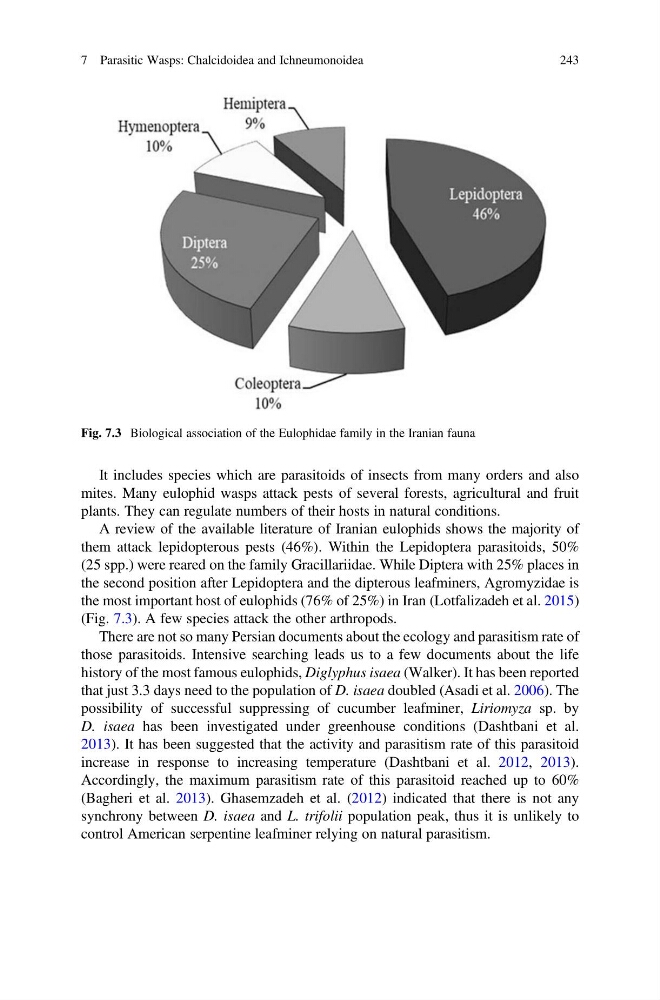
A review of the available literature of Iranian eulophids shows the majority of
them attack lepidopterous pests (46%). Within the Lepidoptera parasitoids, 50%
(25 spp.) were reared on the family Gracillariidae. While Diptera with 25% places in
the second position after Lepidoptera and the dipterous leafminers, Agromyzidae is
the most important host of eulophids (76% of 25%) in Iran (Lotfalizadeh et al. 2015)
(Fig. 7.3). A few species attack the other arthropods.
There are not so many Persian documents about the ecology and parasitism rate of
those parasitoids. Intensive searching leads us to a few documents about the life
history of the most famous eulophids, Diglyphus isaea (Walker). It has been reported
that just 3.3 days need to the population of D. isaea doubled (Asadi et al. 2006). The
possibility of successful suppressing of cucumber leafminer, Liriomyza sp. by
D. isaea has been investigated under greenhouse conditions (Dashtbani et al.
2013). It has been suggested that the activity and parasitism rate of this parasitoid
increase in response to increasing temperature (Dashtbani et al. 2012, 2013).
Accordingly, the maximum parasitism rate of this parasitoid reached up to 60%
(Bagheri et al. 2013). Ghasemzadeh et al. (2012) indicated that there is not any
synchrony between D. isaea and L. trifolii population peak, thus it is unlikely to
control American serpentine leafminer relying on natural parasitism.
Fig. 7.3 Biological association of the Eulophidae family in the Iranian fauna
7 Parasitic Wasps: Chalcidoidea and Ichneumonoidea
243
mites. Many eulophid wasps attack pests of several forests, agricultural and fruit
plants. They can regulate numbers of their hosts in natural conditions.
A review of the available literature of Iranian eulophids shows the majority of
them attack lepidopterous pests (46%). Within the Lepidoptera parasitoids, 50%
(25 spp.) were reared on the family Gracillariidae. While Diptera with 25% places in
the second position after Lepidoptera and the dipterous leafminers, Agromyzidae is
the most important host of eulophids (76% of 25%) in Iran (Lotfalizadeh et al. 2015)
(Fig. 7.3). A few species attack the other arthropods.
There are not so many Persian documents about the ecology and parasitism rate of
those parasitoids. Intensive searching leads us to a few documents about the life
history of the most famous eulophids, Diglyphus isaea (Walker). It has been reported
that just 3.3 days need to the population of D. isaea doubled (Asadi et al. 2006). The
possibility of successful suppressing of cucumber leafminer, Liriomyza sp. by
D. isaea has been investigated under greenhouse conditions (Dashtbani et al.
2013). It has been suggested that the activity and parasitism rate of this parasitoid
increase in response to increasing temperature (Dashtbani et al. 2012, 2013).
Accordingly, the maximum parasitism rate of this parasitoid reached up to 60%
(Bagheri et al. 2013). Ghasemzadeh et al. (2012) indicated that there is not any
synchrony between D. isaea and L. trifolii population peak, thus it is unlikely to
control American serpentine leafminer relying on natural parasitism.
Fig. 7.3 Biological association of the Eulophidae family in the Iranian fauna
7 Parasitic Wasps: Chalcidoidea and Ichneumonoidea
243