

The diversity of hymenopterous parasitoids was studied in the northwest of Iran.
This study showed the most of these parasitoids belong to the family Eulophidae
(93%) including two subfamilies (Eulophinae and Entedoninae). Amongst reared
parasitoids, Diglyphus isaea (Walker) was the most common species and had the
highest frequency.
7.2.7 Grape Berry Moth Parasitoids
The hymenopterous parasitoids of grape berry moth Lobesia botrana (Denis and
Schiffermüller) (Lep.: Tortricidae) in Iran were studied sparsely. This aggregation
includes 12 species belong to five families Bethylidae, Braconidae, Ichneumonidae,
Pteromalidae and Trichogramatidae are listed as egg (two species), larval (nine
species) and pupal (four species) parasitoids (Table 7.4). During this study, two
species Dibrachys affinis Masi (Hym.: Pteromalidae, Pteromalinae) and Itoplectis
alternans (Gravenhorst) (Hym.: Ichneumonidae, Pimplinae) are new records for
Iranian insect fauna and larval parasitoid of L. botrana. Finally, all of the hymenopterous parasitoids of grape berry moth in Iran were reviewed.
Noyes (2018) listed 28 chalcidoid species as reported parasitoids of grape berry
moth worldwide. These parasitoids attack to different life stages of L. botrana.
About half of these attacks to larvae and are larval parasitoid and the rest attack
pupa (Akbarzadeh-Shoukat et al. 2008b). Based on Akbarzadeh-Shoukat et al.
(2008a), the rate of larval parasitism of L. botrana varied from 1% to 16.8% (average
6.33%). This parasitism was significantly different in other localities and the pest
generations, but the maximum rate of parasitism was in the first generation of
the pest.
Within this list, T. ingricum has not been reported as a parasitoid of L. botrana. It
is widely distributed in the north and north-west of Iran as parasitoid of L. botrana,
Cydia pomonella (L.) and Chilo supressalis Walker (Ebrahimi and AkbarzadehShoukat 2008). Suppressing potential of T. ingricum on L. botrana was assessed by
about 60% in Urmia vineyards (Akbarzadeh-Shoukat and Ebrahimi 2008). They
reported that it is widely distributed in this region with 40–50% parasitism rate in the
first generation of L. botrana.
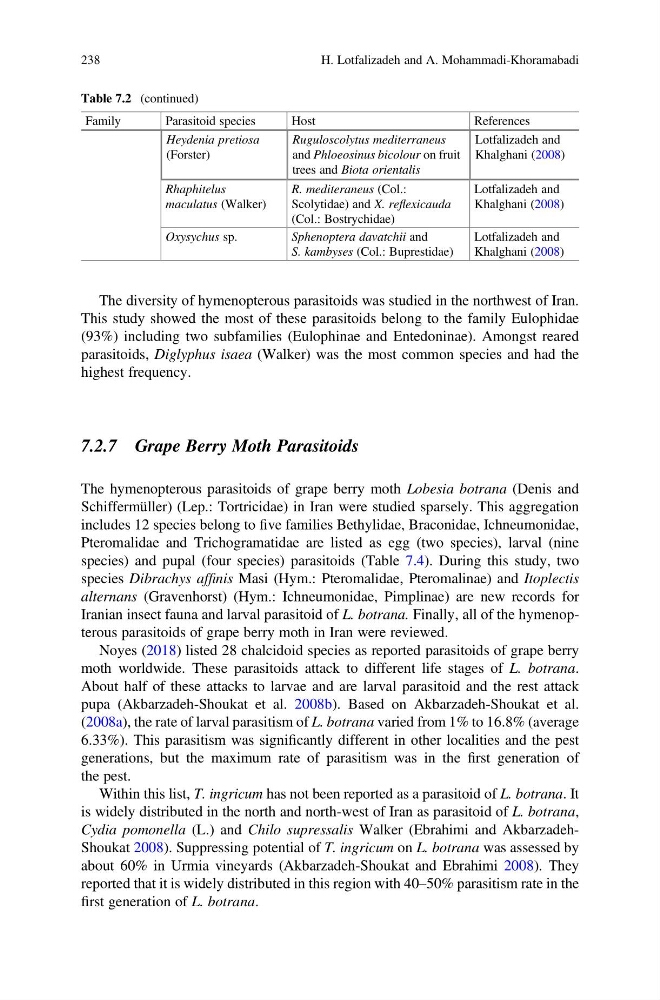
Table 7.2 (continued)
Family
Parasitoid species
Host
References
Heydenia pretiosa
(Forster)
Ruguloscolytus mediterraneus
and Phloeosinus bicolour on fruit
trees and Biota orientalis
Lotfalizadeh and
Khalghani (2008)
Rhaphitelus
maculatus (Walker)
R. mediteraneus (Col.:
Scolytidae) and X. reflexicauda
(Col.: Bostrychidae)
Lotfalizadeh and
Khalghani (2008)
Oxysychus sp.
Sphenoptera davatchii and
S. kambyses (Col.: Buprestidae)
Lotfalizadeh and
Khalghani (2008)
238
H. Lotfalizadeh and A. Mohammadi-Khoramabadi
This study showed the most of these parasitoids belong to the family Eulophidae
(93%) including two subfamilies (Eulophinae and Entedoninae). Amongst reared
parasitoids, Diglyphus isaea (Walker) was the most common species and had the
highest frequency.
7.2.7 Grape Berry Moth Parasitoids
The hymenopterous parasitoids of grape berry moth Lobesia botrana (Denis and
Schiffermüller) (Lep.: Tortricidae) in Iran were studied sparsely. This aggregation
includes 12 species belong to five families Bethylidae, Braconidae, Ichneumonidae,
Pteromalidae and Trichogramatidae are listed as egg (two species), larval (nine
species) and pupal (four species) parasitoids (Table 7.4). During this study, two
species Dibrachys affinis Masi (Hym.: Pteromalidae, Pteromalinae) and Itoplectis
alternans (Gravenhorst) (Hym.: Ichneumonidae, Pimplinae) are new records for
Iranian insect fauna and larval parasitoid of L. botrana. Finally, all of the hymenopterous parasitoids of grape berry moth in Iran were reviewed.
Noyes (2018) listed 28 chalcidoid species as reported parasitoids of grape berry
moth worldwide. These parasitoids attack to different life stages of L. botrana.
About half of these attacks to larvae and are larval parasitoid and the rest attack
pupa (Akbarzadeh-Shoukat et al. 2008b). Based on Akbarzadeh-Shoukat et al.
(2008a), the rate of larval parasitism of L. botrana varied from 1% to 16.8% (average
6.33%). This parasitism was significantly different in other localities and the pest
generations, but the maximum rate of parasitism was in the first generation of
the pest.
Within this list, T. ingricum has not been reported as a parasitoid of L. botrana. It
is widely distributed in the north and north-west of Iran as parasitoid of L. botrana,
Cydia pomonella (L.) and Chilo supressalis Walker (Ebrahimi and AkbarzadehShoukat 2008). Suppressing potential of T. ingricum on L. botrana was assessed by
about 60% in Urmia vineyards (Akbarzadeh-Shoukat and Ebrahimi 2008). They
reported that it is widely distributed in this region with 40–50% parasitism rate in the
first generation of L. botrana.
Table 7.2 (continued)
Family
Parasitoid species
Host
References
Heydenia pretiosa
(Forster)
Ruguloscolytus mediterraneus
and Phloeosinus bicolour on fruit
trees and Biota orientalis
Lotfalizadeh and
Khalghani (2008)
Rhaphitelus
maculatus (Walker)
R. mediteraneus (Col.:
Scolytidae) and X. reflexicauda
(Col.: Bostrychidae)
Lotfalizadeh and
Khalghani (2008)
Oxysychus sp.
Sphenoptera davatchii and
S. kambyses (Col.: Buprestidae)
Lotfalizadeh and
Khalghani (2008)
238
H. Lotfalizadeh and A. Mohammadi-Khoramabadi