

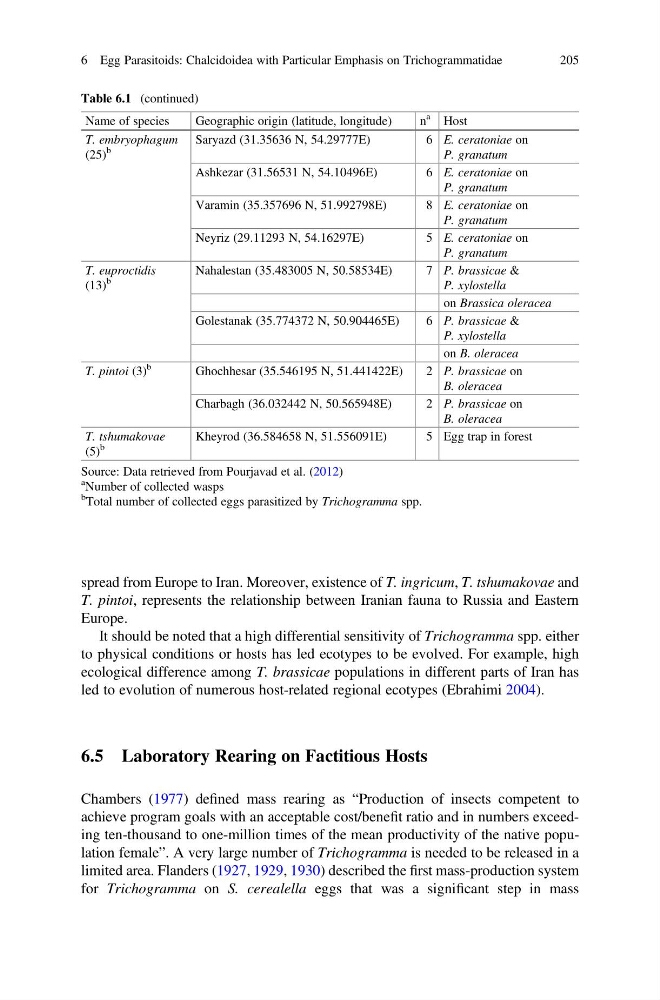
spread from Europe to Iran. Moreover, existence of T. ingricum, T. tshumakovae and
T. pintoi, represents the relationship between Iranian fauna to Russia and Eastern
Europe.
It should be noted that a high differential sensitivity of Trichogramma spp. either
to physical conditions or hosts has led ecotypes to be evolved. For example, high
ecological difference among T. brassicae populations in different parts of Iran has
led to evolution of numerous host-related regional ecotypes (Ebrahimi 2004).
6.5 Laboratory Rearing on Factitious Hosts
Chambers (1977) defined mass rearing as “Production of insects competent to
achieve program goals with an acceptable cost/benefit ratio and in numbers exceeding ten-thousand to one-million times of the mean productivity of the native population female”. A very large number of Trichogramma is needed to be released in a
limited area. Flanders (1927, 1929, 1930) described the first mass-production system
for Trichogramma on S. cerealella eggs that was a significant step in mass
Table 6.1 (continued)
Name of species
Geographic origin (latitude, longitude)
n
a
Host
T. embryophagum
(25)
b
Saryazd (31.35636 N, 54.29777E)
6 E. ceratoniae on
P. granatum
Ashkezar (31.56531 N, 54.10496E)
6 E. ceratoniae on
P. granatum
Varamin (35.357696 N, 51.992798E)
8 E. ceratoniae on
P. granatum
Neyriz (29.11293 N, 54.16297E)
5 E. ceratoniae on
P. granatum
T. euproctidis
(13)
b
Nahalestan (35.483005 N, 50.58534E)
7 P. brassicae &
P. xylostella
on Brassica oleracea
Golestanak (35.774372 N, 50.904465E)
6 P. brassicae &
P. xylostella
on B. oleracea
T. pintoi (3)
b
Ghochhesar (35.546195 N, 51.441422E)
2 P. brassicae on
B. oleracea
Charbagh (36.032442 N, 50.565948E)
2 P. brassicae on
B. oleracea
T. tshumakovae
(5)
b
Kheyrod (36.584658 N, 51.556091E)
5 Egg trap in forest
Source: Data retrieved from Pourjavad et al. (2012)
a Number of collected wasps
b
Total number of collected eggs parasitized by Trichogramma spp.
6 Egg Parasitoids: Chalcidoidea with Particular Emphasis on Trichogrammatidae
205
T. pintoi, represents the relationship between Iranian fauna to Russia and Eastern
Europe.
It should be noted that a high differential sensitivity of Trichogramma spp. either
to physical conditions or hosts has led ecotypes to be evolved. For example, high
ecological difference among T. brassicae populations in different parts of Iran has
led to evolution of numerous host-related regional ecotypes (Ebrahimi 2004).
6.5 Laboratory Rearing on Factitious Hosts
Chambers (1977) defined mass rearing as “Production of insects competent to
achieve program goals with an acceptable cost/benefit ratio and in numbers exceeding ten-thousand to one-million times of the mean productivity of the native population female”. A very large number of Trichogramma is needed to be released in a
limited area. Flanders (1927, 1929, 1930) described the first mass-production system
for Trichogramma on S. cerealella eggs that was a significant step in mass
Table 6.1 (continued)
Name of species
Geographic origin (latitude, longitude)
n
a
Host
T. embryophagum
(25)
b
Saryazd (31.35636 N, 54.29777E)
6 E. ceratoniae on
P. granatum
Ashkezar (31.56531 N, 54.10496E)
6 E. ceratoniae on
P. granatum
Varamin (35.357696 N, 51.992798E)
8 E. ceratoniae on
P. granatum
Neyriz (29.11293 N, 54.16297E)
5 E. ceratoniae on
P. granatum
T. euproctidis
(13)
b
Nahalestan (35.483005 N, 50.58534E)
7 P. brassicae &
P. xylostella
on Brassica oleracea
Golestanak (35.774372 N, 50.904465E)
6 P. brassicae &
P. xylostella
on B. oleracea
T. pintoi (3)
b
Ghochhesar (35.546195 N, 51.441422E)
2 P. brassicae on
B. oleracea
Charbagh (36.032442 N, 50.565948E)
2 P. brassicae on
B. oleracea
T. tshumakovae
(5)
b
Kheyrod (36.584658 N, 51.556091E)
5 Egg trap in forest
Source: Data retrieved from Pourjavad et al. (2012)
a Number of collected wasps
b
Total number of collected eggs parasitized by Trichogramma spp.
6 Egg Parasitoids: Chalcidoidea with Particular Emphasis on Trichogrammatidae
205