

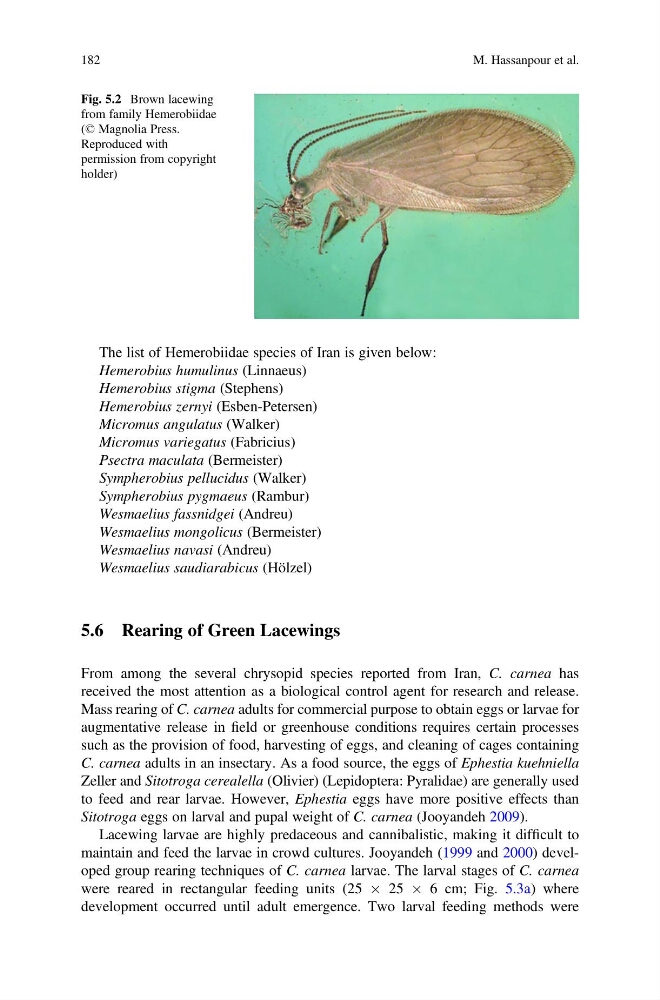
The list of Hemerobiidae species of Iran is given below:
Hemerobius humulinus (Linnaeus)
Hemerobius stigma (Stephens)
Hemerobius zernyi (Esben-Petersen)
Micromus angulatus (Walker)
Micromus variegatus (Fabricius)
Psectra maculata (Bermeister)
Sympherobius pellucidus (Walker)
Sympherobius pygmaeus (Rambur)
Wesmaelius fassnidgei (Andreu)
Wesmaelius mongolicus (Bermeister)
Wesmaelius navasi (Andreu)
Wesmaelius saudiarabicus (Hölzel)
5.6 Rearing of Green Lacewings
From among the several chrysopid species reported from Iran, C. carnea has
received the most attention as a biological control agent for research and release.
Mass rearing of C. carnea adults for commercial purpose to obtain eggs or larvae for
augmentative release in field or greenhouse conditions requires certain processes
such as the provision of food, harvesting of eggs, and cleaning of cages containing
C. carnea adults in an insectary. As a food source, the eggs of Ephestia kuehniella
Zeller and Sitotroga cerealella (Olivier) (Lepidoptera: Pyralidae) are generally used
to feed and rear larvae. However, Ephestia eggs have more positive effects than
Sitotroga eggs on larval and pupal weight of C. carnea (Jooyandeh 2009).
Lacewing larvae are highly predaceous and cannibalistic, making it difficult to
maintain and feed the larvae in crowd cultures. Jooyandeh (1999 and 2000) developed group rearing techniques of C. carnea larvae. The larval stages of C. carnea
were reared in rectangular feeding units (25 Â 25 Â 6 cm; Fig. 5.3a) where
development occurred until adult emergence. Two larval feeding methods were
Fig. 5.2 Brown lacewing
from family Hemerobiidae
(© Magnolia Press.
Reproduced with
permission from copyright
holder)
182
M. Hassanpour et al.
Hemerobius humulinus (Linnaeus)
Hemerobius stigma (Stephens)
Hemerobius zernyi (Esben-Petersen)
Micromus angulatus (Walker)
Micromus variegatus (Fabricius)
Psectra maculata (Bermeister)
Sympherobius pellucidus (Walker)
Sympherobius pygmaeus (Rambur)
Wesmaelius fassnidgei (Andreu)
Wesmaelius mongolicus (Bermeister)
Wesmaelius navasi (Andreu)
Wesmaelius saudiarabicus (Hölzel)
5.6 Rearing of Green Lacewings
From among the several chrysopid species reported from Iran, C. carnea has
received the most attention as a biological control agent for research and release.
Mass rearing of C. carnea adults for commercial purpose to obtain eggs or larvae for
augmentative release in field or greenhouse conditions requires certain processes
such as the provision of food, harvesting of eggs, and cleaning of cages containing
C. carnea adults in an insectary. As a food source, the eggs of Ephestia kuehniella
Zeller and Sitotroga cerealella (Olivier) (Lepidoptera: Pyralidae) are generally used
to feed and rear larvae. However, Ephestia eggs have more positive effects than
Sitotroga eggs on larval and pupal weight of C. carnea (Jooyandeh 2009).
Lacewing larvae are highly predaceous and cannibalistic, making it difficult to
maintain and feed the larvae in crowd cultures. Jooyandeh (1999 and 2000) developed group rearing techniques of C. carnea larvae. The larval stages of C. carnea
were reared in rectangular feeding units (25 Â 25 Â 6 cm; Fig. 5.3a) where
development occurred until adult emergence. Two larval feeding methods were
Fig. 5.2 Brown lacewing
from family Hemerobiidae
(© Magnolia Press.
Reproduced with
permission from copyright
holder)
182
M. Hassanpour et al.