

enemies of several important pests along with ease of production have led to
considerable researches on this useful group within the last two decades in Iran.
Lacewing populations often lag behind their prey and may not be able to satisfactorily reduce heavy infestations of pests.
5.2 Review on Taxonomy of Neuroptera
The Order Neuroptera represents one of the oldest lineages of endopterygota undergoing
complete metamorphosis. Neuroptera comprises three suborders divided into 17 extant
families containing more than 6000 species (Mansell 2002). The families
Myrmeleontidae with more than 2000 species and Chrysopidae with over 1200 species
are the most species-rich families, followed by Hemerobiidae (ca. 550 species) and
Ascalaphidae (ca. 400 species). The suborder Nevrorthiformia with the single family
of Nevrorthidae represents the most basal group, which is sporadically found in
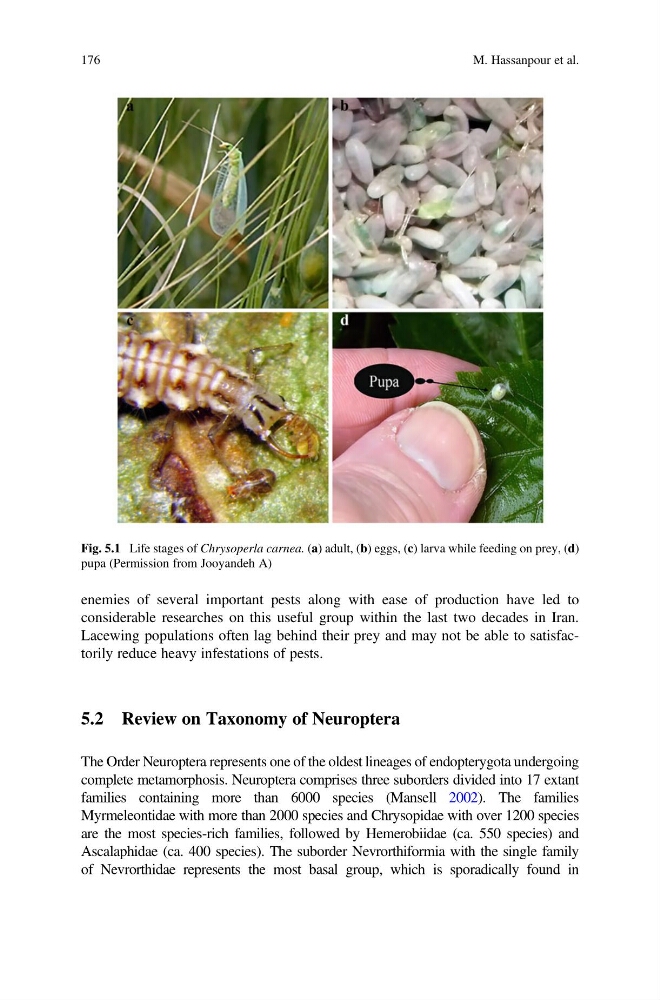
Fig. 5.1 Life stages of Chrysoperla carnea. (a) adult, (b) eggs, (c) larva while feeding on prey, (d)
pupa (Permission from Jooyandeh A)
176
M. Hassanpour et al.
considerable researches on this useful group within the last two decades in Iran.
Lacewing populations often lag behind their prey and may not be able to satisfactorily reduce heavy infestations of pests.
5.2 Review on Taxonomy of Neuroptera
The Order Neuroptera represents one of the oldest lineages of endopterygota undergoing
complete metamorphosis. Neuroptera comprises three suborders divided into 17 extant
families containing more than 6000 species (Mansell 2002). The families
Myrmeleontidae with more than 2000 species and Chrysopidae with over 1200 species
are the most species-rich families, followed by Hemerobiidae (ca. 550 species) and
Ascalaphidae (ca. 400 species). The suborder Nevrorthiformia with the single family
of Nevrorthidae represents the most basal group, which is sporadically found in
Fig. 5.1 Life stages of Chrysoperla carnea. (a) adult, (b) eggs, (c) larva while feeding on prey, (d)
pupa (Permission from Jooyandeh A)
176
M. Hassanpour et al.