

42
4.3.1 Natural Fermentation
It is considered as one of the simplest types of fermentation which does not involve
the addition of starter culture. The microorganisms responsible for such type of
fermentation are present within the raw materials used in the process. In several
cases the products are cooked after the fermentation process is over such as idli,
nan, angkak (Lim 1991), etc.
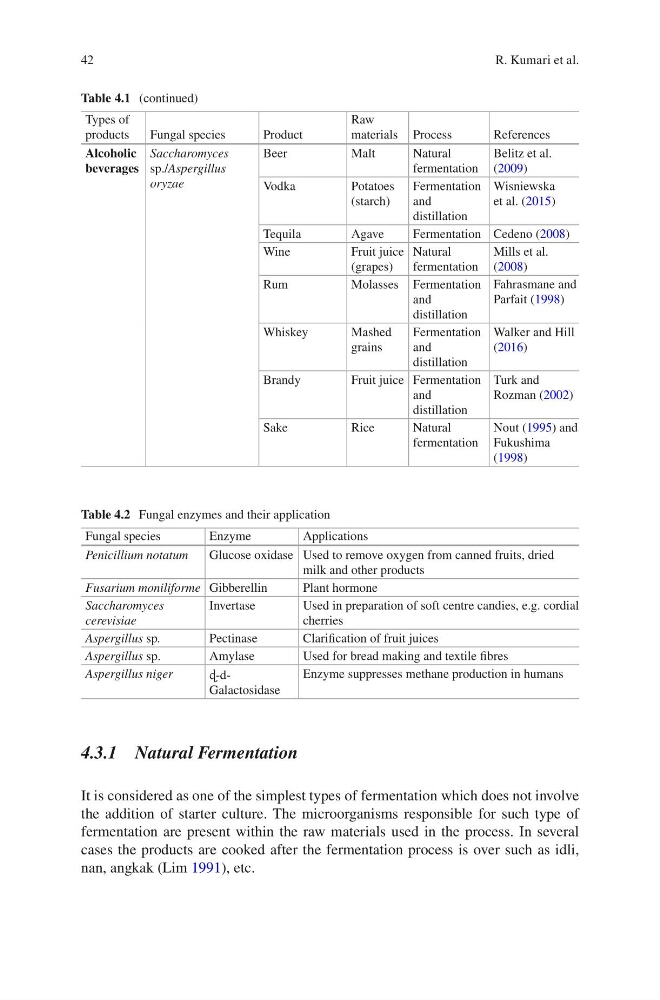
Table 4.1 (continued)
Types of
products
Fungal species
Product
Raw
materials Process
References
Alcoholic
beverages
Saccharomyces
sp./Aspergillus
oryzae
Beer
Malt
Natural
fermentation
Belitz et al.
(2009)
Vodka
Potatoes
(starch)
Fermentation
and
distillation
Wisniewska
et al. (2015)
Tequila
Agave
Fermentation Cedeno (2008)
Wine
Fruit juice
(grapes)
Natural
fermentation
Mills et al.
(2008)
Rum
Molasses Fermentation
and
distillation
Fahrasmane and
Parfait (1998)
Whiskey
Mashed
grains
Fermentation
and
distillation
Walker and Hill
(2016)
Brandy
Fruit juice Fermentation
and
distillation
Turk and
Rozman (2002)
Sake
Rice
Natural
fermentation
Nout (1995) and
Fukushima
(1998)
Table 4.2 Fungal enzymes and their application
Fungal species
Enzyme
Applications
Penicillium notatum
Glucose oxidase Used to remove oxygen from canned fruits, dried
milk and other products
Fusarium moniliforme Gibberellin
Plant hormone
Saccharomyces
cerevisiae
Invertase
Used in preparation of soft centre candies, e.g. cordial
cherries
Aspergillus sp.
Pectinase
Clarification of fruit juices
Aspergillus sp.
Amylase
Used for bread making and textile fibres
Aspergillus niger
ɖ-dGalactosidase
Enzyme suppresses methane production in humans
R. Kumari et al.
4.3.1 Natural Fermentation
It is considered as one of the simplest types of fermentation which does not involve
the addition of starter culture. The microorganisms responsible for such type of
fermentation are present within the raw materials used in the process. In several
cases the products are cooked after the fermentation process is over such as idli,
nan, angkak (Lim 1991), etc.
Table 4.1 (continued)
Types of
products
Fungal species
Product
Raw
materials Process
References
Alcoholic
beverages
Saccharomyces
sp./Aspergillus
oryzae
Beer
Malt
Natural
fermentation
Belitz et al.
(2009)
Vodka
Potatoes
(starch)
Fermentation
and
distillation
Wisniewska
et al. (2015)
Tequila
Agave
Fermentation Cedeno (2008)
Wine
Fruit juice
(grapes)
Natural
fermentation
Mills et al.
(2008)
Rum
Molasses Fermentation
and
distillation
Fahrasmane and
Parfait (1998)
Whiskey
Mashed
grains
Fermentation
and
distillation
Walker and Hill
(2016)
Brandy
Fruit juice Fermentation
and
distillation
Turk and
Rozman (2002)
Sake
Rice
Natural
fermentation
Nout (1995) and
Fukushima
(1998)
Table 4.2 Fungal enzymes and their application
Fungal species
Enzyme
Applications
Penicillium notatum
Glucose oxidase Used to remove oxygen from canned fruits, dried
milk and other products
Fusarium moniliforme Gibberellin
Plant hormone
Saccharomyces
cerevisiae
Invertase
Used in preparation of soft centre candies, e.g. cordial
cherries
Aspergillus sp.
Pectinase
Clarification of fruit juices
Aspergillus sp.
Amylase
Used for bread making and textile fibres
Aspergillus niger
ɖ-dGalactosidase
Enzyme suppresses methane production in humans
R. Kumari et al.