

33
3.5.5 Colouring Agent
Colour is suggested to play a crucial role in determining both the quality and acceptability of foods and beverages. Synthetic colour can have negative effects on the
health of the consumers. Therefore, the demand for natural colour in food is always
high. Plants and microorganisms are sources of natural colours. It has been studied
and investigated that fungal species such as Neurospora, Monascus, Fusarium and
Penicillium are great sources of natural pigments (Gmoser et al. 2017). Red pigments are extracted from Monascus purpureus and used as natural food colorants to
many food items. These pigments not only add colour to the food but also provide
health benefits to the consumers (Dufossé 2016).
3.6 List of GRAS-Certified Fungi and Their Products
The rich diversity of fungal species has been exploited by mankind for a very long
period of time. They served as important sources of innovative food, extracellular
enzymes or secondary metabolites owing to their peculiar growth conditions.
Further, the ability of some of these fungi to secrete extracellular enzymes makes
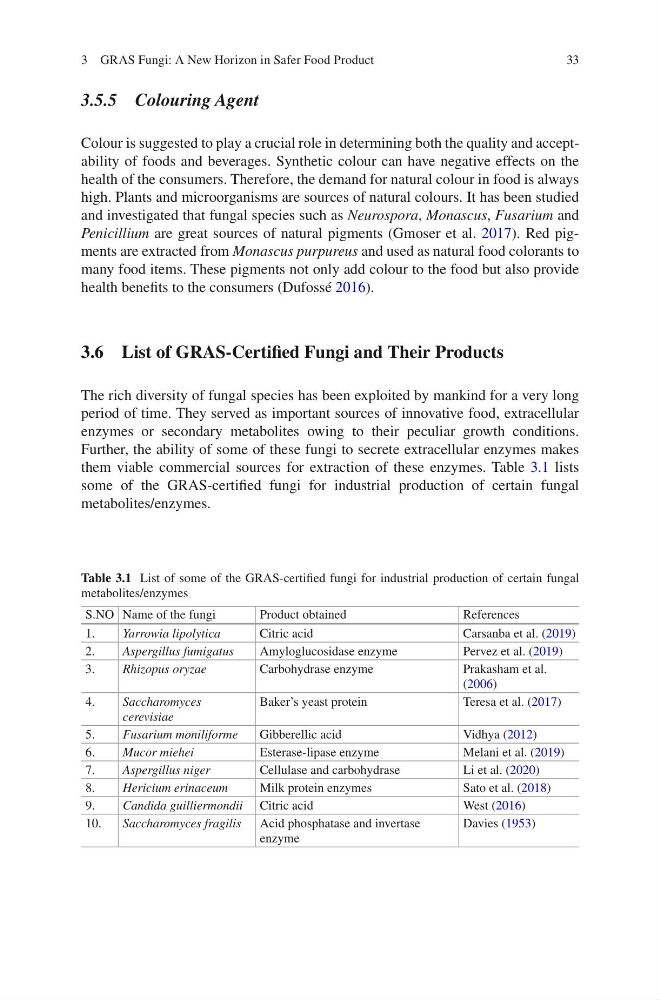
them viable commercial sources for extraction of these enzymes. Table 3.1 lists
some of the GRAS-certified fungi for industrial production of certain fungal
metabolites/enzymes.
Table 3.1 List of some of the GRAS-certified fungi for industrial production of certain fungal
metabolites/enzymes
S.NO Name of the fungi
Product obtained
References
1.
Yarrowia lipolytica
Citric acid
Carsanba et al. (2019)
2.
Aspergillus fumigatus
Amyloglucosidase enzyme
Pervez et al. (2019)
3.
Rhizopus oryzae
Carbohydrase enzyme
Prakasham et al.
(2006)
4.
Saccharomyces
cerevisiae
Baker’s yeast protein
Teresa et al. (2017)
5.
Fusarium moniliforme
Gibberellic acid
Vidhya (2012)
6.
Mucor miehei
Esterase-lipase enzyme
Melani et al. (2019)
7.
Aspergillus niger
Cellulase and carbohydrase
Li et al. (2020)
8.
Hericium erinaceum
Milk protein enzymes
Sato et al. (2018)
9.
Candida guilliermondii Citric acid
West (2016)
10.
Saccharomyces fragilis Acid phosphatase and invertase
enzyme
Davies (1953)
3 GRAS Fungi: A New Horizon in Safer Food Product
3.5.5 Colouring Agent
Colour is suggested to play a crucial role in determining both the quality and acceptability of foods and beverages. Synthetic colour can have negative effects on the
health of the consumers. Therefore, the demand for natural colour in food is always
high. Plants and microorganisms are sources of natural colours. It has been studied
and investigated that fungal species such as Neurospora, Monascus, Fusarium and
Penicillium are great sources of natural pigments (Gmoser et al. 2017). Red pigments are extracted from Monascus purpureus and used as natural food colorants to
many food items. These pigments not only add colour to the food but also provide
health benefits to the consumers (Dufossé 2016).
3.6 List of GRAS-Certified Fungi and Their Products
The rich diversity of fungal species has been exploited by mankind for a very long
period of time. They served as important sources of innovative food, extracellular
enzymes or secondary metabolites owing to their peculiar growth conditions.
Further, the ability of some of these fungi to secrete extracellular enzymes makes
them viable commercial sources for extraction of these enzymes. Table 3.1 lists
some of the GRAS-certified fungi for industrial production of certain fungal
metabolites/enzymes.
Table 3.1 List of some of the GRAS-certified fungi for industrial production of certain fungal
metabolites/enzymes
S.NO Name of the fungi
Product obtained
References
1.
Yarrowia lipolytica
Citric acid
Carsanba et al. (2019)
2.
Aspergillus fumigatus
Amyloglucosidase enzyme
Pervez et al. (2019)
3.
Rhizopus oryzae
Carbohydrase enzyme
Prakasham et al.
(2006)
4.
Saccharomyces
cerevisiae
Baker’s yeast protein
Teresa et al. (2017)
5.
Fusarium moniliforme
Gibberellic acid
Vidhya (2012)
6.
Mucor miehei
Esterase-lipase enzyme
Melani et al. (2019)
7.
Aspergillus niger
Cellulase and carbohydrase
Li et al. (2020)
8.
Hericium erinaceum
Milk protein enzymes
Sato et al. (2018)
9.
Candida guilliermondii Citric acid
West (2016)
10.
Saccharomyces fragilis Acid phosphatase and invertase
enzyme
Davies (1953)
3 GRAS Fungi: A New Horizon in Safer Food Product