

188
The concentration of biomass determines the CO 2 evolution state and so the flow
rate of the medium (Wiebe 2002). The production of mycotoxins can be checked
every 6 h to ensure that the produced mycoproteins are toxin-free. While harvesting
the fungal biomass, it has to be kept for short-time heat treatment to get rid of RNA,
by activating cells’ endogenous RNAse enzymes. The temperature chosen for the
RNA treatment is 68 °C for 30–45 min. Once this process is over, the mycoproteins
can be isolated from the fungal broth by centrifugation process as a paste. This treatment will reduce the RNA content to 2% from 10% of its dry weight (Asgar
et al. 2010).
11.12 Nutritional and Health Benefits
The mycoproteins are a low-fat, high-protein, and high-fiber food component. It
also contains a minimal amount of sodium and enriched amount of zinc, selenium,
and antioxidants (Denny et al. 2008; Smith et al. 2015). The chemical composition
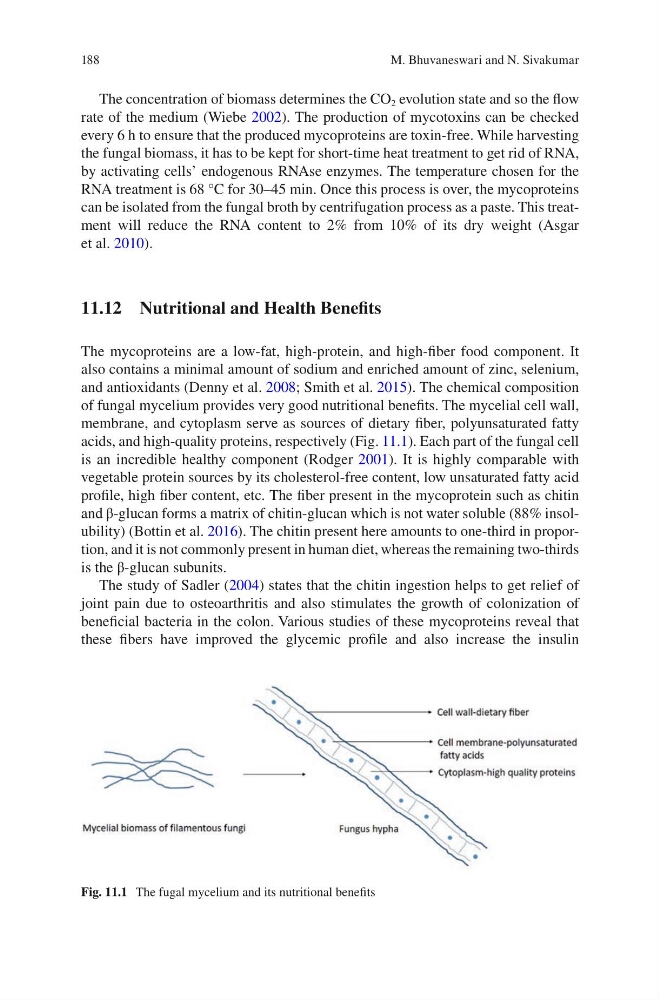
of fungal mycelium provides very good nutritional benefits. The mycelial cell wall,
membrane, and cytoplasm serve as sources of dietary fiber, polyunsaturated fatty
acids, and high-quality proteins, respectively (Fig. 11.1). Each part of the fungal cell
is an incredible healthy component (Rodger 2001). It is highly comparable with
vegetable protein sources by its cholesterol-free content, low unsaturated fatty acid
profile, high fiber content, etc. The fiber present in the mycoprotein such as chitin
and β-glucan forms a matrix of chitin-glucan which is not water soluble (88% insolubility) (Bottin et al. 2016). The chitin present here amounts to one-third in proportion, and it is not commonly present in human diet, whereas the remaining two-thirds
is the β-glucan subunits.
The study of Sadler (2004) states that the chitin ingestion helps to get relief of
joint pain due to osteoarthritis and also stimulates the growth of colonization of
beneficial bacteria in the colon. Various studies of these mycoproteins reveal that
these fibers have improved the glycemic profile and also increase the insulin
Fig. 11.1 The fugal mycelium and its nutritional benefits
M. Bhuvaneswari and N. Sivakumar
The concentration of biomass determines the CO 2 evolution state and so the flow
rate of the medium (Wiebe 2002). The production of mycotoxins can be checked
every 6 h to ensure that the produced mycoproteins are toxin-free. While harvesting
the fungal biomass, it has to be kept for short-time heat treatment to get rid of RNA,
by activating cells’ endogenous RNAse enzymes. The temperature chosen for the
RNA treatment is 68 °C for 30–45 min. Once this process is over, the mycoproteins
can be isolated from the fungal broth by centrifugation process as a paste. This treatment will reduce the RNA content to 2% from 10% of its dry weight (Asgar
et al. 2010).
11.12 Nutritional and Health Benefits
The mycoproteins are a low-fat, high-protein, and high-fiber food component. It
also contains a minimal amount of sodium and enriched amount of zinc, selenium,
and antioxidants (Denny et al. 2008; Smith et al. 2015). The chemical composition
of fungal mycelium provides very good nutritional benefits. The mycelial cell wall,
membrane, and cytoplasm serve as sources of dietary fiber, polyunsaturated fatty
acids, and high-quality proteins, respectively (Fig. 11.1). Each part of the fungal cell
is an incredible healthy component (Rodger 2001). It is highly comparable with
vegetable protein sources by its cholesterol-free content, low unsaturated fatty acid
profile, high fiber content, etc. The fiber present in the mycoprotein such as chitin
and β-glucan forms a matrix of chitin-glucan which is not water soluble (88% insolubility) (Bottin et al. 2016). The chitin present here amounts to one-third in proportion, and it is not commonly present in human diet, whereas the remaining two-thirds
is the β-glucan subunits.
The study of Sadler (2004) states that the chitin ingestion helps to get relief of
joint pain due to osteoarthritis and also stimulates the growth of colonization of
beneficial bacteria in the colon. Various studies of these mycoproteins reveal that
these fibers have improved the glycemic profile and also increase the insulin
Fig. 11.1 The fugal mycelium and its nutritional benefits
M. Bhuvaneswari and N. Sivakumar