

5
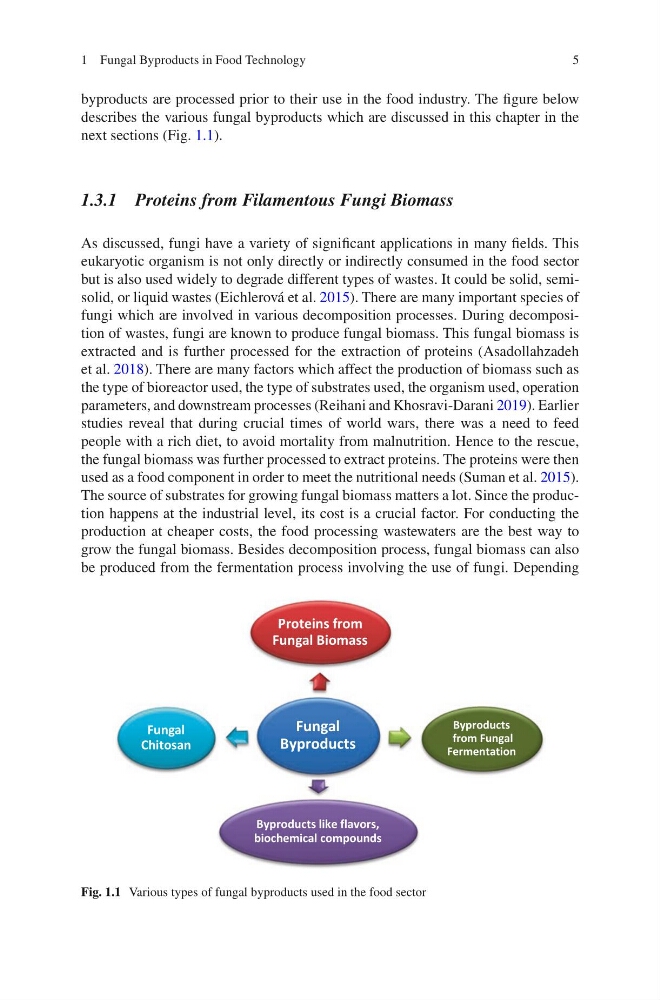
byproducts are processed prior to their use in the food industry. The figure below
describes the various fungal byproducts which are discussed in this chapter in the
next sections (Fig. 1.1).
1.3.1 Proteins from Filamentous Fungi Biomass
As discussed, fungi have a variety of significant applications in many fields. This
eukaryotic organism is not only directly or indirectly consumed in the food sector
but is also used widely to degrade different types of wastes. It could be solid, semisolid, or liquid wastes (Eichlerová et al. 2015). There are many important species of
fungi which are involved in various decomposition processes. During decomposition of wastes, fungi are known to produce fungal biomass. This fungal biomass is
extracted and is further processed for the extraction of proteins (Asadollahzadeh
et al. 2018). There are many factors which affect the production of biomass such as
the type of bioreactor used, the type of substrates used, the organism used, operation
parameters, and downstream processes (Reihani and Khosravi-Darani 2019). Earlier
studies reveal that during crucial times of world wars, there was a need to feed
people with a rich diet, to avoid mortality from malnutrition. Hence to the rescue,
the fungal biomass was further processed to extract proteins. The proteins were then
used as a food component in order to meet the nutritional needs (Suman et al. 2015).
The source of substrates for growing fungal biomass matters a lot. Since the production happens at the industrial level, its cost is a crucial factor. For conducting the
production at cheaper costs, the food processing wastewaters are the best way to
grow the fungal biomass. Besides decomposition process, fungal biomass can also
be produced from the fermentation process involving the use of fungi. Depending
Fungal
Byproducts
Proteins from
Fungal Biomass
Byproducts
from Fungal
Fermentation
Byproducts like flavors,
biochemical compounds
Fungal
Chitosan
Fig. 1.1 Various types of fungal byproducts used in the food sector
1 Fungal Byproducts in Food Technology
byproducts are processed prior to their use in the food industry. The figure below
describes the various fungal byproducts which are discussed in this chapter in the
next sections (Fig. 1.1).
1.3.1 Proteins from Filamentous Fungi Biomass
As discussed, fungi have a variety of significant applications in many fields. This
eukaryotic organism is not only directly or indirectly consumed in the food sector
but is also used widely to degrade different types of wastes. It could be solid, semisolid, or liquid wastes (Eichlerová et al. 2015). There are many important species of
fungi which are involved in various decomposition processes. During decomposition of wastes, fungi are known to produce fungal biomass. This fungal biomass is
extracted and is further processed for the extraction of proteins (Asadollahzadeh
et al. 2018). There are many factors which affect the production of biomass such as
the type of bioreactor used, the type of substrates used, the organism used, operation
parameters, and downstream processes (Reihani and Khosravi-Darani 2019). Earlier
studies reveal that during crucial times of world wars, there was a need to feed
people with a rich diet, to avoid mortality from malnutrition. Hence to the rescue,
the fungal biomass was further processed to extract proteins. The proteins were then
used as a food component in order to meet the nutritional needs (Suman et al. 2015).
The source of substrates for growing fungal biomass matters a lot. Since the production happens at the industrial level, its cost is a crucial factor. For conducting the
production at cheaper costs, the food processing wastewaters are the best way to
grow the fungal biomass. Besides decomposition process, fungal biomass can also
be produced from the fermentation process involving the use of fungi. Depending
Fungal
Byproducts
Proteins from
Fungal Biomass
Byproducts
from Fungal
Fermentation
Byproducts like flavors,
biochemical compounds
Fungal
Chitosan
Fig. 1.1 Various types of fungal byproducts used in the food sector
1 Fungal Byproducts in Food Technology