

152
substrate, pH, temperature, and humidity among others. Mushrooms are good
sources of almost all essential amino acids when compared with common vegetables; besides their digestibility is very good. On average, the moisture content of the
mushrooms is 90% in fresh weight. In the dry matter, carbohydrates are the major
components with values of approximately 40% constituted by glycogen, chitin
which is the main component of the fiber, glucan, chitosan, and mannans (simple
carbohydrates are found in low quantities, since fungi do not perform
photosynthesis).
Mushrooms provide an average of 85–125 kJ/100 g, while an adult male needs
about 10,000 kJ per day. This low energy value of mushrooms enables it to be used
in low-calorie diets which are ideal for diabetics (Moore 2017). Another very important characteristic is that the fungi are free of cholesterol, so its consumption helps
reduce the risk of coronary heart disease and other related disorders, also present
very low lipid content (2–8% dry weight), constituted by triglycerides, free fatty
acids, glycerides, sterols, and phospholipids. The mushrooms are an excellent
source of B-complex vitamins (riboflavin (B2), niacin, pantothenic acid, thiamin
(B1), biotin, folate, and vitamin B12) and vitamin D and also of minerals such as
copper, selenium, potassium, phosphorous, zinc, and magnesium. Mushrooms are
important and necessary in the diet due to their nutritional quality and the health
benefits they provide such as blood pressure control, lowering of blood cholesterol,
glucose regulation in blood, regulation of the intestinal function, control of tumor
growth, anti-inflammatory effect, and antioxidant activity among others (TéllezTéllez and Díaz-Godínez 2017).
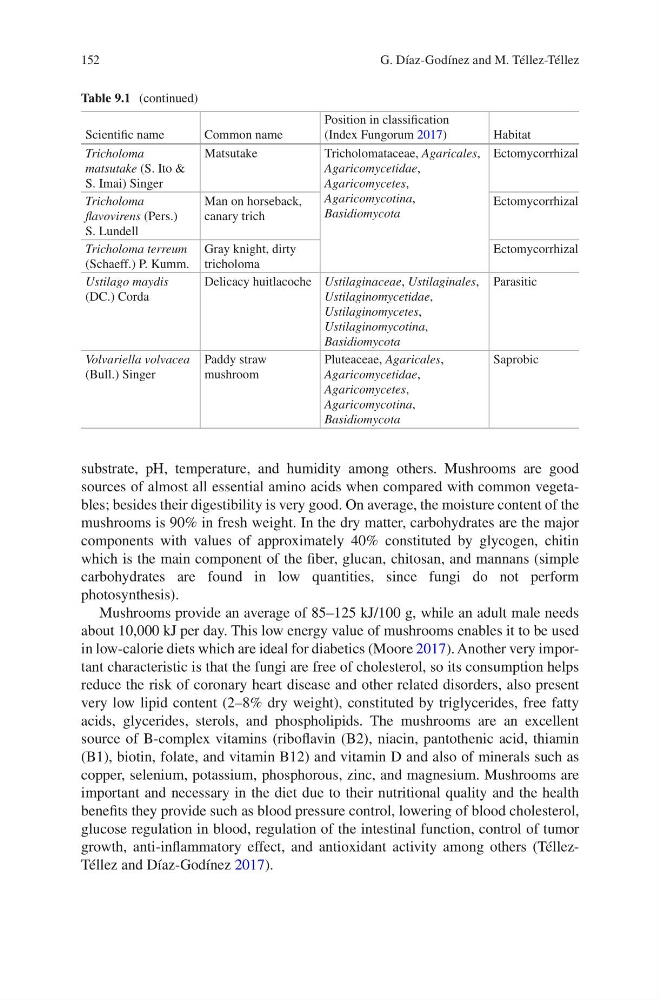
Table 9.1 (continued)
Scientific name
Common name
Position in classification
(Index Fungorum 2017)
Habitat
Tricholoma
matsutake (S. Ito &
S. Imai) Singer
Matsutake
Tricholomataceae, Agaricales,
Agaricomycetidae,
Agaricomycetes,
Agaricomycotina,
Basidiomycota
Ectomycorrhizal
Tricholoma
flavovirens (Pers.)
S. Lundell
Man on horseback,
canary trich
Ectomycorrhizal
Tricholoma terreum
(Schaeff.) P. Kumm.
Gray knight, dirty
tricholoma
Ectomycorrhizal
Ustilago maydis
(DC.) Corda
Delicacy huitlacoche Ustilaginaceae, Ustilaginales,
Ustilaginomycetidae,
Ustilaginomycetes,
Ustilaginomycotina,
Basidiomycota
Parasitic
Volvariella volvacea
(Bull.) Singer
Paddy straw
mushroom
Pluteaceae, Agaricales,
Agaricomycetidae,
Agaricomycetes,
Agaricomycotina,
Basidiomycota
Saprobic
G. Díaz-Godínez and M. Téllez-Téllez
substrate, pH, temperature, and humidity among others. Mushrooms are good
sources of almost all essential amino acids when compared with common vegetables; besides their digestibility is very good. On average, the moisture content of the
mushrooms is 90% in fresh weight. In the dry matter, carbohydrates are the major
components with values of approximately 40% constituted by glycogen, chitin
which is the main component of the fiber, glucan, chitosan, and mannans (simple
carbohydrates are found in low quantities, since fungi do not perform
photosynthesis).
Mushrooms provide an average of 85–125 kJ/100 g, while an adult male needs
about 10,000 kJ per day. This low energy value of mushrooms enables it to be used
in low-calorie diets which are ideal for diabetics (Moore 2017). Another very important characteristic is that the fungi are free of cholesterol, so its consumption helps
reduce the risk of coronary heart disease and other related disorders, also present
very low lipid content (2–8% dry weight), constituted by triglycerides, free fatty
acids, glycerides, sterols, and phospholipids. The mushrooms are an excellent
source of B-complex vitamins (riboflavin (B2), niacin, pantothenic acid, thiamin
(B1), biotin, folate, and vitamin B12) and vitamin D and also of minerals such as
copper, selenium, potassium, phosphorous, zinc, and magnesium. Mushrooms are
important and necessary in the diet due to their nutritional quality and the health
benefits they provide such as blood pressure control, lowering of blood cholesterol,
glucose regulation in blood, regulation of the intestinal function, control of tumor
growth, anti-inflammatory effect, and antioxidant activity among others (TéllezTéllez and Díaz-Godínez 2017).
Table 9.1 (continued)
Scientific name
Common name
Position in classification
(Index Fungorum 2017)
Habitat
Tricholoma
matsutake (S. Ito &
S. Imai) Singer
Matsutake
Tricholomataceae, Agaricales,
Agaricomycetidae,
Agaricomycetes,
Agaricomycotina,
Basidiomycota
Ectomycorrhizal
Tricholoma
flavovirens (Pers.)
S. Lundell
Man on horseback,
canary trich
Ectomycorrhizal
Tricholoma terreum
(Schaeff.) P. Kumm.
Gray knight, dirty
tricholoma
Ectomycorrhizal
Ustilago maydis
(DC.) Corda
Delicacy huitlacoche Ustilaginaceae, Ustilaginales,
Ustilaginomycetidae,
Ustilaginomycetes,
Ustilaginomycotina,
Basidiomycota
Parasitic
Volvariella volvacea
(Bull.) Singer
Paddy straw
mushroom
Pluteaceae, Agaricales,
Agaricomycetidae,
Agaricomycetes,
Agaricomycotina,
Basidiomycota
Saprobic
G. Díaz-Godínez and M. Téllez-Téllez