

57
4.4.6 Wine
Wine is one of the alcoholic beverages made from fermentation of grapes without
the addition of any acid, enzymes, sugar, water or any other nutrient (Johnson 1989).
The production of wine can date back to thousand years ago having early traces
rooted to some parts of China (Hames 2010). According to our history, wine has
always been consumed for its intoxicating effect. Wine holds religious importance
as well. Red wine was thought to be associated with the blood of Egyptians. The
most important organism responsible for wine fermentation is yeast. Yeast utilizes
the sugar present in grapes and converts it into ethanol and carbon dioxide. Apart
from grapes, there are several other substrates used to produce wine such as rice,
plum, cherries, elderberry and pomegranate.
4.4.6.1 Mycology of Wine Fermentation
Saccharomyces cerevisiae is the major yeast responsible for wine fermentation.
Vineyard is responsible for affecting the initial environment of wine fermentation
(Mills et al. 2008). Microbes initially colonize around the stomata of grapes
(Ribereau-Gaetyon et al. 2000). The most prevalent vineyard yeasts are
Hanseniaspora and Kloeckera which are sexual anamorphs, representing over half
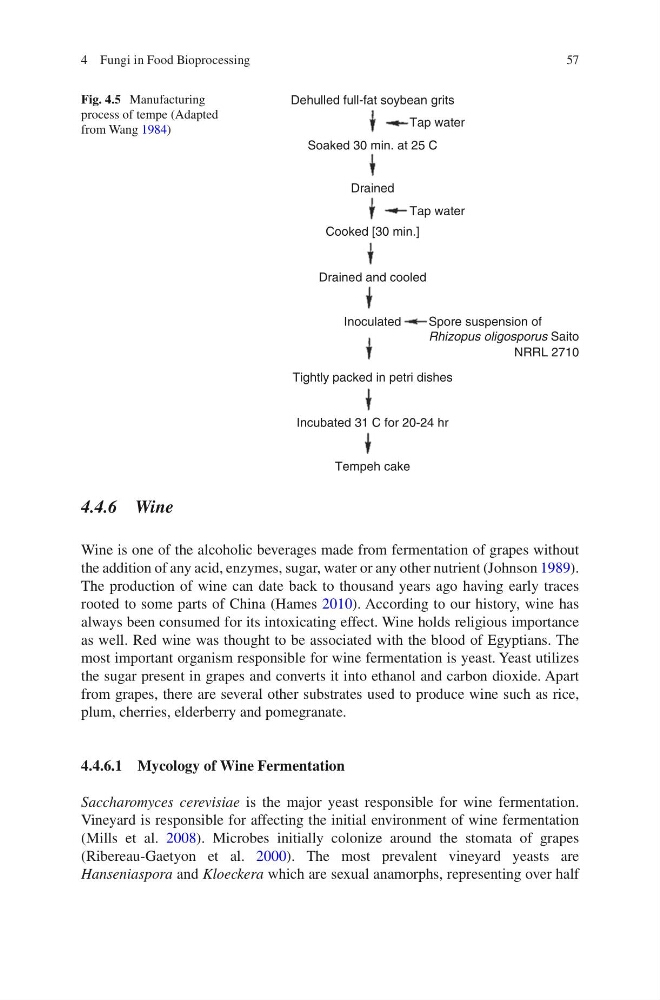
Dehulled full-fat soybean grits
Tap water
Tap water
Soaked 30 min. at 25 C
Drained
Cooked [30 min.]
Drained and cooled
Inoculated
Tightly packed in petri dishes
Incubated 31 C for 20-24 hr
Tempeh cake
Spore suspension of
Rhizopus oligosporus Saito
NRRL 2710
Fig. 4.5 Manufacturing
process of tempe (Adapted
from Wang 1984)
4 Fungi in Food Bioprocessing
4.4.6 Wine
Wine is one of the alcoholic beverages made from fermentation of grapes without
the addition of any acid, enzymes, sugar, water or any other nutrient (Johnson 1989).
The production of wine can date back to thousand years ago having early traces
rooted to some parts of China (Hames 2010). According to our history, wine has
always been consumed for its intoxicating effect. Wine holds religious importance
as well. Red wine was thought to be associated with the blood of Egyptians. The
most important organism responsible for wine fermentation is yeast. Yeast utilizes
the sugar present in grapes and converts it into ethanol and carbon dioxide. Apart
from grapes, there are several other substrates used to produce wine such as rice,
plum, cherries, elderberry and pomegranate.
4.4.6.1 Mycology of Wine Fermentation
Saccharomyces cerevisiae is the major yeast responsible for wine fermentation.
Vineyard is responsible for affecting the initial environment of wine fermentation
(Mills et al. 2008). Microbes initially colonize around the stomata of grapes
(Ribereau-Gaetyon et al. 2000). The most prevalent vineyard yeasts are
Hanseniaspora and Kloeckera which are sexual anamorphs, representing over half
Dehulled full-fat soybean grits
Tap water
Tap water
Soaked 30 min. at 25 C
Drained
Cooked [30 min.]
Drained and cooled
Inoculated
Tightly packed in petri dishes
Incubated 31 C for 20-24 hr
Tempeh cake
Spore suspension of
Rhizopus oligosporus Saito
NRRL 2710
Fig. 4.5 Manufacturing
process of tempe (Adapted
from Wang 1984)
4 Fungi in Food Bioprocessing