

55
4.4.5 Tempe
Originated a hundred years ago, in Central and Eastern Java island (Shurtleff and
Aoyagi 1979), tempe is considered as a staple food of Indonesia. Basically, tempe
is a fermented product based on the solid state fermentation of soy beans involving
the primary fungal strain of Rhizopus genus. There are several other ingredients
apart from soy beans which can be used for tempe production. Tempe can be divided
into five categories based on the raw materials used for its production: presscake
residues, non-legume seeds, legumes, grains and a combination of both legumes
and grains (Nout and Kiers 2005; Feng 2006). Since tempe is nutritionally rich and
easy to digest, there is an increase in its demand by consumers who want to replace
meat in their diet (Nout and Aidoo 2010).
4.4.5.1 Mycology of Tempe
Rhizopus microsporus is the major genus involved in tempe production, with several of its varieties such as chinensis, microsporus, oligosporus and rhizopodiformis
(Liou et al. 1990; Nout and Rombouts 1990). An additional variety tuberosus
involved in tempe production was described by Zheng and Chen 1990. The optimum temperature required for germination of sporangiospores in R. oligosporus is
37 °C and also that the accumulation of acetic acid is inhibitory (De Reu et al.
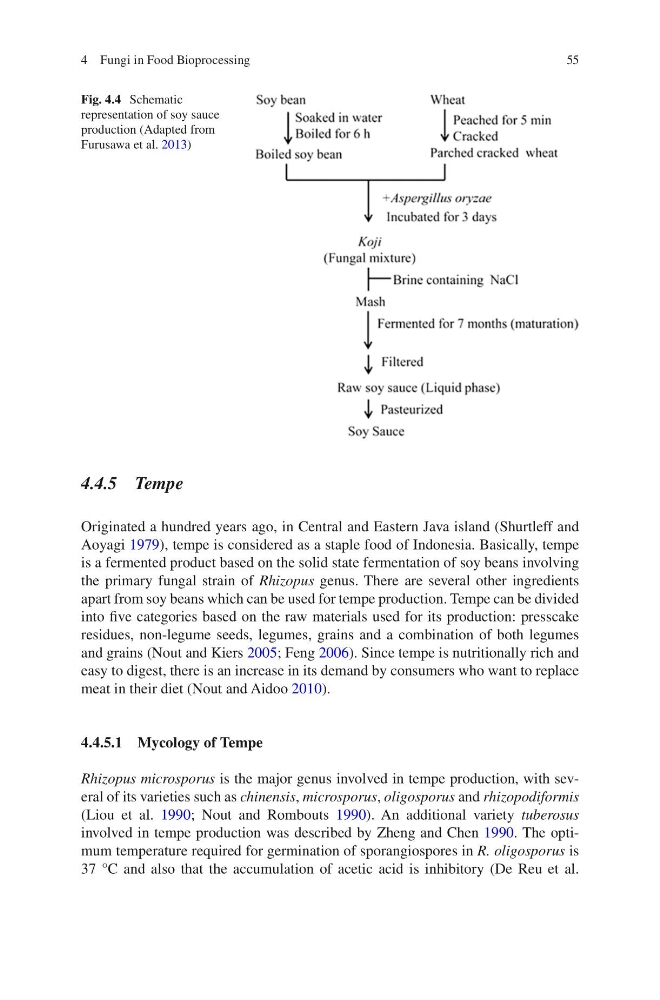
Fig. 4.4 Schematic
representation of soy sauce
production (Adapted from
Furusawa et al. 2013)
4 Fungi in Food Bioprocessing
4.4.5 Tempe
Originated a hundred years ago, in Central and Eastern Java island (Shurtleff and
Aoyagi 1979), tempe is considered as a staple food of Indonesia. Basically, tempe
is a fermented product based on the solid state fermentation of soy beans involving
the primary fungal strain of Rhizopus genus. There are several other ingredients
apart from soy beans which can be used for tempe production. Tempe can be divided
into five categories based on the raw materials used for its production: presscake
residues, non-legume seeds, legumes, grains and a combination of both legumes
and grains (Nout and Kiers 2005; Feng 2006). Since tempe is nutritionally rich and
easy to digest, there is an increase in its demand by consumers who want to replace
meat in their diet (Nout and Aidoo 2010).
4.4.5.1 Mycology of Tempe
Rhizopus microsporus is the major genus involved in tempe production, with several of its varieties such as chinensis, microsporus, oligosporus and rhizopodiformis
(Liou et al. 1990; Nout and Rombouts 1990). An additional variety tuberosus
involved in tempe production was described by Zheng and Chen 1990. The optimum temperature required for germination of sporangiospores in R. oligosporus is
37 °C and also that the accumulation of acetic acid is inhibitory (De Reu et al.
Fig. 4.4 Schematic
representation of soy sauce
production (Adapted from
Furusawa et al. 2013)
4 Fungi in Food Bioprocessing