

50
Preparation of Tofu
This step is highly mechanized which involves less of human labour. There are several factors that affect the quality of tofu being produced such as soymilk characteristics (Lim et al. 1990), soya bean composition (Murphy et al. 1997), types of
coagulants used (Moizuddin et al. 1999) and several other factors. High-quality
soya bean is selected, washed and ground in a steel mill and converted into milk
slurry by addition of water. The soymilk is then separated from the slurry by heating
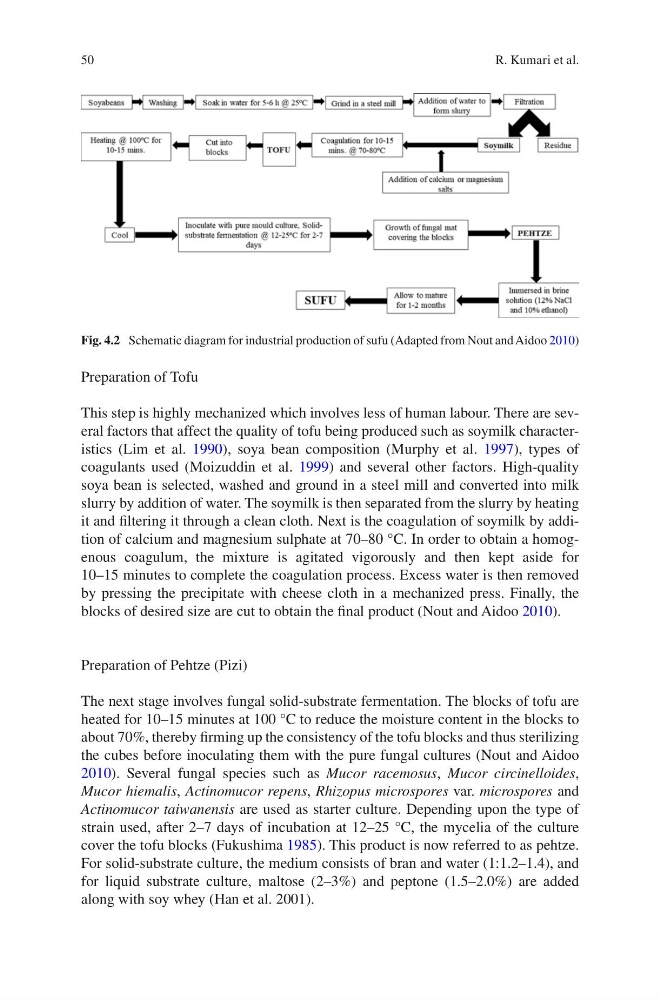
it and filtering it through a clean cloth. Next is the coagulation of soymilk by addition of calcium and magnesium sulphate at 70–80 °C. In order to obtain a homogenous coagulum, the mixture is agitated vigorously and then kept aside for
10–15 minutes to complete the coagulation process. Excess water is then removed
by pressing the precipitate with cheese cloth in a mechanized press. Finally, the
blocks of desired size are cut to obtain the final product (Nout and Aidoo 2010).
Preparation of Pehtze (Pizi)
The next stage involves fungal solid-substrate fermentation. The blocks of tofu are
heated for 10–15 minutes at 100 °C to reduce the moisture content in the blocks to
about 70%, thereby firming up the consistency of the tofu blocks and thus sterilizing
the cubes before inoculating them with the pure fungal cultures (Nout and Aidoo
2010). Several fungal species such as Mucor racemosus, Mucor circinelloides,
Mucor hiemalis, Actinomucor repens, Rhizopus microspores var. microspores and
Actinomucor taiwanensis are used as starter culture. Depending upon the type of
strain used, after 2–7 days of incubation at 12–25 °C, the mycelia of the culture
cover the tofu blocks (Fukushima 1985). This product is now referred to as pehtze.
For solid-substrate culture, the medium consists of bran and water (1:1.2–1.4), and
for liquid substrate culture, maltose (2–3%) and peptone (1.5–2.0%) are added
along with soy whey (Han et al. 2001).
Fig. 4.2 Schematic diagram for industrial production of sufu (Adapted from Nout and Aidoo 2010)
R. Kumari et al.
Preparation of Tofu
This step is highly mechanized which involves less of human labour. There are several factors that affect the quality of tofu being produced such as soymilk characteristics (Lim et al. 1990), soya bean composition (Murphy et al. 1997), types of
coagulants used (Moizuddin et al. 1999) and several other factors. High-quality
soya bean is selected, washed and ground in a steel mill and converted into milk
slurry by addition of water. The soymilk is then separated from the slurry by heating
it and filtering it through a clean cloth. Next is the coagulation of soymilk by addition of calcium and magnesium sulphate at 70–80 °C. In order to obtain a homogenous coagulum, the mixture is agitated vigorously and then kept aside for
10–15 minutes to complete the coagulation process. Excess water is then removed
by pressing the precipitate with cheese cloth in a mechanized press. Finally, the
blocks of desired size are cut to obtain the final product (Nout and Aidoo 2010).
Preparation of Pehtze (Pizi)
The next stage involves fungal solid-substrate fermentation. The blocks of tofu are
heated for 10–15 minutes at 100 °C to reduce the moisture content in the blocks to
about 70%, thereby firming up the consistency of the tofu blocks and thus sterilizing
the cubes before inoculating them with the pure fungal cultures (Nout and Aidoo
2010). Several fungal species such as Mucor racemosus, Mucor circinelloides,
Mucor hiemalis, Actinomucor repens, Rhizopus microspores var. microspores and
Actinomucor taiwanensis are used as starter culture. Depending upon the type of
strain used, after 2–7 days of incubation at 12–25 °C, the mycelia of the culture
cover the tofu blocks (Fukushima 1985). This product is now referred to as pehtze.
For solid-substrate culture, the medium consists of bran and water (1:1.2–1.4), and
for liquid substrate culture, maltose (2–3%) and peptone (1.5–2.0%) are added
along with soy whey (Han et al. 2001).
Fig. 4.2 Schematic diagram for industrial production of sufu (Adapted from Nout and Aidoo 2010)
R. Kumari et al.