

45
manufacturer. Another method is the sponge and dough method in which the ingredients are mixed in two steps. In this, the leavening agent is prepared in the first step.
The first step of this method involves the mixing of yeast, flour and water which is
kept aside for several hours. The next step involves the mixing of other ingredients.
The third method involves the mixing of all ingredients in one go in an ultrahigh
mixer for few minutes. This method is commonly known as Chorleywood method
(Giannou et al. 2003).
Bakers in large industries basically use two methods to prepare bread: mechanical dough development method and bulk fermentation method (O’Donnell 1996).
The bulk fermentation method is a traditional method where the dough is kept
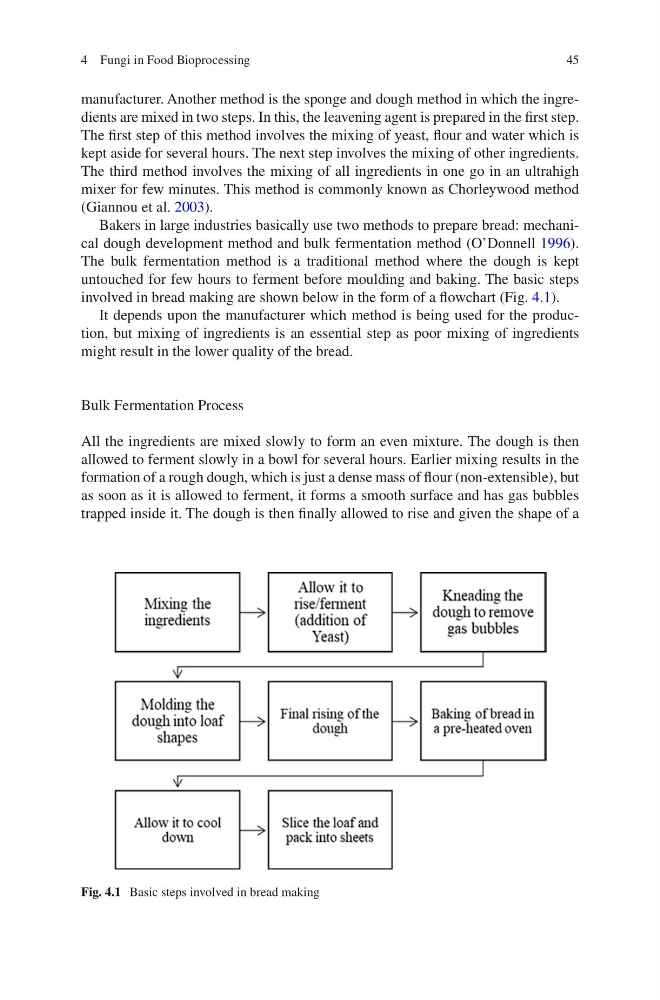
untouched for few hours to ferment before moulding and baking. The basic steps
involved in bread making are shown below in the form of a flowchart (Fig. 4.1).
It depends upon the manufacturer which method is being used for the production, but mixing of ingredients is an essential step as poor mixing of ingredients
might result in the lower quality of the bread.
Bulk Fermentation Process
All the ingredients are mixed slowly to form an even mixture. The dough is then
allowed to ferment slowly in a bowl for several hours. Earlier mixing results in the
formation of a rough dough, which is just a dense mass of flour (non-extensible), but
as soon as it is allowed to ferment, it forms a smooth surface and has gas bubbles
trapped inside it. The dough is then finally allowed to rise and given the shape of a
Fig. 4.1 Basic steps involved in bread making
4 Fungi in Food Bioprocessing
manufacturer. Another method is the sponge and dough method in which the ingredients are mixed in two steps. In this, the leavening agent is prepared in the first step.
The first step of this method involves the mixing of yeast, flour and water which is
kept aside for several hours. The next step involves the mixing of other ingredients.
The third method involves the mixing of all ingredients in one go in an ultrahigh
mixer for few minutes. This method is commonly known as Chorleywood method
(Giannou et al. 2003).
Bakers in large industries basically use two methods to prepare bread: mechanical dough development method and bulk fermentation method (O’Donnell 1996).
The bulk fermentation method is a traditional method where the dough is kept
untouched for few hours to ferment before moulding and baking. The basic steps
involved in bread making are shown below in the form of a flowchart (Fig. 4.1).
It depends upon the manufacturer which method is being used for the production, but mixing of ingredients is an essential step as poor mixing of ingredients
might result in the lower quality of the bread.
Bulk Fermentation Process
All the ingredients are mixed slowly to form an even mixture. The dough is then
allowed to ferment slowly in a bowl for several hours. Earlier mixing results in the
formation of a rough dough, which is just a dense mass of flour (non-extensible), but
as soon as it is allowed to ferment, it forms a smooth surface and has gas bubbles
trapped inside it. The dough is then finally allowed to rise and given the shape of a
Fig. 4.1 Basic steps involved in bread making
4 Fungi in Food Bioprocessing