

215
12.10 Ochratoxins
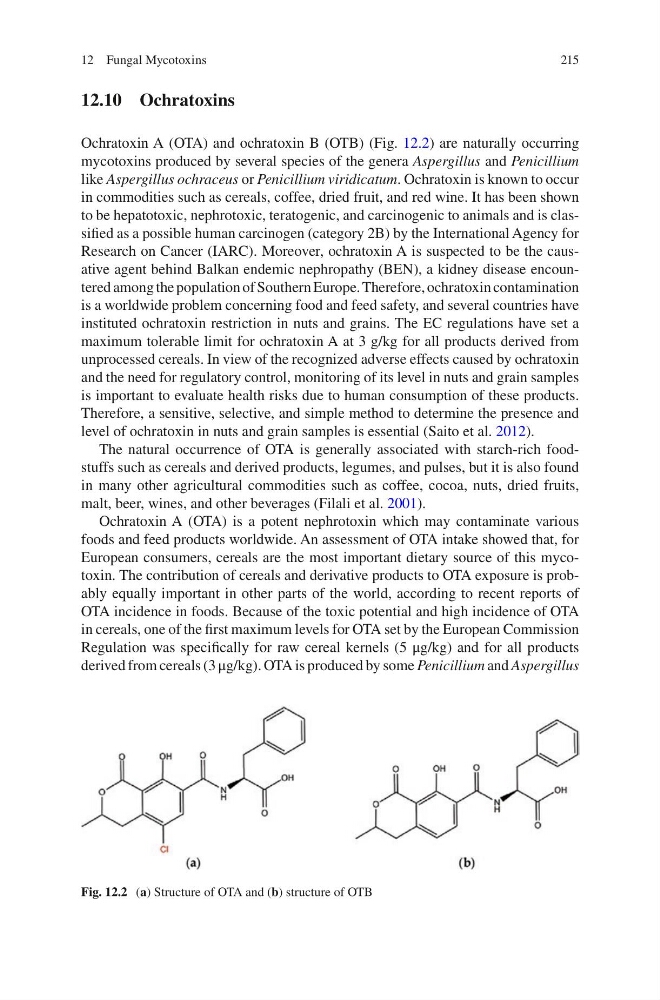
Ochratoxin A (OTA) and ochratoxin B (OTB) (Fig. 12.2) are naturally occurring
mycotoxins produced by several species of the genera Aspergillus and Penicillium
like Aspergillus ochraceus or Penicillium viridicatum. Ochratoxin is known to occur
in commodities such as cereals, coffee, dried fruit, and red wine. It has been shown
to be hepatotoxic, nephrotoxic, teratogenic, and carcinogenic to animals and is classified as a possible human carcinogen (category 2B) by the International Agency for
Research on Cancer (IARC). Moreover, ochratoxin A is suspected to be the causative agent behind Balkan endemic nephropathy (BEN), a kidney disease encountered among the population of Southern Europe. Therefore, ochratoxin contamination
is a worldwide problem concerning food and feed safety, and several countries have
instituted ochratoxin restriction in nuts and grains. The EC regulations have set a
maximum tolerable limit for ochratoxin A at 3 g/kg for all products derived from
unprocessed cereals. In view of the recognized adverse effects caused by ochratoxin
and the need for regulatory control, monitoring of its level in nuts and grain samples
is important to evaluate health risks due to human consumption of these products.
Therefore, a sensitive, selective, and simple method to determine the presence and
level of ochratoxin in nuts and grain samples is essential (Saito et al. 2012).
The natural occurrence of OTA is generally associated with starch-rich foodstuffs such as cereals and derived products, legumes, and pulses, but it is also found
in many other agricultural commodities such as coffee, cocoa, nuts, dried fruits,
malt, beer, wines, and other beverages (Filali et al. 2001).
Ochratoxin A (OTA) is a potent nephrotoxin which may contaminate various
foods and feed products worldwide. An assessment of OTA intake showed that, for
European consumers, cereals are the most important dietary source of this mycotoxin. The contribution of cereals and derivative products to OTA exposure is probably equally important in other parts of the world, according to recent reports of
OTA incidence in foods. Because of the toxic potential and high incidence of OTA
in cereals, one of the first maximum levels for OTA set by the European Commission
Regulation was specifically for raw cereal kernels (5 μg/kg) and for all products
derived from cereals (3 μg/kg). OTA is produced by some Penicillium and Aspergillus
Fig. 12.2 (a) Structure of OTA and (b) structure of OTB
12 Fungal Mycotoxins
12.10 Ochratoxins
Ochratoxin A (OTA) and ochratoxin B (OTB) (Fig. 12.2) are naturally occurring
mycotoxins produced by several species of the genera Aspergillus and Penicillium
like Aspergillus ochraceus or Penicillium viridicatum. Ochratoxin is known to occur
in commodities such as cereals, coffee, dried fruit, and red wine. It has been shown
to be hepatotoxic, nephrotoxic, teratogenic, and carcinogenic to animals and is classified as a possible human carcinogen (category 2B) by the International Agency for
Research on Cancer (IARC). Moreover, ochratoxin A is suspected to be the causative agent behind Balkan endemic nephropathy (BEN), a kidney disease encountered among the population of Southern Europe. Therefore, ochratoxin contamination
is a worldwide problem concerning food and feed safety, and several countries have
instituted ochratoxin restriction in nuts and grains. The EC regulations have set a
maximum tolerable limit for ochratoxin A at 3 g/kg for all products derived from
unprocessed cereals. In view of the recognized adverse effects caused by ochratoxin
and the need for regulatory control, monitoring of its level in nuts and grain samples
is important to evaluate health risks due to human consumption of these products.
Therefore, a sensitive, selective, and simple method to determine the presence and
level of ochratoxin in nuts and grain samples is essential (Saito et al. 2012).
The natural occurrence of OTA is generally associated with starch-rich foodstuffs such as cereals and derived products, legumes, and pulses, but it is also found
in many other agricultural commodities such as coffee, cocoa, nuts, dried fruits,
malt, beer, wines, and other beverages (Filali et al. 2001).
Ochratoxin A (OTA) is a potent nephrotoxin which may contaminate various
foods and feed products worldwide. An assessment of OTA intake showed that, for
European consumers, cereals are the most important dietary source of this mycotoxin. The contribution of cereals and derivative products to OTA exposure is probably equally important in other parts of the world, according to recent reports of
OTA incidence in foods. Because of the toxic potential and high incidence of OTA
in cereals, one of the first maximum levels for OTA set by the European Commission
Regulation was specifically for raw cereal kernels (5 μg/kg) and for all products
derived from cereals (3 μg/kg). OTA is produced by some Penicillium and Aspergillus
Fig. 12.2 (a) Structure of OTA and (b) structure of OTB
12 Fungal Mycotoxins