

208
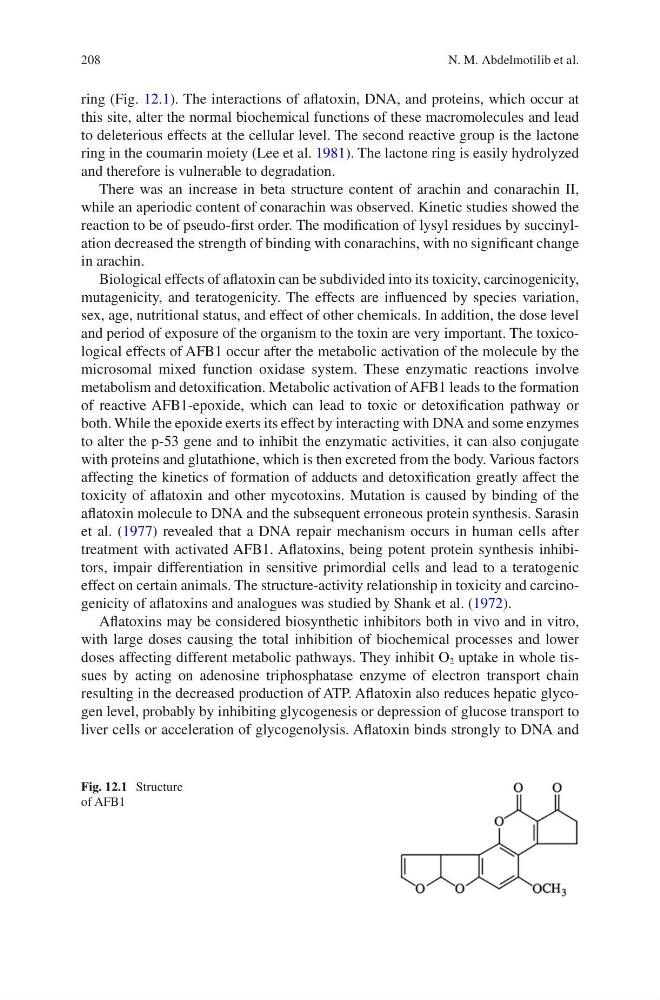
ring (Fig. 12.1). The interactions of aflatoxin, DNA, and proteins, which occur at
this site, alter the normal biochemical functions of these macromolecules and lead
to deleterious effects at the cellular level. The second reactive group is the lactone
ring in the coumarin moiety (Lee et al. 1981). The lactone ring is easily hydrolyzed
and therefore is vulnerable to degradation.
There was an increase in beta structure content of arachin and conarachin II,
while an aperiodic content of conarachin was observed. Kinetic studies showed the
reaction to be of pseudo-first order. The modification of lysyl residues by succinylation decreased the strength of binding with conarachins, with no significant change
in arachin.
Biological effects of aflatoxin can be subdivided into its toxicity, carcinogenicity,
mutagenicity, and teratogenicity. The effects are influenced by species variation,
sex, age, nutritional status, and effect of other chemicals. In addition, the dose level
and period of exposure of the organism to the toxin are very important. The toxicological effects of AFB1 occur after the metabolic activation of the molecule by the
microsomal mixed function oxidase system. These enzymatic reactions involve
metabolism and detoxification. Metabolic activation of AFB1 leads to the formation
of reactive AFB1-epoxide, which can lead to toxic or detoxification pathway or
both. While the epoxide exerts its effect by interacting with DNA and some enzymes
to alter the p-53 gene and to inhibit the enzymatic activities, it can also conjugate
with proteins and glutathione, which is then excreted from the body. Various factors
affecting the kinetics of formation of adducts and detoxification greatly affect the
toxicity of aflatoxin and other mycotoxins. Mutation is caused by binding of the
aflatoxin molecule to DNA and the subsequent erroneous protein synthesis. Sarasin
et al. (1977) revealed that a DNA repair mechanism occurs in human cells after
treatment with activated AFB1. Aflatoxins, being potent protein synthesis inhibitors, impair differentiation in sensitive primordial cells and lead to a teratogenic
effect on certain animals. The structure-activity relationship in toxicity and carcinogenicity of aflatoxins and analogues was studied by Shank et al. (1972).
Aflatoxins may be considered biosynthetic inhibitors both in vivo and in vitro,
with large doses causing the total inhibition of biochemical processes and lower
doses affecting different metabolic pathways. They inhibit O 2 uptake in whole tissues by acting on adenosine triphosphatase enzyme of electron transport chain
resulting in the decreased production of ATP. Aflatoxin also reduces hepatic glycogen level, probably by inhibiting glycogenesis or depression of glucose transport to
liver cells or acceleration of glycogenolysis. Aflatoxin binds strongly to DNA and
Fig. 12.1 Structure
of AFB1
N. M. Abdelmotilib et al.
ring (Fig. 12.1). The interactions of aflatoxin, DNA, and proteins, which occur at
this site, alter the normal biochemical functions of these macromolecules and lead
to deleterious effects at the cellular level. The second reactive group is the lactone
ring in the coumarin moiety (Lee et al. 1981). The lactone ring is easily hydrolyzed
and therefore is vulnerable to degradation.
There was an increase in beta structure content of arachin and conarachin II,
while an aperiodic content of conarachin was observed. Kinetic studies showed the
reaction to be of pseudo-first order. The modification of lysyl residues by succinylation decreased the strength of binding with conarachins, with no significant change
in arachin.
Biological effects of aflatoxin can be subdivided into its toxicity, carcinogenicity,
mutagenicity, and teratogenicity. The effects are influenced by species variation,
sex, age, nutritional status, and effect of other chemicals. In addition, the dose level
and period of exposure of the organism to the toxin are very important. The toxicological effects of AFB1 occur after the metabolic activation of the molecule by the
microsomal mixed function oxidase system. These enzymatic reactions involve
metabolism and detoxification. Metabolic activation of AFB1 leads to the formation
of reactive AFB1-epoxide, which can lead to toxic or detoxification pathway or
both. While the epoxide exerts its effect by interacting with DNA and some enzymes
to alter the p-53 gene and to inhibit the enzymatic activities, it can also conjugate
with proteins and glutathione, which is then excreted from the body. Various factors
affecting the kinetics of formation of adducts and detoxification greatly affect the
toxicity of aflatoxin and other mycotoxins. Mutation is caused by binding of the
aflatoxin molecule to DNA and the subsequent erroneous protein synthesis. Sarasin
et al. (1977) revealed that a DNA repair mechanism occurs in human cells after
treatment with activated AFB1. Aflatoxins, being potent protein synthesis inhibitors, impair differentiation in sensitive primordial cells and lead to a teratogenic
effect on certain animals. The structure-activity relationship in toxicity and carcinogenicity of aflatoxins and analogues was studied by Shank et al. (1972).
Aflatoxins may be considered biosynthetic inhibitors both in vivo and in vitro,
with large doses causing the total inhibition of biochemical processes and lower
doses affecting different metabolic pathways. They inhibit O 2 uptake in whole tissues by acting on adenosine triphosphatase enzyme of electron transport chain
resulting in the decreased production of ATP. Aflatoxin also reduces hepatic glycogen level, probably by inhibiting glycogenesis or depression of glucose transport to
liver cells or acceleration of glycogenolysis. Aflatoxin binds strongly to DNA and
Fig. 12.1 Structure
of AFB1
N. M. Abdelmotilib et al.