

191
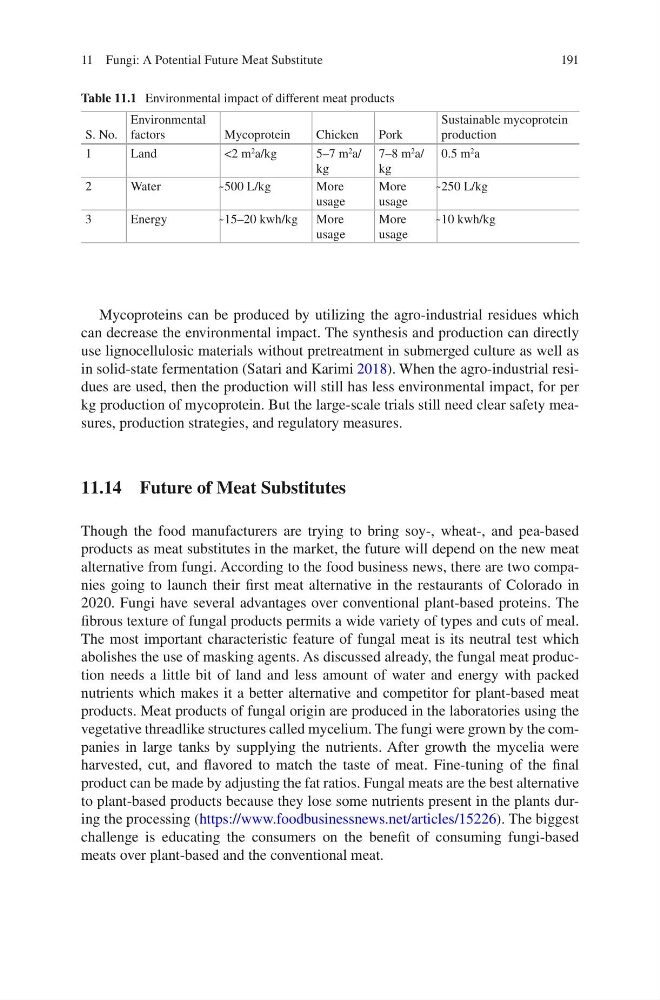
Mycoproteins can be produced by utilizing the agro-industrial residues which
can decrease the environmental impact. The synthesis and production can directly
use lignocellulosic materials without pretreatment in submerged culture as well as
in solid-state fermentation (Satari and Karimi 2018). When the agro-industrial residues are used, then the production will still has less environmental impact, for per
kg production of mycoprotein. But the large-scale trials still need clear safety measures, production strategies, and regulatory measures.
11.14 Future of Meat Substitutes
Though the food manufacturers are trying to bring soy-, wheat-, and pea-based
products as meat substitutes in the market, the future will depend on the new meat
alternative from fungi. According to the food business news, there are two companies going to launch their first meat alternative in the restaurants of Colorado in
2020. Fungi have several advantages over conventional plant-based proteins. The
fibrous texture of fungal products permits a wide variety of types and cuts of meal.
The most important characteristic feature of fungal meat is its neutral test which
abolishes the use of masking agents. As discussed already, the fungal meat production needs a little bit of land and less amount of water and energy with packed
nutrients which makes it a better alternative and competitor for plant-based meat
products. Meat products of fungal origin are produced in the laboratories using the
vegetative threadlike structures called mycelium. The fungi were grown by the companies in large tanks by supplying the nutrients. After growth the mycelia were
harvested, cut, and flavored to match the taste of meat. Fine-tuning of the final
product can be made by adjusting the fat ratios. Fungal meats are the best alternative
to plant-based products because they lose some nutrients present in the plants during the processing (https://www.foodbusinessnews.net/articles/15226). The biggest
challenge is educating the consumers on the benefit of consuming fungi-based
meats over plant-based and the conventional meat.
Table 11.1 Environmental impact of different meat products
S. No.
Environmental
factors
Mycoprotein
Chicken
Pork
Sustainable mycoprotein
production
1
Land
<2 m
2 a/kg
5–7 m
2 a/
kg
7–8 m
2 a/
kg
0.5 m
2
a
2
Water
̴ 500 L/kg
More
usage
More
usage
̴ 250 L/kg
3
Energy
̴ 15–20 kwh/kg More
usage
More
usage
̴ 10 kwh/kg
11 Fungi: A Potential Future Meat Substitute
Mycoproteins can be produced by utilizing the agro-industrial residues which
can decrease the environmental impact. The synthesis and production can directly
use lignocellulosic materials without pretreatment in submerged culture as well as
in solid-state fermentation (Satari and Karimi 2018). When the agro-industrial residues are used, then the production will still has less environmental impact, for per
kg production of mycoprotein. But the large-scale trials still need clear safety measures, production strategies, and regulatory measures.
11.14 Future of Meat Substitutes
Though the food manufacturers are trying to bring soy-, wheat-, and pea-based
products as meat substitutes in the market, the future will depend on the new meat
alternative from fungi. According to the food business news, there are two companies going to launch their first meat alternative in the restaurants of Colorado in
2020. Fungi have several advantages over conventional plant-based proteins. The
fibrous texture of fungal products permits a wide variety of types and cuts of meal.
The most important characteristic feature of fungal meat is its neutral test which
abolishes the use of masking agents. As discussed already, the fungal meat production needs a little bit of land and less amount of water and energy with packed
nutrients which makes it a better alternative and competitor for plant-based meat
products. Meat products of fungal origin are produced in the laboratories using the
vegetative threadlike structures called mycelium. The fungi were grown by the companies in large tanks by supplying the nutrients. After growth the mycelia were
harvested, cut, and flavored to match the taste of meat. Fine-tuning of the final
product can be made by adjusting the fat ratios. Fungal meats are the best alternative
to plant-based products because they lose some nutrients present in the plants during the processing (https://www.foodbusinessnews.net/articles/15226). The biggest
challenge is educating the consumers on the benefit of consuming fungi-based
meats over plant-based and the conventional meat.
Table 11.1 Environmental impact of different meat products
S. No.
Environmental
factors
Mycoprotein
Chicken
Pork
Sustainable mycoprotein
production
1
Land
<2 m
2 a/kg
5–7 m
2 a/
kg
7–8 m
2 a/
kg
0.5 m
2
a
2
Water
̴ 500 L/kg
More
usage
More
usage
̴ 250 L/kg
3
Energy
̴ 15–20 kwh/kg More
usage
More
usage
̴ 10 kwh/kg
11 Fungi: A Potential Future Meat Substitute