

135
make it a good candidate for large-scale production of high nutritional quality protein extracts, potentially applicable to human nutrition. One example could be to
increase the protein quality of cereal-based food products. Generally, SCP has been
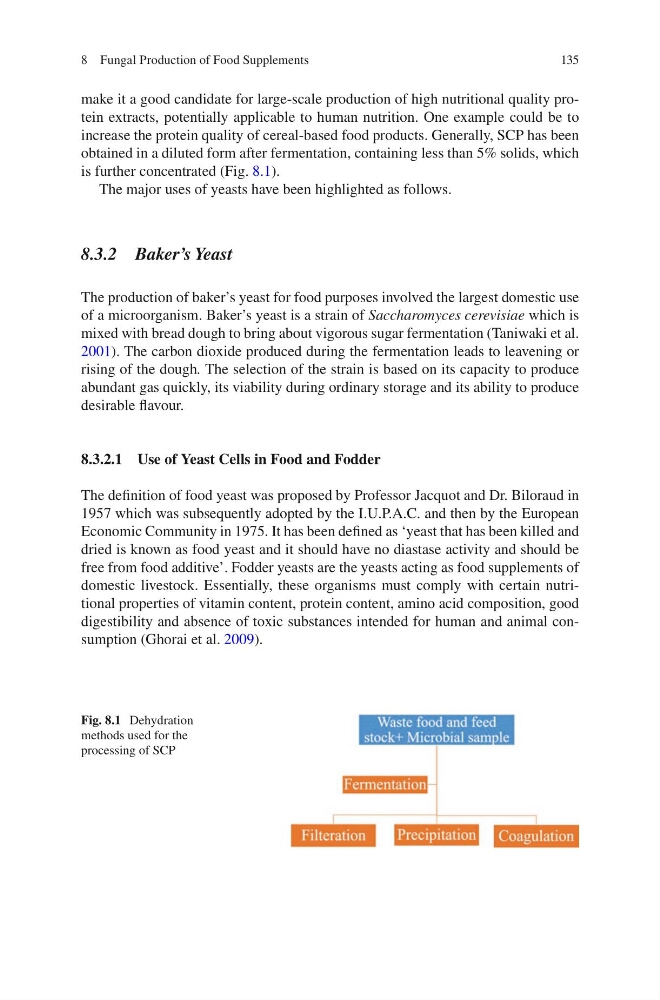
obtained in a diluted form after fermentation, containing less than 5% solids, which
is further concentrated (Fig. 8.1).
The major uses of yeasts have been highlighted as follows.
8.3.2 Baker’s Yeast
The production of baker’s yeast for food purposes involved the largest domestic use
of a microorganism. Baker’s yeast is a strain of Saccharomyces cerevisiae which is
mixed with bread dough to bring about vigorous sugar fermentation (Taniwaki et al.
2001). The carbon dioxide produced during the fermentation leads to leavening or
rising of the dough. The selection of the strain is based on its capacity to produce
abundant gas quickly, its viability during ordinary storage and its ability to produce
desirable flavour.
8.3.2.1 Use of Yeast Cells in Food and Fodder
The definition of food yeast was proposed by Professor Jacquot and Dr. Biloraud in
1957 which was subsequently adopted by the I.U.P.A.C. and then by the European
Economic Community in 1975. It has been defined as ‘yeast that has been killed and
dried is known as food yeast and it should have no diastase activity and should be
free from food additive’. Fodder yeasts are the yeasts acting as food supplements of
domestic livestock. Essentially, these organisms must comply with certain nutritional properties of vitamin content, protein content, amino acid composition, good
digestibility and absence of toxic substances intended for human and animal consumption (Ghorai et al. 2009).
Fig. 8.1 Dehydration
methods used for the
processing of SCP
8 Fungal Production of Food Supplements
make it a good candidate for large-scale production of high nutritional quality protein extracts, potentially applicable to human nutrition. One example could be to
increase the protein quality of cereal-based food products. Generally, SCP has been
obtained in a diluted form after fermentation, containing less than 5% solids, which
is further concentrated (Fig. 8.1).
The major uses of yeasts have been highlighted as follows.
8.3.2 Baker’s Yeast
The production of baker’s yeast for food purposes involved the largest domestic use
of a microorganism. Baker’s yeast is a strain of Saccharomyces cerevisiae which is
mixed with bread dough to bring about vigorous sugar fermentation (Taniwaki et al.
2001). The carbon dioxide produced during the fermentation leads to leavening or
rising of the dough. The selection of the strain is based on its capacity to produce
abundant gas quickly, its viability during ordinary storage and its ability to produce
desirable flavour.
8.3.2.1 Use of Yeast Cells in Food and Fodder
The definition of food yeast was proposed by Professor Jacquot and Dr. Biloraud in
1957 which was subsequently adopted by the I.U.P.A.C. and then by the European
Economic Community in 1975. It has been defined as ‘yeast that has been killed and
dried is known as food yeast and it should have no diastase activity and should be
free from food additive’. Fodder yeasts are the yeasts acting as food supplements of
domestic livestock. Essentially, these organisms must comply with certain nutritional properties of vitamin content, protein content, amino acid composition, good
digestibility and absence of toxic substances intended for human and animal consumption (Ghorai et al. 2009).
Fig. 8.1 Dehydration
methods used for the
processing of SCP
8 Fungal Production of Food Supplements