

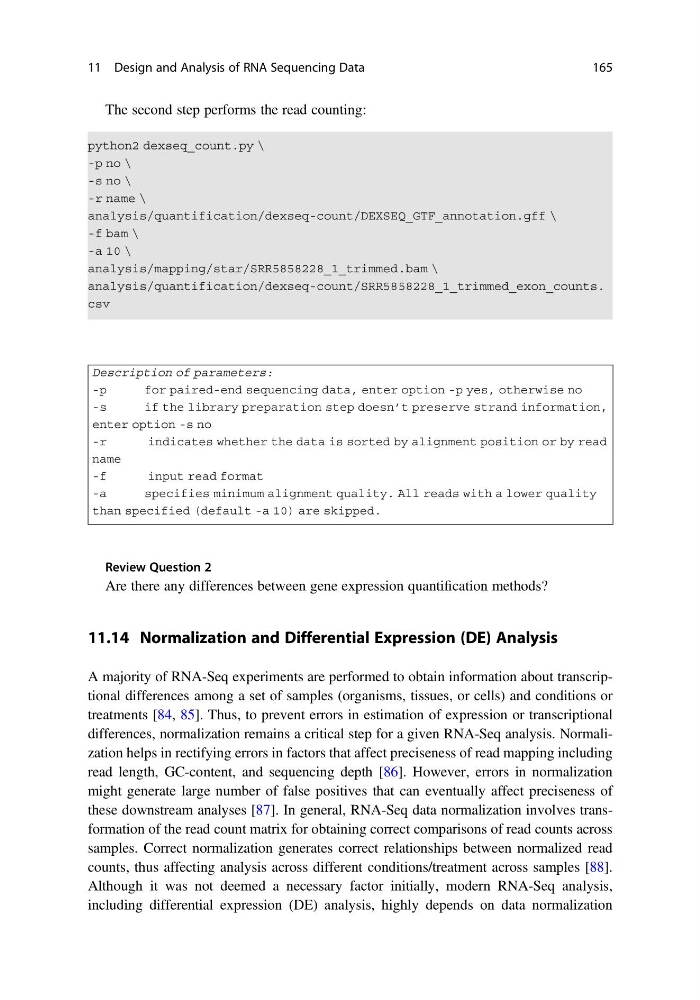
The second step performs the read counting:
Review Question 2
Are there any differences between gene expression quantification methods?
11.14 Normalization and Differential Expression (DE) Analysis
A majority of RNA-Seq experiments are performed to obtain information about transcriptional differences among a set of samples (organisms, tissues, or cells) and conditions or
treatments [84, 85]. Thus, to prevent errors in estimation of expression or transcriptional
differences, normalization remains a critical step for a given RNA-Seq analysis. Normalization helps in rectifying errors in factors that affect preciseness of read mapping including
read length, GC-content, and sequencing depth [86]. However, errors in normalization
might generate large number of false positives that can eventually affect preciseness of
these downstream analyses [87]. In general, RNA-Seq data normalization involves transformation of the read count matrix for obtaining correct comparisons of read counts across
samples. Correct normalization generates correct relationships between normalized read
counts, thus affecting analysis across different conditions/treatment across samples [88].
Although it was not deemed a necessary factor initially, modern RNA-Seq analysis,
including differential expression (DE) analysis, highly depends on data normalization
11 Design and Analysis of RNA Sequencing Data
165
Review Question 2
Are there any differences between gene expression quantification methods?
11.14 Normalization and Differential Expression (DE) Analysis
A majority of RNA-Seq experiments are performed to obtain information about transcriptional differences among a set of samples (organisms, tissues, or cells) and conditions or
treatments [84, 85]. Thus, to prevent errors in estimation of expression or transcriptional
differences, normalization remains a critical step for a given RNA-Seq analysis. Normalization helps in rectifying errors in factors that affect preciseness of read mapping including
read length, GC-content, and sequencing depth [86]. However, errors in normalization
might generate large number of false positives that can eventually affect preciseness of
these downstream analyses [87]. In general, RNA-Seq data normalization involves transformation of the read count matrix for obtaining correct comparisons of read counts across
samples. Correct normalization generates correct relationships between normalized read
counts, thus affecting analysis across different conditions/treatment across samples [88].
Although it was not deemed a necessary factor initially, modern RNA-Seq analysis,
including differential expression (DE) analysis, highly depends on data normalization
11 Design and Analysis of RNA Sequencing Data
165