

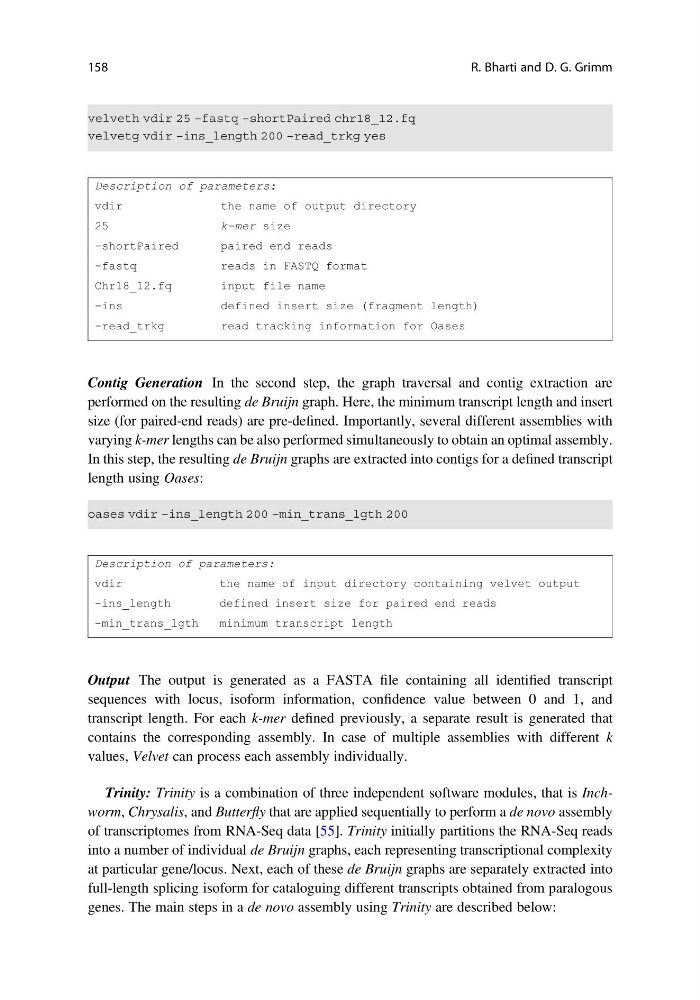
Description of parameters:
vdir
the name of output directory
25
k-mer size
-shortPaired
paired end reads
-fastq
reads in FASTQ format
Chr18_12.fq
input file name
-ins
defined insert size (fragment length)
-read_trkg
read tracking information for Oases
Contig Generation In the second step, the graph traversal and contig extraction are
performed on the resulting de Bruijn graph. Here, the minimum transcript length and insert
size (for paired-end reads) are pre-defined. Importantly, several different assemblies with
varying k-mer lengths can be also performed simultaneously to obtain an optimal assembly.
In this step, the resulting de Bruijn graphs are extracted into contigs for a defined transcript
length using Oases:
Description of parameters:
vdir
the name of input directory containing velvet output
-ins_length
defined insert size for paired end reads
-min_trans_lgth
minimum transcript length
Output The output is generated as a FASTA file containing all identified transcript
sequences with locus, isoform information, confidence value between 0 and 1, and
transcript length. For each k-mer defined previously, a separate result is generated that
contains the corresponding assembly. In case of multiple assemblies with different k
values, Velvet can process each assembly individually.
Trinity: Trinity is a combination of three independent software modules, that is Inchworm, Chrysalis, and Butterfly that are applied sequentially to perform a de novo assembly
of transcriptomes from RNA-Seq data [55]. Trinity initially partitions the RNA-Seq reads
into a number of individual de Bruijn graphs, each representing transcriptional complexity
at particular gene/locus. Next, each of these de Bruijn graphs are separately extracted into
full-length splicing isoform for cataloguing different transcripts obtained from paralogous
genes. The main steps in a de novo assembly using Trinity are described below:
158
R. Bharti and D. G. Grimm
vdir
the name of output directory
25
k-mer size
-shortPaired
paired end reads
-fastq
reads in FASTQ format
Chr18_12.fq
input file name
-ins
defined insert size (fragment length)
-read_trkg
read tracking information for Oases
Contig Generation In the second step, the graph traversal and contig extraction are
performed on the resulting de Bruijn graph. Here, the minimum transcript length and insert
size (for paired-end reads) are pre-defined. Importantly, several different assemblies with
varying k-mer lengths can be also performed simultaneously to obtain an optimal assembly.
In this step, the resulting de Bruijn graphs are extracted into contigs for a defined transcript
length using Oases:
Description of parameters:
vdir
the name of input directory containing velvet output
-ins_length
defined insert size for paired end reads
-min_trans_lgth
minimum transcript length
Output The output is generated as a FASTA file containing all identified transcript
sequences with locus, isoform information, confidence value between 0 and 1, and
transcript length. For each k-mer defined previously, a separate result is generated that
contains the corresponding assembly. In case of multiple assemblies with different k
values, Velvet can process each assembly individually.
Trinity: Trinity is a combination of three independent software modules, that is Inchworm, Chrysalis, and Butterfly that are applied sequentially to perform a de novo assembly
of transcriptomes from RNA-Seq data [55]. Trinity initially partitions the RNA-Seq reads
into a number of individual de Bruijn graphs, each representing transcriptional complexity
at particular gene/locus. Next, each of these de Bruijn graphs are separately extracted into
full-length splicing isoform for cataloguing different transcripts obtained from paralogous
genes. The main steps in a de novo assembly using Trinity are described below:
158
R. Bharti and D. G. Grimm