

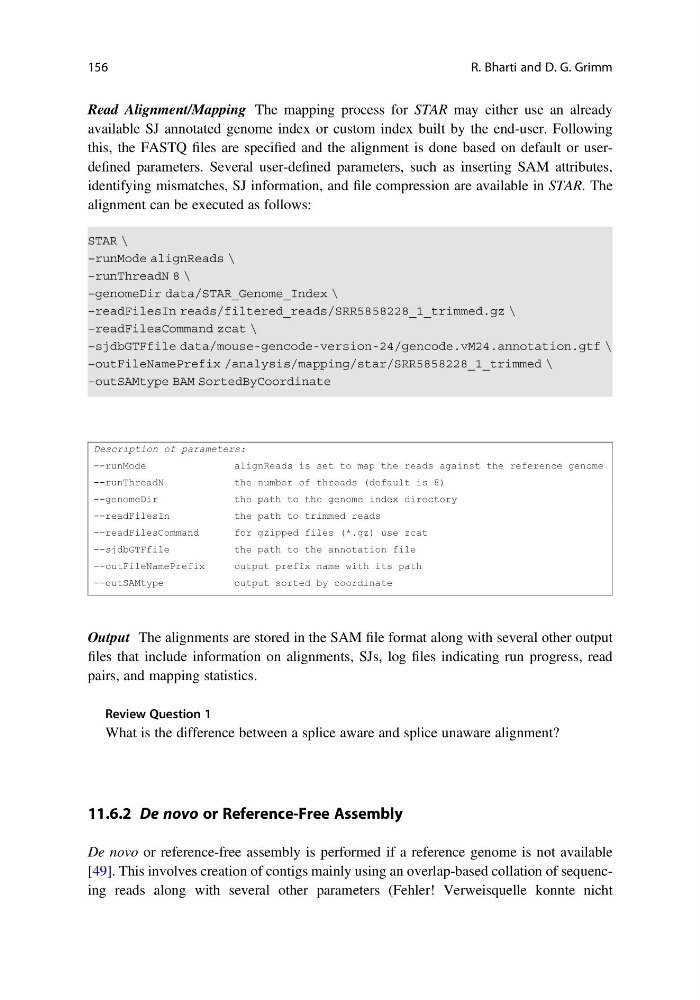
Read Alignment/Mapping The mapping process for STAR may either use an already
available SJ annotated genome index or custom index built by the end-user. Following
this, the FASTQ files are specified and the alignment is done based on default or userdefined parameters. Several user-defined parameters, such as inserting SAM attributes,
identifying mismatches, SJ information, and file compression are available in STAR. The
alignment can be executed as follows:
Description of parameters:
--runMode
alignReads is set to map the reads against the reference genome
--runThreadN
the number of threads (default is 8)
--genomeDir
the path to the genome index directory
--readFilesIn
the path to trimmed reads
--readFilesCommand
for gzipped files (*.gz) use zcat
--sjdbGTFfile
the path to the annotation file
--outFileNamePrefix
output prefix name with its path
--outSAMtype
output sorted by coordinate
Output The alignments are stored in the SAM file format along with several other output
files that include information on alignments, SJs, log files indicating run progress, read
pairs, and mapping statistics.
Review Question 1
What is the difference between a splice aware and splice unaware alignment?
11.6.2 De novo or Reference-Free Assembly
De novo or reference-free assembly is performed if a reference genome is not available
[49]. This involves creation of contigs mainly using an overlap-based collation of sequencing reads along with several other parameters (Fehler! Verweisquelle konnte nicht
156
R. Bharti and D. G. Grimm
available SJ annotated genome index or custom index built by the end-user. Following
this, the FASTQ files are specified and the alignment is done based on default or userdefined parameters. Several user-defined parameters, such as inserting SAM attributes,
identifying mismatches, SJ information, and file compression are available in STAR. The
alignment can be executed as follows:
Description of parameters:
--runMode
alignReads is set to map the reads against the reference genome
--runThreadN
the number of threads (default is 8)
--genomeDir
the path to the genome index directory
--readFilesIn
the path to trimmed reads
--readFilesCommand
for gzipped files (*.gz) use zcat
--sjdbGTFfile
the path to the annotation file
--outFileNamePrefix
output prefix name with its path
--outSAMtype
output sorted by coordinate
Output The alignments are stored in the SAM file format along with several other output
files that include information on alignments, SJs, log files indicating run progress, read
pairs, and mapping statistics.
Review Question 1
What is the difference between a splice aware and splice unaware alignment?
11.6.2 De novo or Reference-Free Assembly
De novo or reference-free assembly is performed if a reference genome is not available
[49]. This involves creation of contigs mainly using an overlap-based collation of sequencing reads along with several other parameters (Fehler! Verweisquelle konnte nicht
156
R. Bharti and D. G. Grimm