

a
b
Unspliced
alignment
Reference genome/transcriptome
Mapped segments
Unmapped segment
Maximum mappable
length
Read
Reference genome
Seed 1
Donor
site
Acceptor
site
Reference genome
Stitched read
Seed 2
Spliced
alignment
Unmapped reads
x
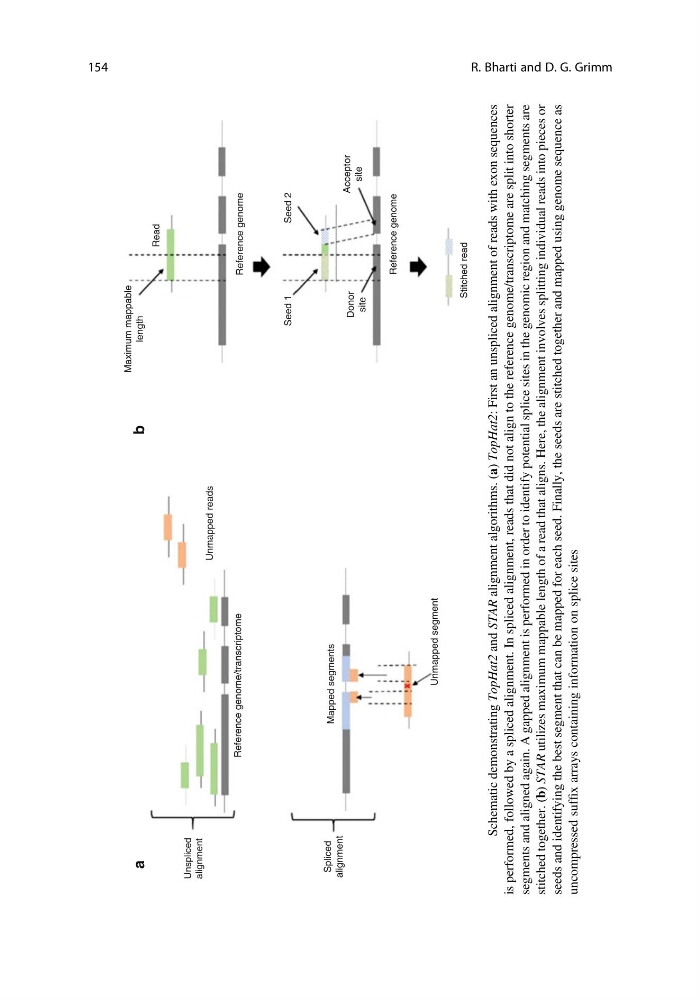
Fig. 11.4
Schematic demonstrating TopHat2
and STAR
alignment algorithms. (a) TopHat2:
First an unspliced alignment of reads with exon sequences
is performed, followed by a spliced alignment. In spliced alignment, reads that did not align to the reference genome/transcriptome are split into shorter
segments and aligned again. A gapped alignment is performed in order to identify potential splice sites in the genomic region and matching segments are
stitched together. (b) STAR
utilizes maximum mappable length of a read that aligns. Here, the alignment involves splitting individual reads into pieces or
seeds and identifying the best segment that can be mapped for each seed. Finally, the seeds are stitched together and mapped using genome sequence as
uncompressed suffix arrays containing information on splice sites
154
R. Bharti and D. G. Grimm
b
Unspliced
alignment
Reference genome/transcriptome
Mapped segments
Unmapped segment
Maximum mappable
length
Read
Reference genome
Seed 1
Donor
site
Acceptor
site
Reference genome
Stitched read
Seed 2
Spliced
alignment
Unmapped reads
x
Fig. 11.4
Schematic demonstrating TopHat2
and STAR
alignment algorithms. (a) TopHat2:
First an unspliced alignment of reads with exon sequences
is performed, followed by a spliced alignment. In spliced alignment, reads that did not align to the reference genome/transcriptome are split into shorter
segments and aligned again. A gapped alignment is performed in order to identify potential splice sites in the genomic region and matching segments are
stitched together. (b) STAR
utilizes maximum mappable length of a read that aligns. Here, the alignment involves splitting individual reads into pieces or
seeds and identifying the best segment that can be mapped for each seed. Finally, the seeds are stitched together and mapped using genome sequence as
uncompressed suffix arrays containing information on splice sites
154
R. Bharti and D. G. Grimm