

Fig. 11.1
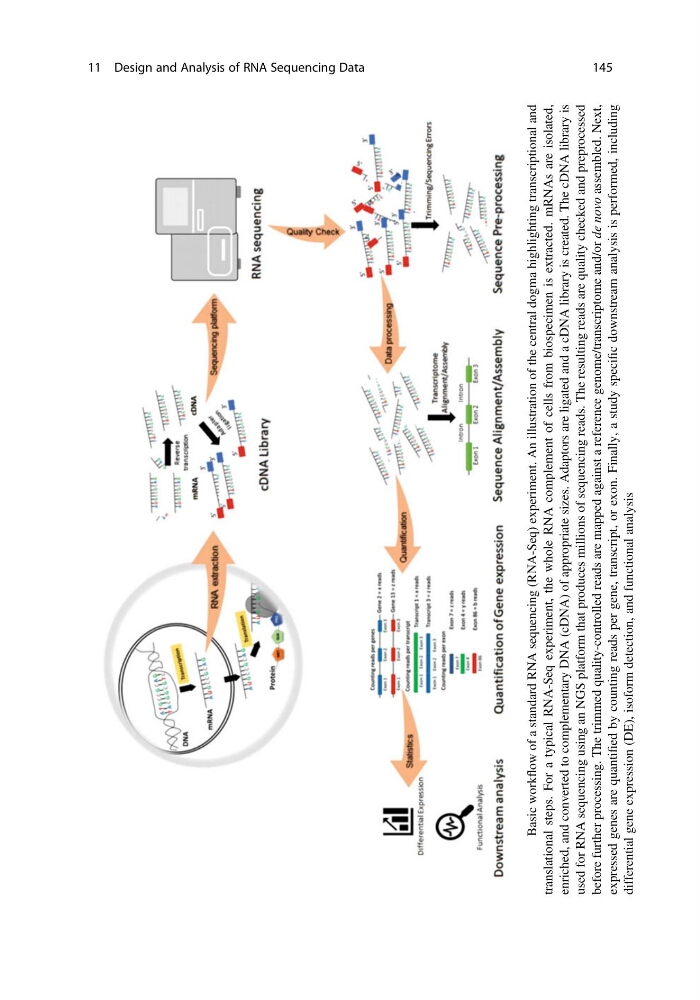
Basic workflow of a standard RNA sequencing (RNA-Seq) experiment. An illustration of the central dogma highlighting transcriptional and
translational steps. For a typical RNA-Seq experiment, the whole RNA complement of cells from biospecimen is extracted. mRNAs are isolated,
enriched, and converted to complementary DNA (cDNA) of appropriate sizes. Adaptors are ligated and a cDNA library is created. The cDNA library is
used for RNA sequencing using an NGS platform that produces millions of sequencing reads. The resulting reads are quality checked and preprocessed
before further processing. The trimmed quality-controlled reads are mapped against a reference genome/transcriptome and/or de novo
assembled. Next,
expressed genes are quantified by counting reads per gene, transcript, or exon. Finally, a study specific downstream analysis is performed, including
differential gene expression (DE), isoform detection, and functional analysis
11 Design and Analysis of RNA Sequencing Data
145
Basic workflow of a standard RNA sequencing (RNA-Seq) experiment. An illustration of the central dogma highlighting transcriptional and
translational steps. For a typical RNA-Seq experiment, the whole RNA complement of cells from biospecimen is extracted. mRNAs are isolated,
enriched, and converted to complementary DNA (cDNA) of appropriate sizes. Adaptors are ligated and a cDNA library is created. The cDNA library is
used for RNA sequencing using an NGS platform that produces millions of sequencing reads. The resulting reads are quality checked and preprocessed
before further processing. The trimmed quality-controlled reads are mapped against a reference genome/transcriptome and/or de novo
assembled. Next,
expressed genes are quantified by counting reads per gene, transcript, or exon. Finally, a study specific downstream analysis is performed, including
differential gene expression (DE), isoform detection, and functional analysis
11 Design and Analysis of RNA Sequencing Data
145