

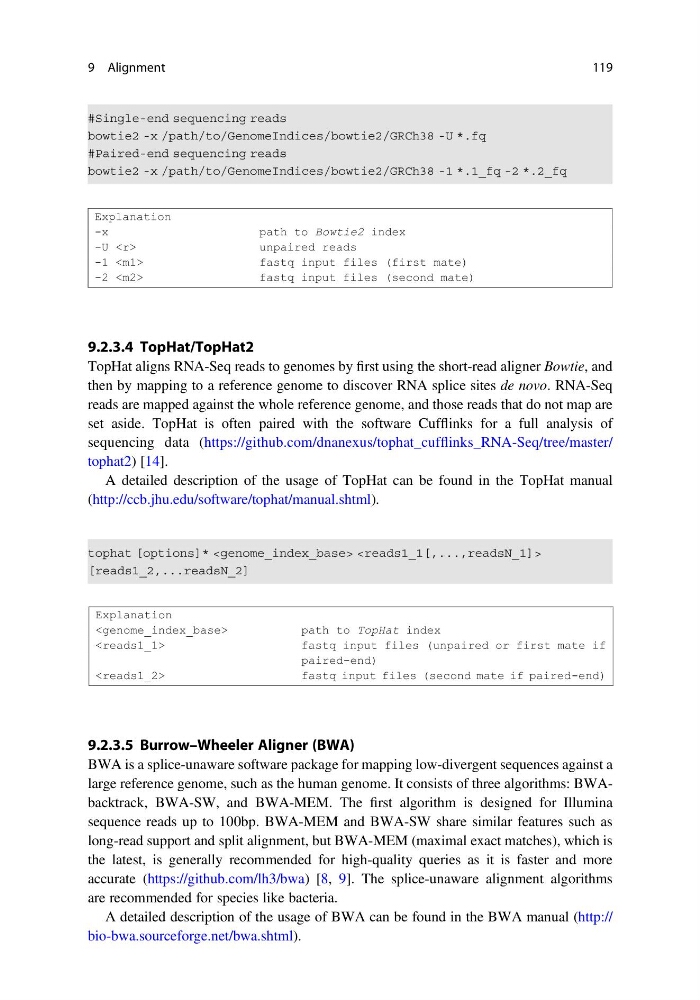
9.2.3.4 TopHat/TopHat2
TopHat aligns RNA-Seq reads to genomes by first using the short-read aligner Bowtie, and
then by mapping to a reference genome to discover RNA splice sites de novo. RNA-Seq
reads are mapped against the whole reference genome, and those reads that do not map are
set aside. TopHat is often paired with the software Cufflinks for a full analysis of
sequencing data (https://github.com/dnanexus/tophat_cufflinks_RNA-Seq/tree/master/
tophat2) [14].
A detailed description of the usage of TopHat can be found in the TopHat manual
(http://ccb.jhu.edu/software/tophat/manual.shtml).
9.2.3.5 Burrow–Wheeler Aligner (BWA)
BWA is a splice-unaware software package for mapping low-divergent sequences against a
large reference genome, such as the human genome. It consists of three algorithms: BWAbacktrack, BWA-SW, and BWA-MEM. The first algorithm is designed for Illumina
sequence reads up to 100bp. BWA-MEM and BWA-SW share similar features such as
long-read support and split alignment, but BWA-MEM (maximal exact matches), which is
the latest, is generally recommended for high-quality queries as it is faster and more
accurate (https://github.com/lh3/bwa) [8, 9]. The splice-unaware alignment algorithms
are recommended for species like bacteria.
A detailed description of the usage of BWA can be found in the BWA manual (http://
bio-bwa.sourceforge.net/bwa.shtml).
9 Alignment
119
TopHat aligns RNA-Seq reads to genomes by first using the short-read aligner Bowtie, and
then by mapping to a reference genome to discover RNA splice sites de novo. RNA-Seq
reads are mapped against the whole reference genome, and those reads that do not map are
set aside. TopHat is often paired with the software Cufflinks for a full analysis of
sequencing data (https://github.com/dnanexus/tophat_cufflinks_RNA-Seq/tree/master/
tophat2) [14].
A detailed description of the usage of TopHat can be found in the TopHat manual
(http://ccb.jhu.edu/software/tophat/manual.shtml).
9.2.3.5 Burrow–Wheeler Aligner (BWA)
BWA is a splice-unaware software package for mapping low-divergent sequences against a
large reference genome, such as the human genome. It consists of three algorithms: BWAbacktrack, BWA-SW, and BWA-MEM. The first algorithm is designed for Illumina
sequence reads up to 100bp. BWA-MEM and BWA-SW share similar features such as
long-read support and split alignment, but BWA-MEM (maximal exact matches), which is
the latest, is generally recommended for high-quality queries as it is faster and more
accurate (https://github.com/lh3/bwa) [8, 9]. The splice-unaware alignment algorithms
are recommended for species like bacteria.
A detailed description of the usage of BWA can be found in the BWA manual (http://
bio-bwa.sourceforge.net/bwa.shtml).
9 Alignment
119