

therefore used for discovering new splice forms, along with the analysis of gene expression
levels (Table 9.1).
In this context the most common alignment tools are explained in the following section.
9.2.3 Alignment Tools
9.2.3.1 STAR
Spliced Transcripts Alignment to a Reference (STAR) is a standalone software that uses
sequential maximum mappable seed search followed by seed clustering and stitching to
align RNA-Seq reads. It is able to detect canonical junctions, non-canonical splices, and
chimeric transcripts.
The main advantages of STAR are its high speed, exactness, and efficiency. STAR is
implemented as a standalone C++ code and is freely available on GitHub (https://github.
com/alexdobin/STAR/releases) [10].
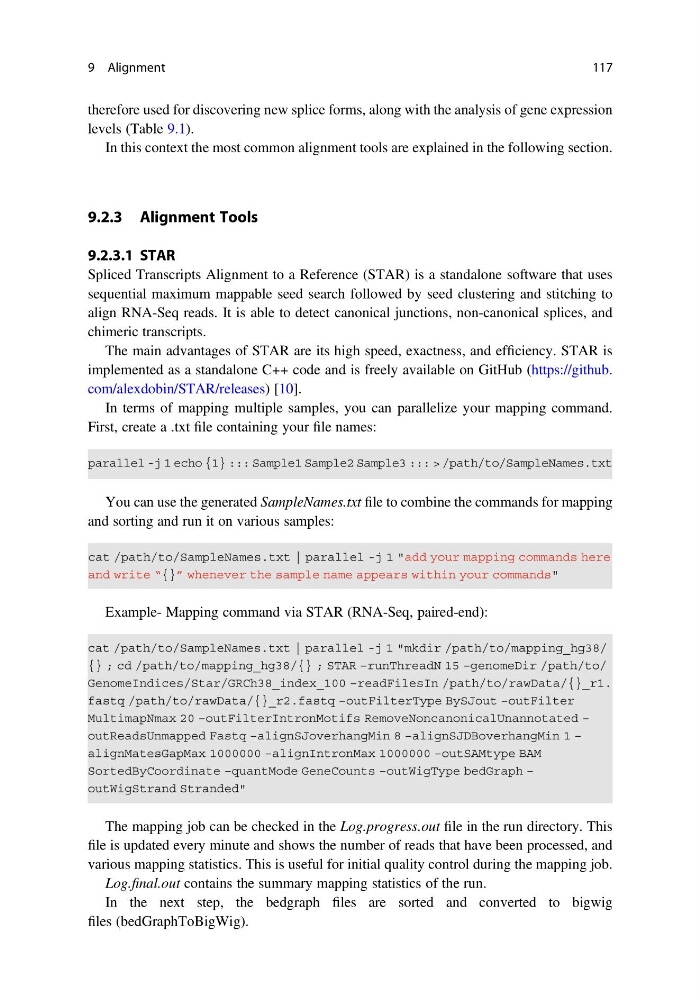
In terms of mapping multiple samples, you can parallelize your mapping command.
First, create a .txt file containing your file names:
You can use the generated SampleNames.txt file to combine the commands for mapping
and sorting and run it on various samples:
Example- Mapping command via STAR (RNA-Seq, paired-end):
The mapping job can be checked in the Log.progress.out file in the run directory. This
file is updated every minute and shows the number of reads that have been processed, and
various mapping statistics. This is useful for initial quality control during the mapping job.
Log.final.out contains the summary mapping statistics of the run.
In the next step, the bedgraph files are sorted and converted to bigwig
files (bedGraphToBigWig).
9 Alignment
117
levels (Table 9.1).
In this context the most common alignment tools are explained in the following section.
9.2.3 Alignment Tools
9.2.3.1 STAR
Spliced Transcripts Alignment to a Reference (STAR) is a standalone software that uses
sequential maximum mappable seed search followed by seed clustering and stitching to
align RNA-Seq reads. It is able to detect canonical junctions, non-canonical splices, and
chimeric transcripts.
The main advantages of STAR are its high speed, exactness, and efficiency. STAR is
implemented as a standalone C++ code and is freely available on GitHub (https://github.
com/alexdobin/STAR/releases) [10].
In terms of mapping multiple samples, you can parallelize your mapping command.
First, create a .txt file containing your file names:
You can use the generated SampleNames.txt file to combine the commands for mapping
and sorting and run it on various samples:
Example- Mapping command via STAR (RNA-Seq, paired-end):
The mapping job can be checked in the Log.progress.out file in the run directory. This
file is updated every minute and shows the number of reads that have been processed, and
various mapping statistics. This is useful for initial quality control during the mapping job.
Log.final.out contains the summary mapping statistics of the run.
In the next step, the bedgraph files are sorted and converted to bigwig
files (bedGraphToBigWig).
9 Alignment
117