

time. However, all d-compounds are
not dextrorotatory. For instance, the
acid obtained by oxidizing the –CHO
group of glyceraldehyde is glyceric
acid (1,2-dihydroxypropanoic acid).
By convention, this belongs to the dseries, but it is in fact laevorotatory;
i.e. its name can be written as dglyceric acid or l-glyceric acid. To
avoid confusion it is better to use +
(for dextrorotatory) and – (for laevorotatory), as in d-(+)-glyceraldehyde
and d-(–)-glyceric acid.
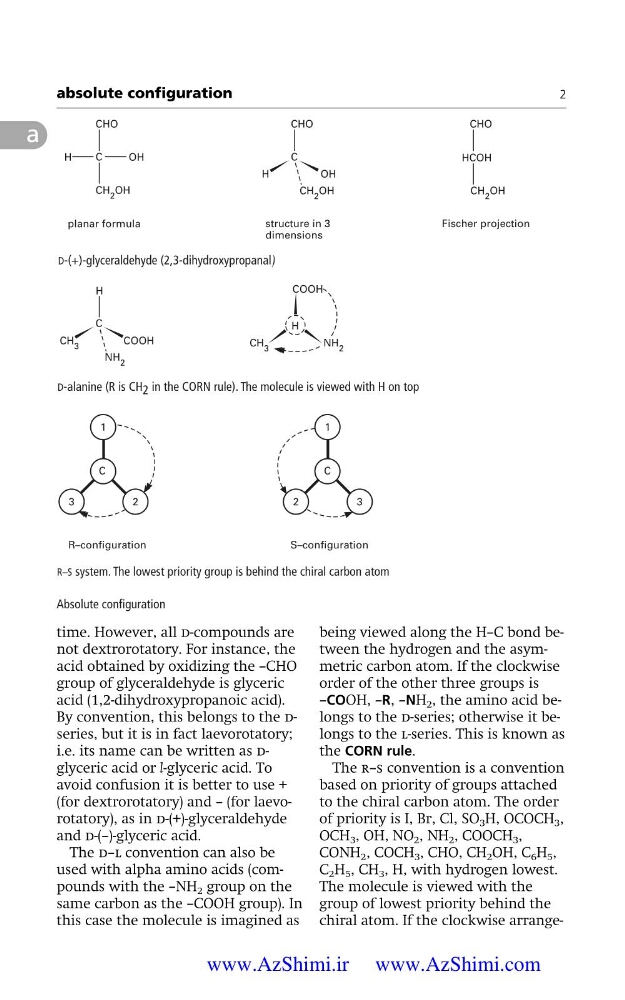
The d–l convention can also be
used with alpha amino acids (compounds with the –NH 2 group on the
same carbon as the –COOH group). In
this case the molecule is imagined as
being viewed along the H–C bond between the hydrogen and the asymmetric carbon atom. If the clockwise
order of the other three groups is
–COOH, –R, –NH 2 , the amino acid belongs to the d-series; otherwise it belongs to the l-series. This is known as
the CORN rule.
The r–s convention is a convention
based on priority of groups attached
to the chiral carbon atom. The order
of priority is I, Br, Cl, SO 3 H, OCOCH 3 ,
OCH 3 , OH, NO 2 , NH 2 , COOCH 3 ,
CONH 2 , COCH 3 , CHO, CH 2 OH, C 6 H 5 ,
C 2 H 5 , CH 3 , H, with hydrogen lowest.
The molecule is viewed with the
group of lowest priority behind the
chiral atom. If the clockwise arrangeabsolute configuration
2
a
CHO
OH
CH 2 OH
H
C
planar formula
CHO
C
H
O H
CH 2 OH
CHO
CH 2 OH
HCOH
structure in 3
dimensions
Fischer projection
C
CH 3
NH 2
COOH
H
COOH
CH 3
H
NH 2
1
C
3
2
1
C
2
3
Rconfiguration
Sconfiguration
D-(+)-glyceraldehyde (2,3-dihydroxypropanal)
D-alanine (R is CH 2 in the CORN rule). The molecule is viewed with H on top
RS system. The lowest priority group is behind the chiral carbon atom
Absolute configuration
www.AzShimi.ir www.AzShimi.com
not dextrorotatory. For instance, the
acid obtained by oxidizing the –CHO
group of glyceraldehyde is glyceric
acid (1,2-dihydroxypropanoic acid).
By convention, this belongs to the dseries, but it is in fact laevorotatory;
i.e. its name can be written as dglyceric acid or l-glyceric acid. To
avoid confusion it is better to use +
(for dextrorotatory) and – (for laevorotatory), as in d-(+)-glyceraldehyde
and d-(–)-glyceric acid.
The d–l convention can also be
used with alpha amino acids (compounds with the –NH 2 group on the
same carbon as the –COOH group). In
this case the molecule is imagined as
being viewed along the H–C bond between the hydrogen and the asymmetric carbon atom. If the clockwise
order of the other three groups is
–COOH, –R, –NH 2 , the amino acid belongs to the d-series; otherwise it belongs to the l-series. This is known as
the CORN rule.
The r–s convention is a convention
based on priority of groups attached
to the chiral carbon atom. The order
of priority is I, Br, Cl, SO 3 H, OCOCH 3 ,
OCH 3 , OH, NO 2 , NH 2 , COOCH 3 ,
CONH 2 , COCH 3 , CHO, CH 2 OH, C 6 H 5 ,
C 2 H 5 , CH 3 , H, with hydrogen lowest.
The molecule is viewed with the
group of lowest priority behind the
chiral atom. If the clockwise arrangeabsolute configuration
2
a
CHO
OH
CH 2 OH
H
C
planar formula
CHO
C
H
O H
CH 2 OH
CHO
CH 2 OH
HCOH
structure in 3
dimensions
Fischer projection
C
CH 3
NH 2
COOH
H
COOH
CH 3
H
NH 2
1
C
3
2
1
C
2
3
Rconfiguration
Sconfiguration
D-(+)-glyceraldehyde (2,3-dihydroxypropanal)
D-alanine (R is CH 2 in the CORN rule). The molecule is viewed with H on top
RS system. The lowest priority group is behind the chiral carbon atom
Absolute configuration
www.AzShimi.ir www.AzShimi.com